Blogs
AI Authority: Why Enterprises Are Right to Be Cautious About Agentic AI

Imagine an AI agent working inside a bank. It reviews a customer’s information, retrieves relevant records, identifies a potential risk, and prepares a recommendation. The workflow appears successful.
Now imagine the same agent changing the customer’s risk classification, restricting an account, or initiating a financial transaction without human approval.
The difference between these scenarios is not necessarily the intelligence of the agent. It is the authority the enterprise has given it, and how clearly that authority has been defined.
This is the central challenge of AI authority in Agentic AI: determining what an agent is permitted to do, under whose authority, and with what level of accountability.
Enterprise leaders recognise the potential of Agentic AI to improve productivity, accelerate decisions, and coordinate complex workflows. Their caution is understandable, particularly when AI moves beyond answering questions and begins taking actions with real business consequences.
The objective should not be to make every process fully autonomous. It should be to identify where AI can handle complex analysis and execution tasks, where human judgement remains essential, and how the two can operate together. This allows enterprises to make greater use of AI while keeping consequential decisions within clearly defined boundaries.
| Why Agentic AI Changes the Enterprise Control Model
Traditional enterprise applications generally operate within defined workflows. Users authenticate, receive permissions, and perform actions through established interfaces. Access controls, approval steps, and audit logs help govern what happens.
Agentic AI introduces a different operating pattern. An agent may interpret an objective, retrieve information from several sources, select tools, invoke APIs, interact with business applications, and coordinate with other agents to complete a task. It may determine the steps along the way rather than follow a single fixed sequence.
That flexibility creates value, but it also changes the control problem. A user’s permission to access a system does not automatically mean an AI agent should be allowed to perform every action available through that system. Nor does a successful test in one workflow prove that the same level of autonomy is safe in another.
Enterprises still need identity management, role-based access, and established security controls. They also need a governance layer that considers the agent’s purpose, the actions it can take, the context in which it operates, and the consequences of those actions. Agentic AI governance must account for how authority is delegated and enforced throughout a workflow, not just how a model generates responses.
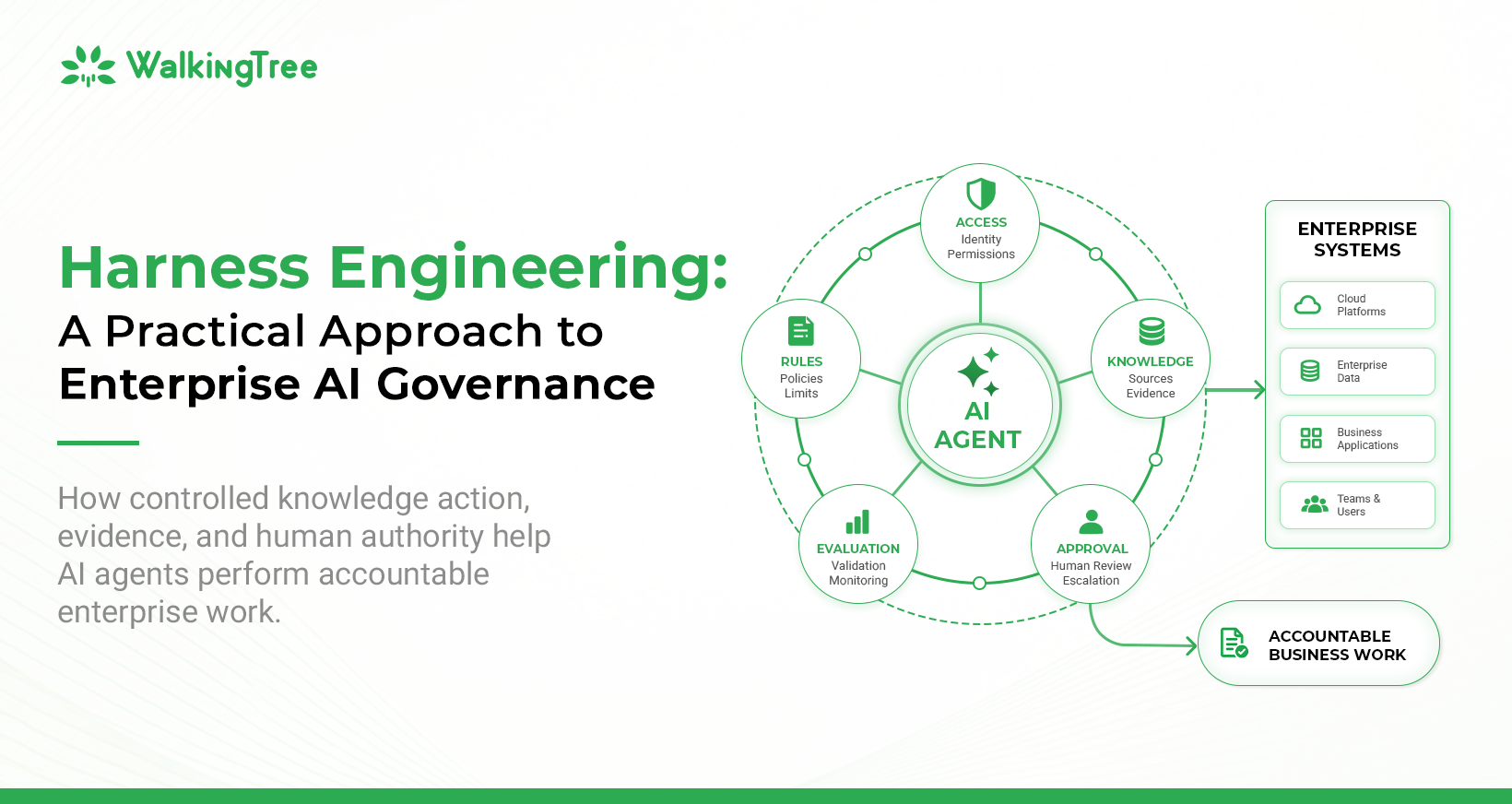
WalkingTree explores a related engineering approach in Harness Engineering: A Practical Approach to Enterprise AI Governance. The broader lesson is that reliable AI deployment depends on the system around the model, not only on the model itself.
| The Real Risk Is Not Just an Incorrect AI Response
An incorrect answer can be reviewed and corrected. An incorrect action may already have affected a customer, changed a record, triggered a payment, or set another workflow in motion. Several risks deserve particular attention.
The risks of Agentic AI extend beyond isolated model errors. Gartner predicts that more than 40% of agentic AI projects will be cancelled by the end of 2027 due to escalating costs, unclear business value, or inadequate risk controls. This reinforces an important point: enterprises need to establish clear authority boundaries and safeguards before scaling autonomous workflows, rather than treating governance as a later consideration.
When one mistake triggers another
An agent working with outdated inventory data might recommend an unnecessary purchase. If it can also create purchase orders, the recommendation could become a financial commitment. A second agent might then process the order or update a planning system based on that first action.
The risk is not limited to one model making one mistake. It is the possibility that an error moves through connected workflows before anyone recognises it. AI risk management must therefore account for downstream effects, not just the accuracy of individual responses.
Controls should include validation before consequential actions, limits on what can be executed automatically, and clear ways to pause or reverse a workflow when something goes wrong.
When access becomes difficult to govern
An agent that can retrieve a document does not necessarily need permission to edit it, share it externally, or use it to initiate another action. Yet broad tool permissions can make those boundaries difficult to maintain.
Agents can also encounter instructions embedded in untrusted documents or external content. If an agent treats that content as an instruction rather than data to evaluate, it may attempt actions outside the user’s original intent. Excessive privileges increase the potential impact.
AI agent security therefore involves more than protecting the model endpoint. It requires restricting tool and data access, treating untrusted inputs carefully, validating requested actions, and enforcing permissions outside the model’s own reasoning. Effective AI access control means giving an agent only the permissions required for its assigned task and enforcing those permissions at the application or tool level.
When accountability becomes unclear
If an agent changes a customer record or initiates a transaction, an enterprise should be able to determine what happened and why. Which information did the agent use? Which tools did it call? What permissions applied? Was approval required, and if so, who provided it?
Without this traceability, investigation becomes harder and responsibility can become blurred between the model, the application team, the business owner, and the people who approved the workflow.
AI accountability needs to be designed into the system. Logging, decision records, approval history, and clear ownership should make it possible to reconstruct consequential actions and respond when an outcome is wrong.
| What AI Can Do Is Not the Same as What AI May Do
A model may be capable of completing a task, but capability alone does not grant permission to do it. Enterprises need to distinguish technical ability from authorised action.
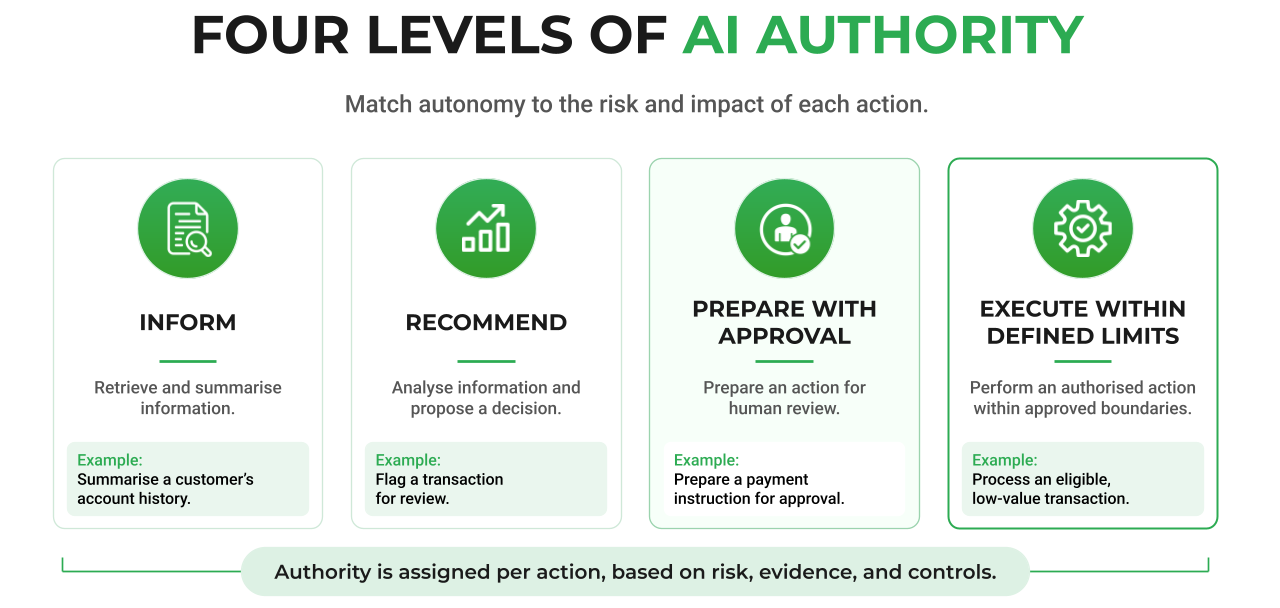
One practical approach is to define levels of authority for each workflow
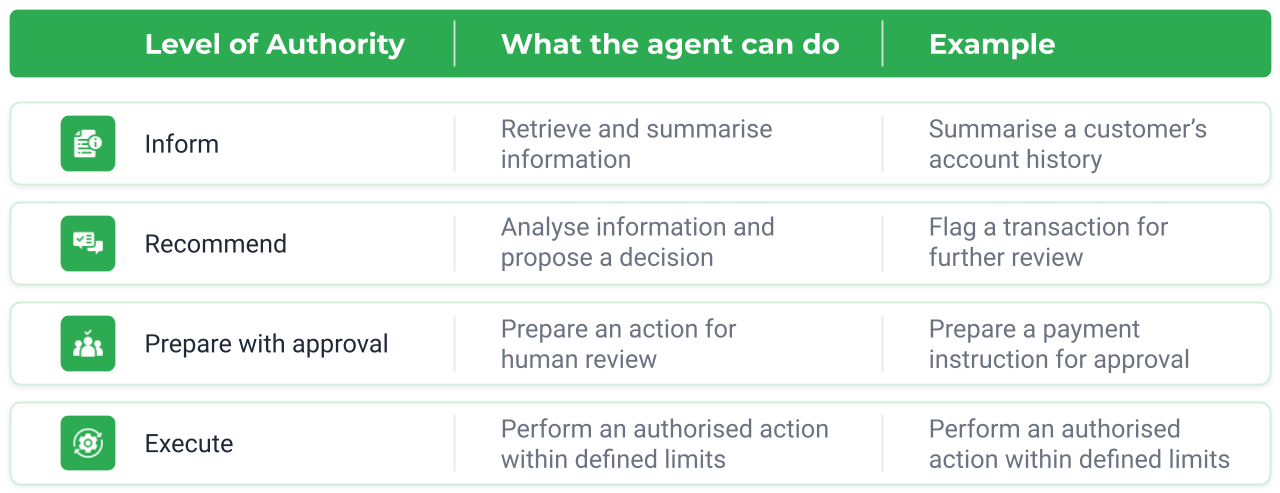
These levels are not a maturity ladder that every agent should automatically climb. They are choices to be made based on the action, its potential impact, the quality of available evidence, and the controls surrounding it.
For example, an agent may be permitted to summarise customer records independently but require approval before changing a customer’s status. It may prepare a payment instruction while leaving the final authorisation to a designated employee. A low-risk, reversible task may qualify for bounded execution, while a high-impact decision may always require human involvement.
The principle is straightforward: autonomy should be assigned to an action, not simply to an agent. This is a practical foundation for an AI governance framework because it connects permissions to business consequences rather than granting broad autonomy based on an agent’s general capabilities.
| How an AI Authority Envelope Defines the Boundaries of Action
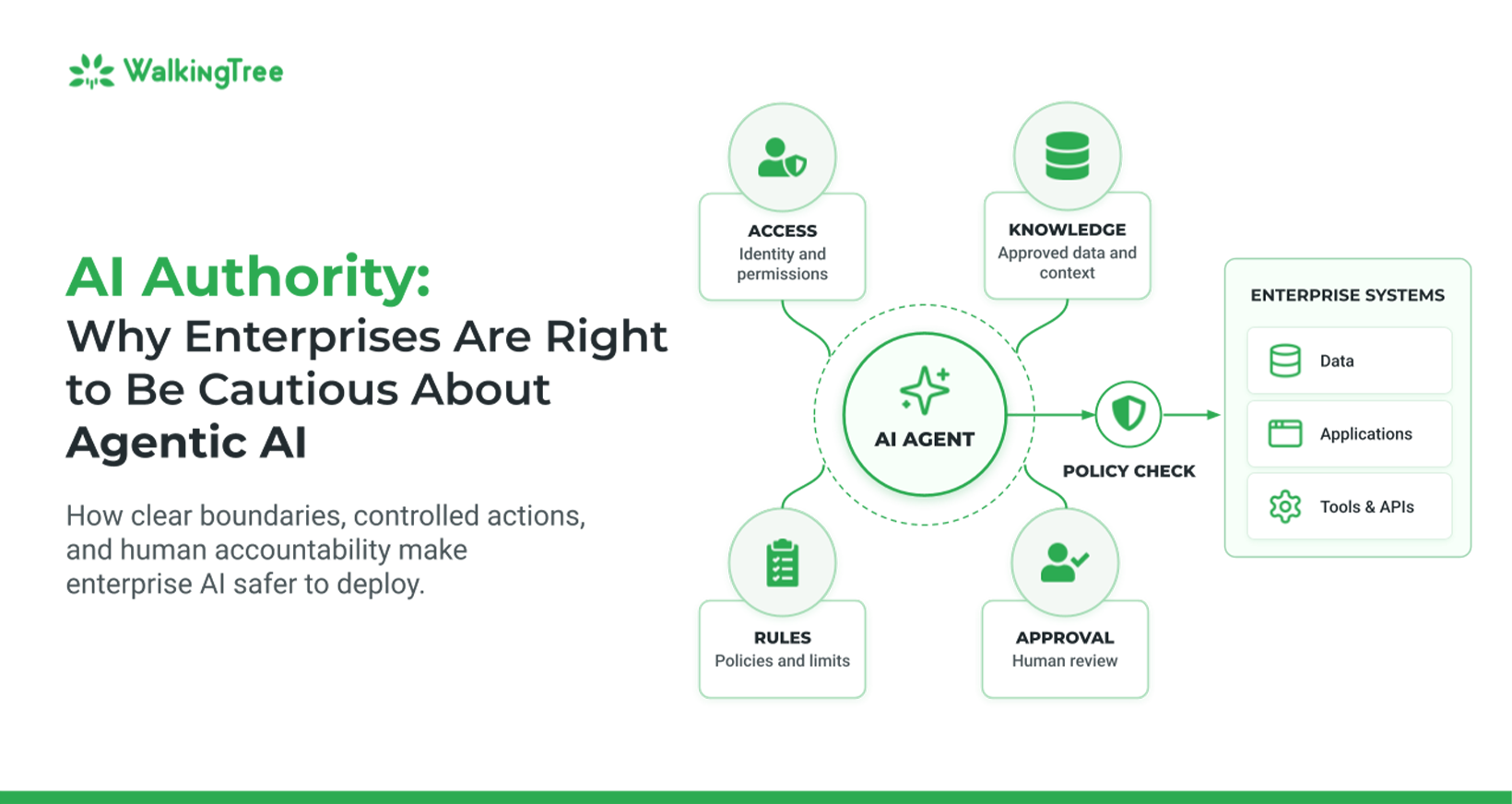
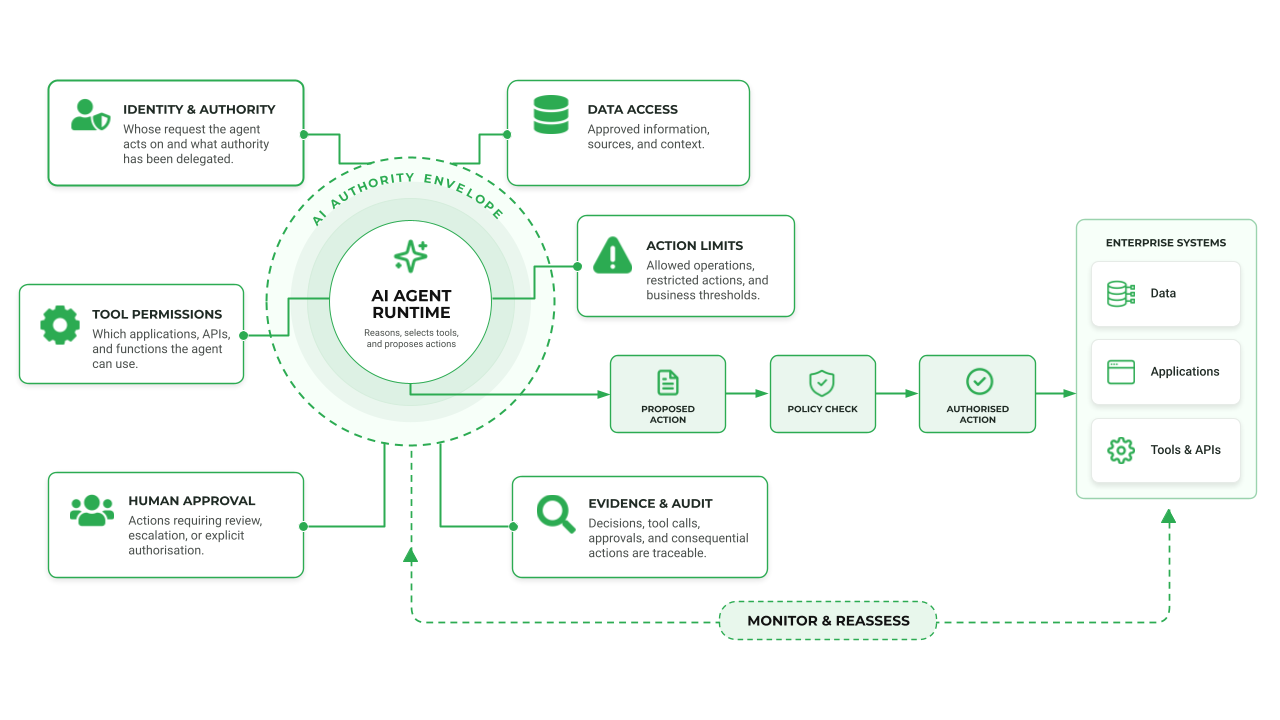
Enterprises need a clear way to specify what an agent is permitted to do. An AI authority envelope provides a useful way to think about those boundaries.
The envelope defines the scope within which an agent can operate. Depending on the workflow, it should specify:
- Identity and delegated authority: Whose request the agent is acting on and what authority has been delegated.
- Data access: Which records and sources the agent may retrieve or use.
- Tool permissions: Which applications, APIs, and functions it may call.
- Action limits: Which operations are allowed, restricted, or prohibited, including transaction thresholds or other business rules.
- Approval and escalation: Which actions require human review and when the agent must return control.
- Monitoring and accountability: What must be logged, how exceptions are surfaced, and how an action can be stopped or reversed.
Clear AI authority boundaries should be enforced by the surrounding application and infrastructure wherever possible, rather than relying on the model to follow instructions consistently. The model can help interpret a request, but policy enforcement should not depend solely on that interpretation.
An authority envelope is not a one-time configuration. It should be reviewed as business processes, connected systems, models, and risk conditions change.
| Should AI Autonomy Be Granted Permanently?
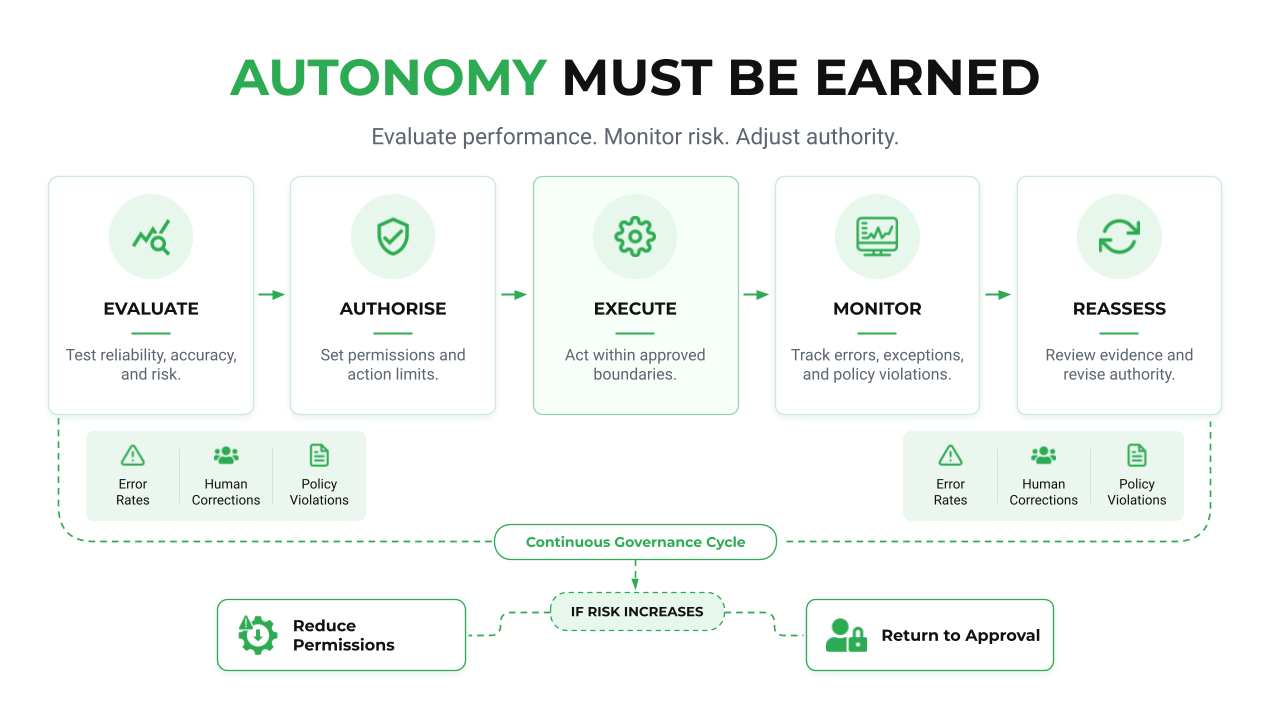
Autonomy should be earned through evidence and reassessed over time. An agent that performs reliably in a controlled pilot may behave differently when it encounters new data, higher workloads, different user requests, or changed tools.
Consider an agent that prepares purchase orders. It may initially operate in recommendation mode. After its outputs are reviewed across a representative set of cases, the enterprise might allow it to prepare orders for approval. Only after further evidence, and only for specified low-risk cases, might limited automatic execution be appropriate.
That decision should be supported by measurable indicators, such as error rates, human correction frequency, policy violations, exception handling, and the impact of incorrect actions. The organisation should also test whether controls work when data is incomplete, systems are unavailable, or instructions conflict.
Autonomy must be reassessed after material changes to the model, prompts, tools, data sources, workflow, or business policy. If performance deteriorates or the operating context changes, the enterprise should be able to narrow permissions, return the agent to an approval-based mode, or revoke its authority.
This is where AI agent autonomy differs from a simple feature setting. It is an operational decision that depends on evidence, risk tolerance, and the organisation’s ability to monitor and control what happens.
| From AI Experimentation to Controlled Enterprise Deployment
Moving an agent from a promising demonstration into a production workflow requires more than connecting a model to business systems. It requires a deliberate engineering and governance process.
Start with the workflow, not the agent. Identify the business outcome, the decisions involved, the systems and information required, and the consequences of each possible action. Separate actions that can be automated from those that require approval or must remain with a human decision-maker.
Bring business owners, engineering teams, security, risk, and compliance into the design. Each group sees different failure modes, and authority boundaries need to reflect both technical constraints and business obligations.
Then implement controls around the workflow: scoped permissions, input and output validation, policy checks, human approvals, monitoring, audit records, and recovery procedures. Test normal operation as well as failure scenarios, including stale information, unavailable tools, conflicting instructions, unexpected outputs, and attempted actions outside the agent’s permitted scope.
A sound AI agent architecture makes these boundaries explicit. The model may reason and propose an action, while a separate policy or application layer checks whether that action is authorised before execution. This separation helps ensure that an agent cannot grant itself additional authority through its own interpretation of a task.
Production monitoring should examine not only whether the agent completes tasks, but also whether it stays within its approved boundaries. For a related perspective on operationalising agents, see WalkingTree’s article on Scaling AI Agents in Production.
| The Future of Enterprise AI Depends on How We Govern Authority
Enterprise caution about Agentic AI should not be mistaken for resistance to progress. It reflects a reasonable expectation that systems capable of taking action must operate within clear and enforceable boundaries.
The question is not whether every agent should be autonomous or whether every action should require human approval. The question is how much authority is appropriate for a specific action, under which conditions, and with what evidence that the controls are working.
AI authority must be explicit, limited to a defined purpose, observable in operation, and adjustable as conditions change. Enterprises need to know what an agent can access, what it may do, when it must ask for approval, and how its actions can be investigated or reversed.
The goal is not unrestricted autonomy. It is controlled intelligence: using AI to carry out useful work while keeping decisions, permissions, and accountability aligned with the enterprise’s responsibilities.
AI can contribute to a decision or execute a task within approved limits, but accountability does not transfer to the model. It remains with the enterprise that designs, deploys, and governs the system.
| Building Agentic AI for the Enterprise
Putting Agentic AI into production requires more than capable models. It requires an architecture that defines permissions, enforces policies, and keeps consequential actions within approved boundaries.
Have questions about putting Agentic AI into practice within your enterprise? Connect with WalkingTree Technologies to discuss your AI initiatives and the engineering considerations involved in moving from experimentation to production.