


Blogs
Harness Engineering: A Practical Approach to Enterprise AI Governance

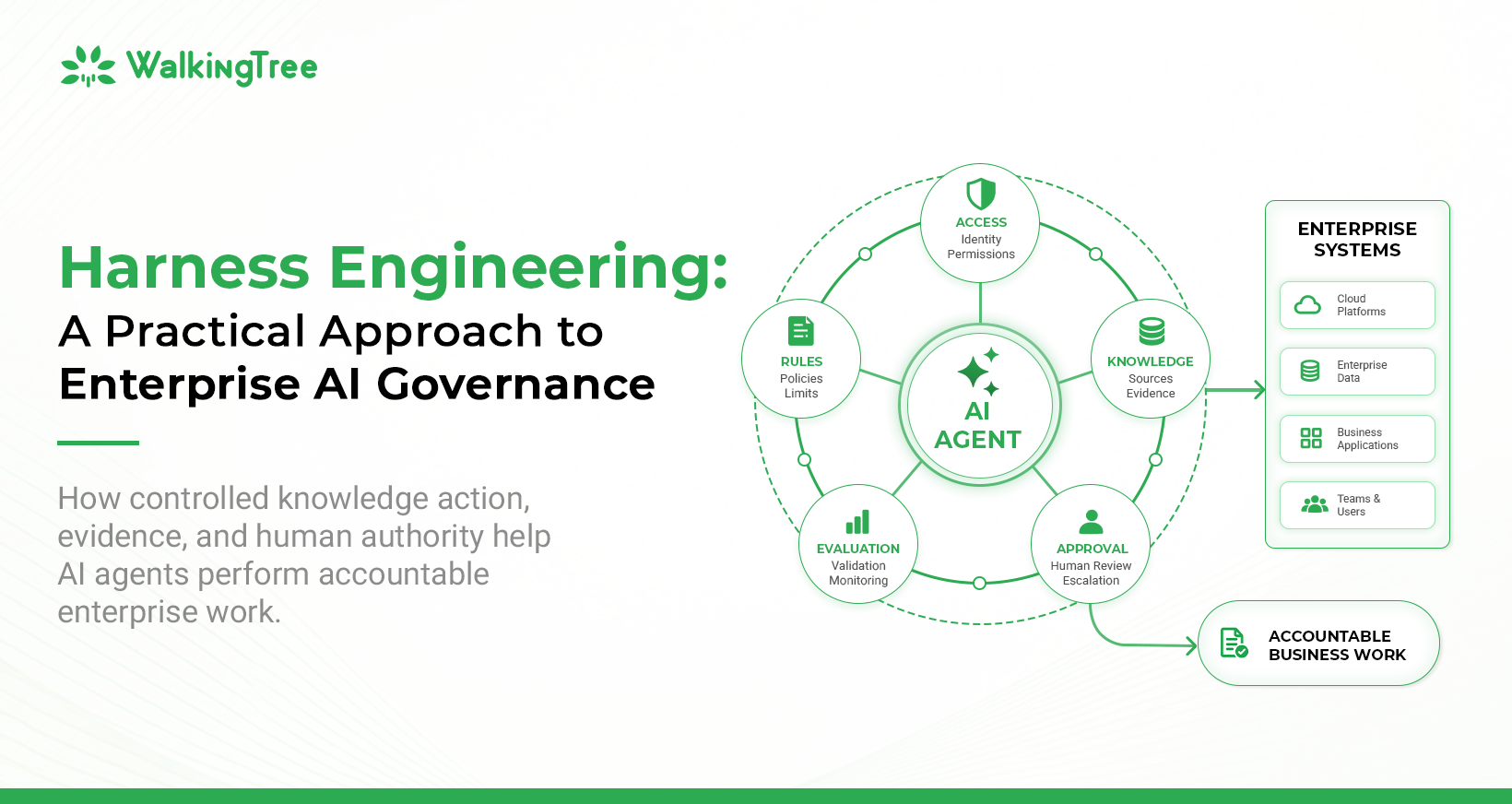
An AI agent is reviewing a high-value banking client before a scheduled compliance review. It finds the relevant documents, checks ownership records across systems, identifies missing evidence, and prepares a recommendation in minutes. The workflow looks successful.
But what if the agent accessed a record the analyst was not entitled to see, relied on an outdated policy, or turned a proposed risk reclassification into an account restriction without the required approval? The task may have been completed. The business obligation was not.
This is where Enterprise AI Governance becomes critical. As AI agents move from prototypes into real business workflows, organizations need more than capable models and well-designed runtime workflows. They need defined authority, controlled access, reliable evidence, human approval, and safe recovery. The goal is not to make AI deterministic; it is to create an environment in which probabilistic AI can perform useful business work within explicit, testable, and governable boundaries.
| Why Harness Engineering Matters for Enterprise AI Governance
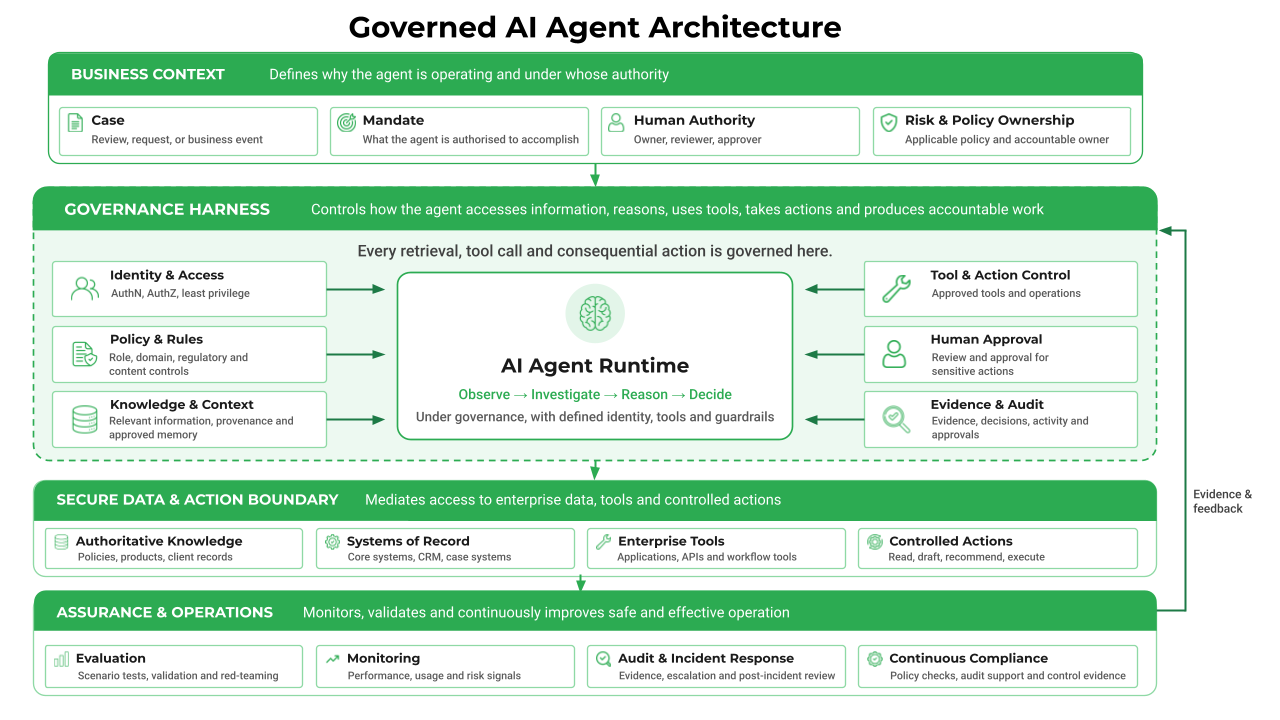
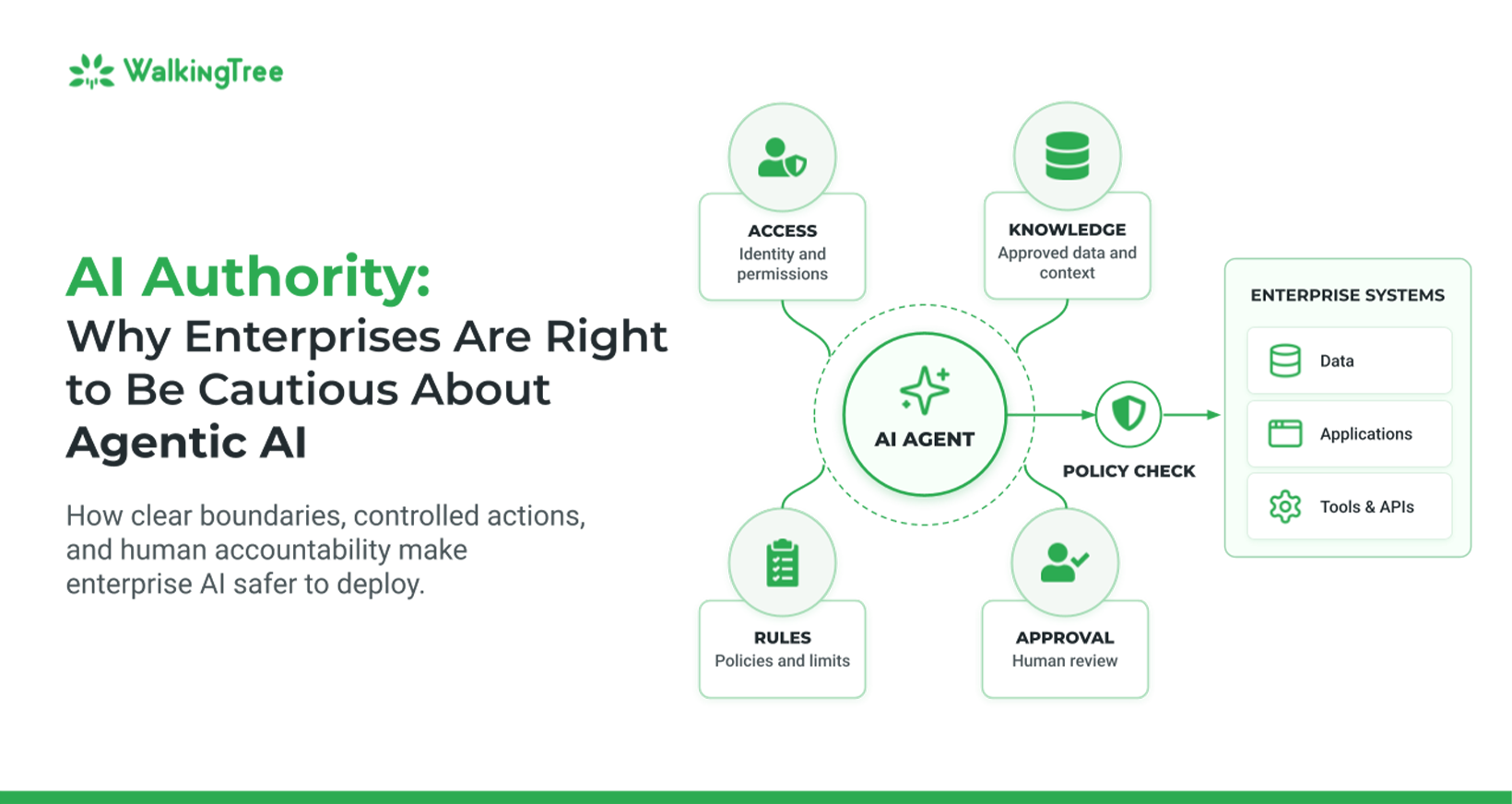
A model provides intelligence. An agent loop provides purposeful behaviour. Neither, by itself, provides institutional authority. Harness Engineering defines the environment around the agent: the tools, data, credentials, controls, evidence, and recovery mechanisms that determine how AI may operate. In an enterprise, that environment becomes a practical mechanism for implementing this governance model through explicit authority, permissions, policies, and accountability.
This aligns with NIST’s AI Risk Management Framework (published January 2023) and its companion Generative AI Profile, which provide guidance for managing AI risks across the design, development, use, and evaluation of AI systems.
Enterprise AI Governance therefore extends beyond model quality. It asks a more practical question: under what authority and operating conditions may an AI agent work?
| Enterprise AI Governance Is More Than AI Compliance
Compliance is one part of governance. This operating model defines how AI systems operate within an organization’s technical and institutional boundaries. An agent may retrieve information or prepare a recommendation, but high-impact actions may require restricted permissions and human approval. The distinction between what an agent can understand, access, and do is central to building accountable AI agents.
| How Enterprise AI Governance Controls What AI Agents Know and Do
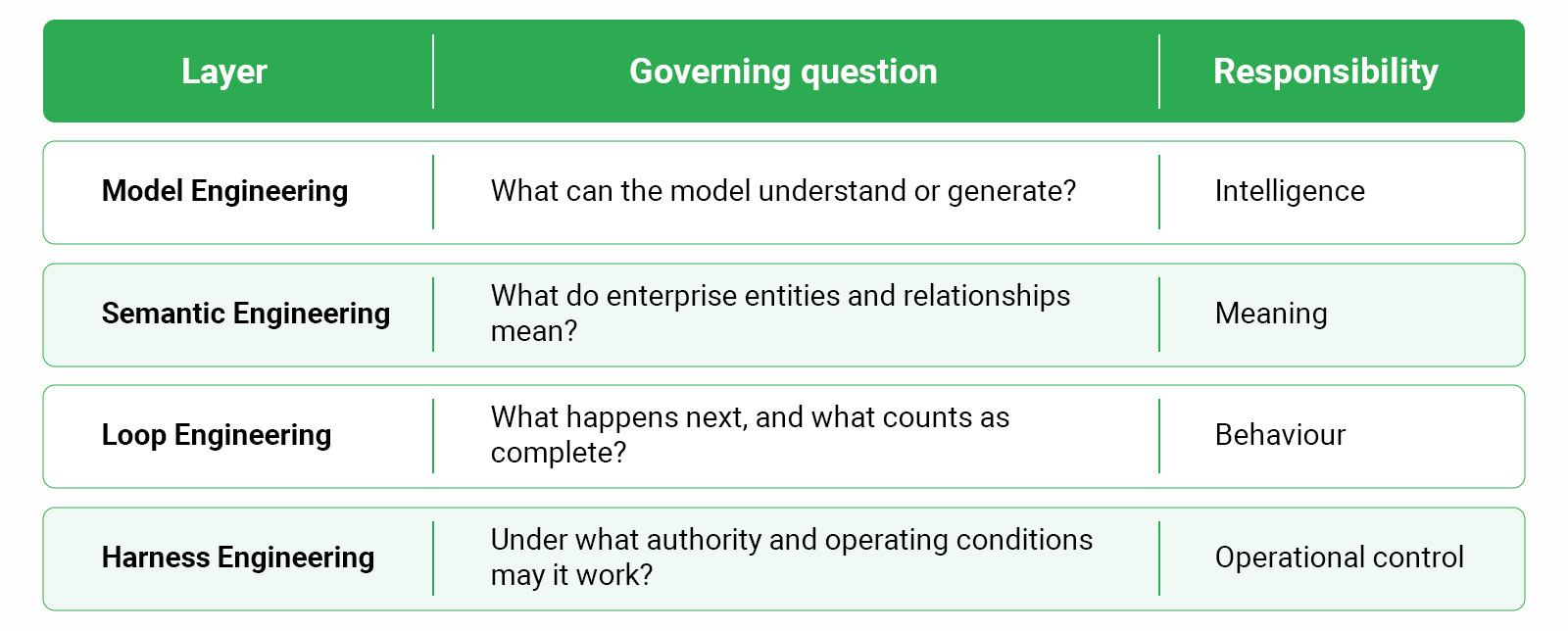
The four layers address different parts of an AI system. Model Engineering governs what the model can understand or generate. Semantic Engineering establishes what enterprise entities and relationships mean. Loop Engineering determines how the agent progresses toward completion. Harness Engineering governs the authority and operating conditions under which it operates.
Their failures differ: fabricated explanations indicate a model failure, endless investigation a loop failure, namesake confusion a semantic failure, and restricted-account access a harness failure. Separating these layers makes testing more precise.
| The Three Governance Boundaries for AI Agents
These boundaries define what an agent may know, what it may do, and who remains accountable for the result.
Knowledge Governance: What May an AI Agent Know?
The Knowledge Boundary governs client identity, source authority, consent, privacy, and memory. More context is not automatically better; the objective is the right context for the task, with clear provenance. An agent reviewing a client may need current ownership records, but not unrestricted access to every account tied to a similarly named individual.
Action Governance: What May an AI Agent Do?
The Action Boundary governs tool access, transaction or risk limits, separation of duties, approval, and reversibility. Reading a case, drafting a disposition, changing a risk rating, and restricting an account represent different levels of authority.
This matters as agents gain access to enterprise tools. The OWASP Top 10 for Agentic Applications 2026 identifies risks including tool misuse, identity and privilege abuse, memory poisoning, cascading failures, and human-agent trust exploitation. It also emphasizes Least Agency: unnecessary autonomy can expand the attack surface without adding value. An agent’s ability to reason should not automatically translate into authority to execute.
Accountability Governance: Who Owns the Result?
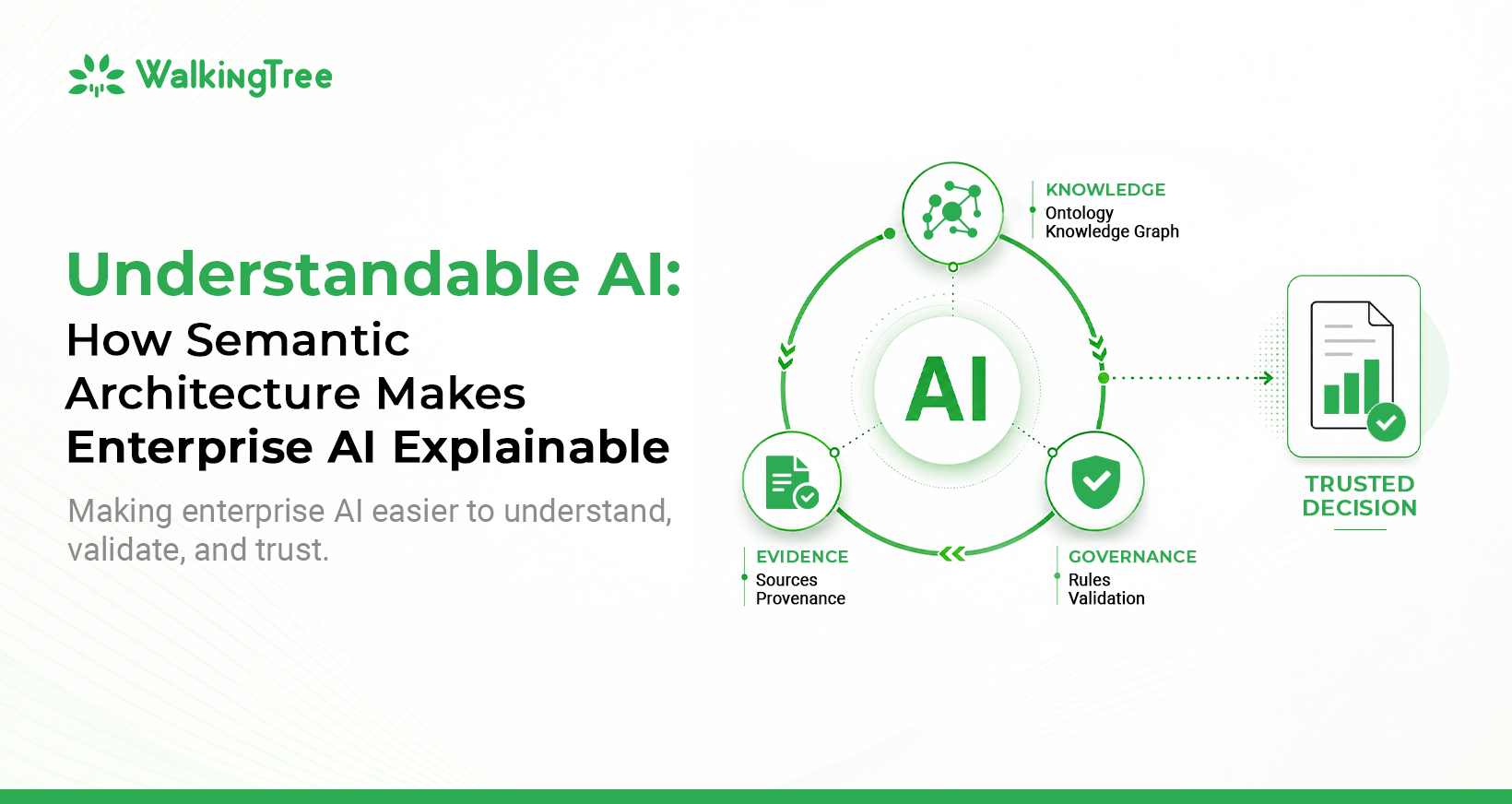
The Accountability Boundary governs evidence, logs, escalation, overrides, and final responsibility. A human in the loop is inadequate if that human sees only a polished conclusion and cannot challenge its basis. These boundaries let organizations delegate useful work without delegating responsibility into a black box.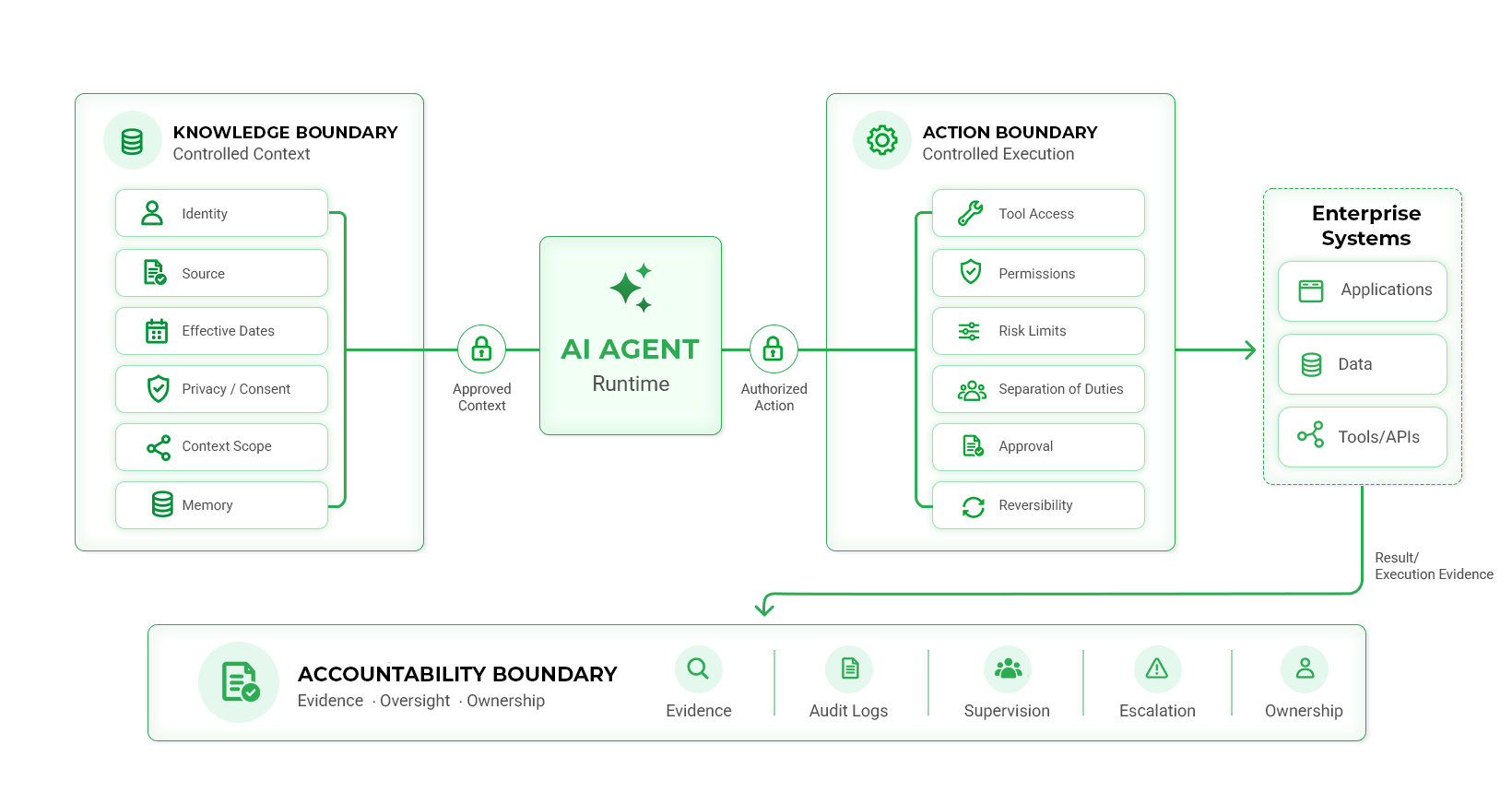
| Enterprise AI Governance in Action
Consider Meridian Private Bank, a fictional institution serving internationally connected, high-net-worth families. Client reviews can involve individuals, trusts, foundations, beneficial owners, and accounts across jurisdictions, making evidence reconstruction and review labour-intensive.
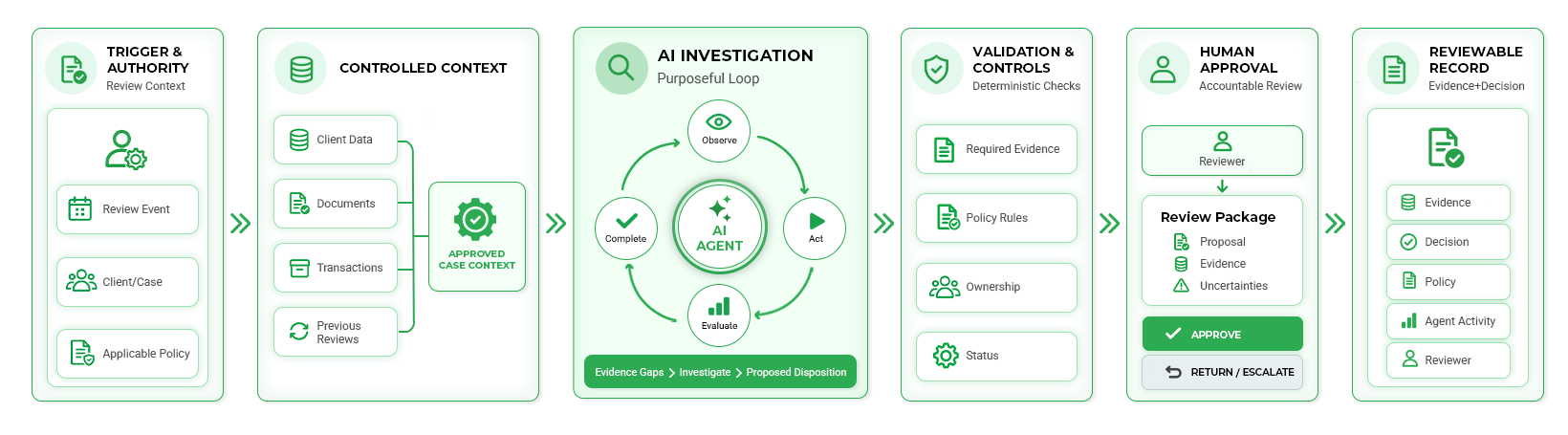
Meridian introduces a Client Review Harness, not an autonomous compliance officer. Its purpose is to assemble evidence, coordinate a bounded investigation, apply explicit checks, and prepare a disposition for accountable review.
Trigger and Authority: Establishing the Review Context
A review begins when a scheduled date arrives or an event occurs: an identity document expiry, ownership change, or jurisdictional risk change. Before the agent runs, the harness creates the case, identifies the client perimeter, and determines the applicable policy and review type, since identical evidence can require different treatment depending on legal entity and client segment.
Controlled Context Assembly
The harness retrieves permitted information from client-lifecycle platforms, document stores, and previous reviews, with each item carrying its source and status. Entity resolution is critical: the system must distinguish a person from a namesake, while preserving uncertainty where evidence is incomplete. A model-generated connection begins as a candidate assertion, not an institutional fact.
Agent Loop Enables Purposeful Investigation
The agent inspects the case, identifies gaps, retrieves allowed evidence, tests requirements, and decides whether another investigative pass is justified. Completion means required evidence is present or explicitly unresolved, contradictions are surfaced, and mandatory tests have run, not simply that a summary was generated. Stopping conditions such as maximum iterations and escalation for unresolved contradictions prevent endless investigation or premature confidence.
Validation, Disposition, and Human Approval
Language models can interpret documents and explain discrepancies, but deterministic controls should verify what can be verified exactly, such as document expiry and ownership reconciliation. The agent may propose that a review is complete or that a risk change should be considered, but material classification changes and account restrictions cross a human approval boundary. The harness packages the proposal, evidence, policy checks, and model activity into a reviewable record.
Where the Runtime Workflow Ends and the Harness Begins
The distinction becomes clearest when behavioural and environmental concerns overlap. If a source is unavailable, the runtime workflow determines whether another attempt would advance the task, while the harness provides retry, credential handling, timeout, alternative-source, and failure-trace mechanisms. If evidence conflicts, the workflow decides whether further investigation is justified; the harness determines what evidence the agent may retrieve and who receives the escalation.
A reliable system needs both the loop and harness to be strong: a strong loop inside a weak harness can only perform unsafe work efficiently, while a strong harness around a confused loop may never reach a useful conclusion.
| How Harness Engineering Turns AI Output Into Accountable Work
The example pattern demonstrates the central principle of Harness Engineering: an agent that can act is not the same as an agent that is governed to act. The difference lies in whether authority, evidence, and approval are made explicit before the agent runs, not discovered afterward.
The business value of governed AI agents is not measured by summaries generated. Productivity improves when analysts spend less time locating files and copying evidence. Quality improves when evidence standards are applied consistently. Control improves when conclusions are connected to sources, policies, and approvals.
The strategic value also comes from reuse. Once shared services exist for identity, evidence, policy versioning, permissions, validation, and audit, the same governance foundation can support onboarding, beneficial-ownership remediation, source-of-wealth review, and offboarding. The first use case establishes the capabilities; later use cases inherit them.
| How to Measure Enterprise AI Governance
The governance model should be measured at four levels:
- Model level: accuracy and grounding
- Loop level: convergence and unnecessary iterations
- Harness level: access enforcement, source freshness, recovery, and trace completeness
- Business level: analyst hours, review duration, rework, backlog, exceptions, and cost per case
Results should be segmented by complexity, client type, product, and jurisdiction to expose weak performance hidden by overall averages.
| The HARNESS Framework for Enterprise AI Governance
Before production, leaders should be able to answer seven questions:
H: Human Authority – who owns the disposition, communication, and consequential action.
A: Access – which data and tools the agent may use, under whose identity, and for what purpose.
R: Rules – which legal and policy constraints apply.
N: Networked Knowledge – which authoritative sources ground the result.
E: Evaluation – how outcomes are tested.
S: State and Memory – what may persist, with what provenance, retention, and approval.
S: Safe Execution – what happens automatically, what needs approval, and how the system is stopped.
Together, these questions form a practical AI governance framework for moving AI agents from experimentation toward controlled deployment.
| How to Build an Enterprise AI Governance Framework for AI Agents
Start with a bounded review type and simplified agent loop, with explicit completion criteria tested against representative cases. Then harden the harness with authorised sources, identity and policy controls, validation, instrumentation, and recovery mechanisms. Test both against stale records, namesakes, contradictory documents, unavailable tools, malicious content, and prohibited actions. WalkingTree Technologies discusses these considerations in its guide to Scaling AI Agents in Production.
 A read-and-draft deployment is a practical starting point. Observe analyst corrections and classify them: a wrong entity improves entity resolution, a stale rule improves policy versioning, and a missing escalation improves the authority model. This staged approach mirrors the lifecycle-oriented thinking in NIST’s AI RMF and its Generative AI Profile.
| Why Enterprise AI Governance Becomes a Strategic Asset
Models will change rapidly. A well-engineered harness lets an organization adopt better models without rebuilding its authority, evidence, permissions, and control system each time. This makes Harness Engineering a durable part of this operating model: governance principles are encoded into the environment around the agent rather than tied to a particular model.
The future of enterprise AI is not simply about agents taking more actions. It is about demonstrating that those actions were appropriate, authorised, recoverable, and valuable. That is what makes Enterprise AI Governance a strategic capability rather than a compliance checkbox.
| Building Governed AI Agents With WalkingTree Technologies
Getting to this point is not only a modeling decision. It requires deciding how much of an organization’s operational authority it is prepared to encode, test, and monitor. That decision extends into the surrounding engineering foundation: how an agent accesses data, follows policy, records evidence, and escalates decisions that need human authority.
WalkingTree Technologies works across enterprise AI, agentic systems, data engineering, cloud, and product engineering. Its teams help organizations assess a workflow, define an agent’s Knowledge, Action, and Accountability Boundaries, and build the identity, evidence, policy, and monitoring components required to move from a controlled proof of concept toward production. For regulated enterprise workflows, that starting point is usually the same: map the boundaries before writing the first line of agent code.
Explore WalkingTree Technologies’ AI and Generative AI Solutions to see how these capabilities can support your organization’s AI agent initiatives.
Ready to Move From AI Proof of Concept to Production?
When you are ready to move from a proof of concept toward a governed, production-ready deployment, connect with our team to discuss your specific workflow and governance requirements.

One thought on “Harness Engineering: A Practical Approach to Enterprise AI Governance”