Blogs
Dedicated Development Team Still Needs Constant Help?

Imagine a VP of Engineering who adds four backend developers, two QA engineers and an SRE to speed up a modernization program. On the workforce plan, capacity jumps overnight. In the sprint, the new engineers wait for an architect to explain an API contract, their pull requests queue behind the same two reviewers, and nobody is sure who owns the release checklist. A team that has joined but still needs constant help is easy to recognize, and it often says more about how the team was integrated than about who was hired.
A dedicated development team is a group of engineers who work full time on your product, usually sourced through a delivery partner. Software development team augmentation is the easy part: a dedicated development team adds potential capacity the day it starts. Integration is the harder part, and it often decides whether that capacity becomes output. DORA’s research on loosely coupled teams points in the same direction, describing effective team and architecture structures as predictors of continuous delivery. This article looks at where integration breaks down and how an extended development team can work inside one delivery system instead of beside it.
| Why Software Development Team Augmentation Doesn’t Automatically Improve Delivery
In most software development team augmentation engagements, the failure modes are easy to recognize, and most sit in the system around the engineers rather than in the engineers themselves. These are practical patterns from delivery experience, not ranked research findings. Context stays with the core team, so new engineers wait for answers. A few senior reviewers often become the only approval path, so extra contributors lengthen the queue instead of raising throughput. Build, test and deploy duties are split across groups, so defects fall between them. Decisions often live in private chats, which keeps an extended development team dependent on internal intermediaries.
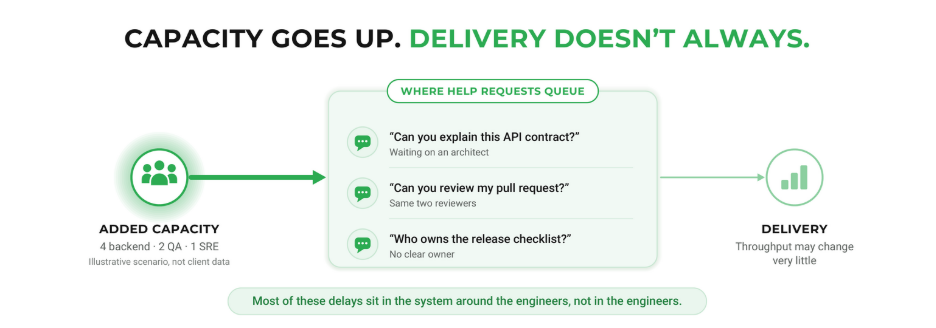
Software development team augmentation does not remove these constraints. It can make them more visible, because more people now wait on the same architects, reviewers and release owners. That is not an argument against augmentation. The right extended team model depends on the work, and the integration effort changes with it. Software development team augmentation for a narrow skill gap needs less structure than a multi-disciplinary delivery stream, but a dedicated development team of any size performs better when its integration is planned instead of left to goodwill.
| What One Team Means for an Extended Development Team
Working as one team does not mean identical reporting lines, and it does not mean removing every boundary. It means shared architecture, governance, delivery goals and accountability, while access permissions and production controls stay deliberately distinct. The idea applies to any dedicated development team, whatever the contract or vendor.
DORA’s research on loosely coupled teams covers the structural side: teams should be able to make changes, test and deploy without excessive outside permission or coordination, and architecture and team structure shape each other. For an extended development team, that turns into practical questions. Can engineers change their assigned area without asking an architect each time? Are service boundaries, API contracts and decision rights documented?
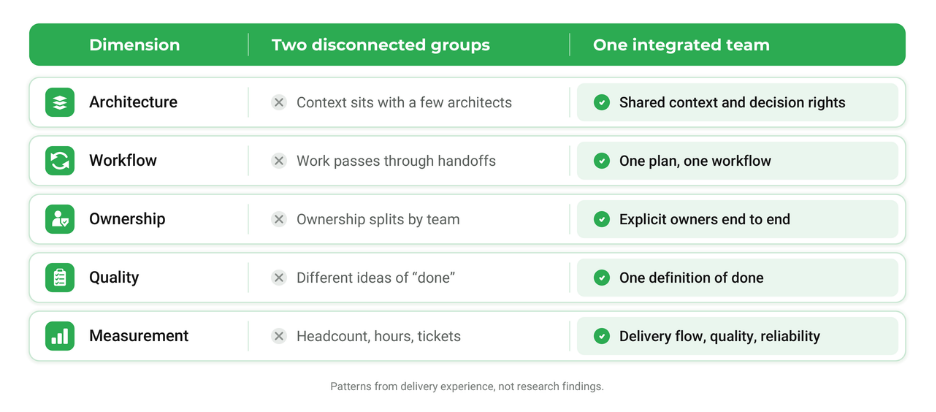
Team Topologies covers the interaction side. It describes three modes: collaboration, X-as-a-Service and facilitation. In an extended engagement, a new module calls for close collaboration, a mature service calls for clear ownership and interfaces, and an unfamiliar platform calls for facilitation and knowledge transfer. An extended development team does not need the same level of contact on every task. When these boundaries are explicit, an extended development team can work independently within agreed constraints, and the internal team does not have to supervise every task.
| Four Practices That Keep Dedicated Software Developers Inside One System
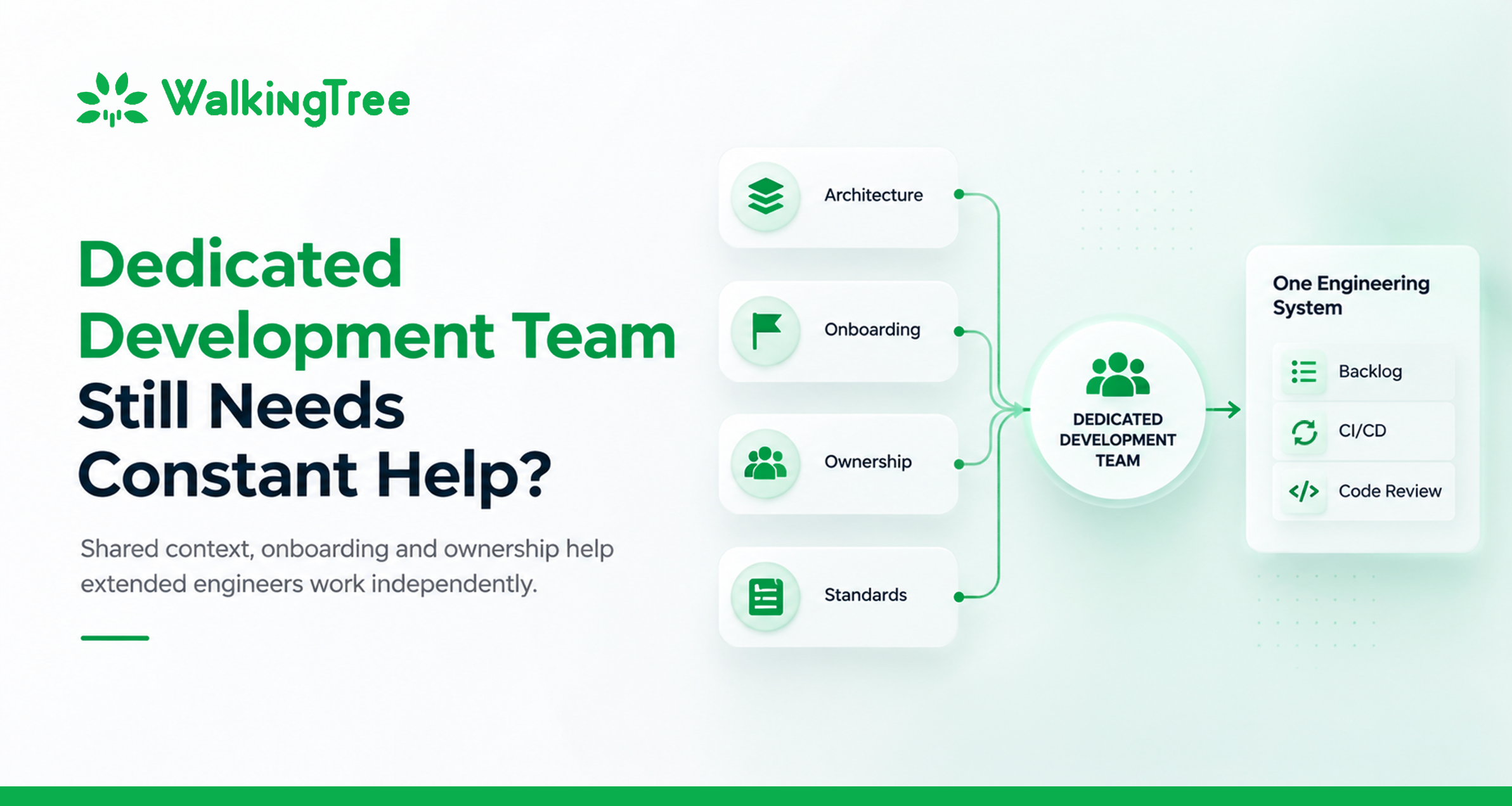
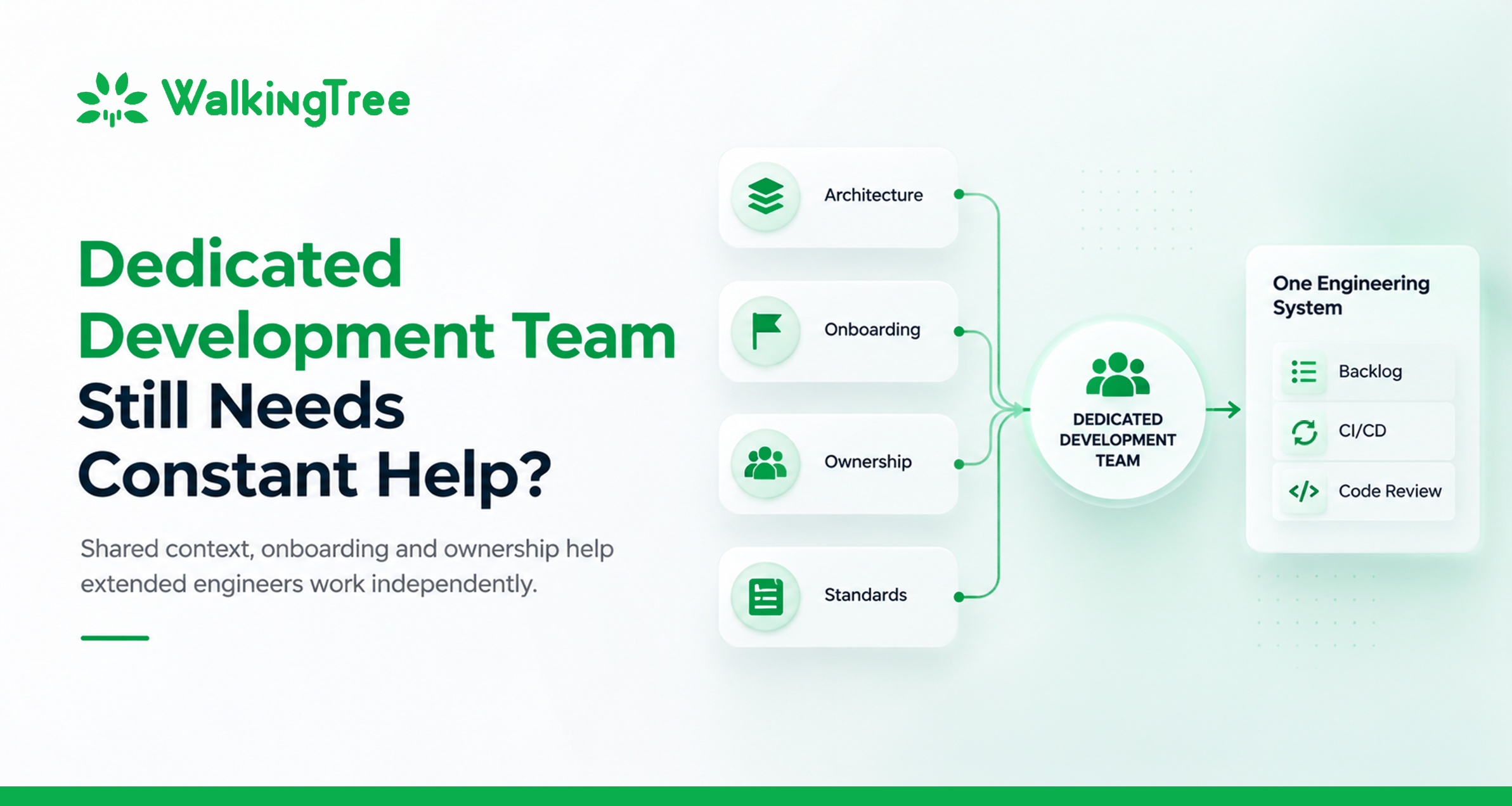
Our delivery experience points to six areas for integrating a dedicated development team. Four are covered here, while onboarding and measurement get their own sections. This is our own editorial framework, not one prescribed by a single source.
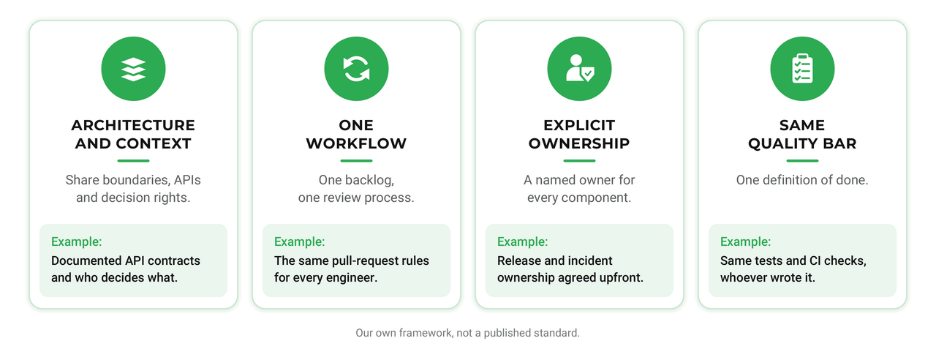
- Share architecture and context. Give dedicated software developers the system boundaries, services, APIs and design decisions that shape their work, and make clear who decides what and what needs review.
- Run one delivery workflow. Use one backlog, one set of acceptance criteria, one pull-request process and an agreed review turnaround. Developer onboarding is part of that flow, and it comes next.
- Make ownership explicit. Define who owns architecture, implementation, testing, security, release and operational support for each component, with clear escalation routes. Without that, defects and delays often fall between ownership boundaries.
- Apply the same quality bar. The same definition of done, test expectations and review rules should apply to every change, whoever wrote it. Microsoft’s Engineering Fundamentals Playbook recommends shared pipelines and automated checks, with human review for security-sensitive changes. If dedicated software developers meet a different bar from internal engineers, the result is effectively two systems. A dedicated development team that follows the same standards and review rules as the core team is easier to trust and easier to scale.
| Developer Onboarding Should Transfer Context, Not Just Access
Developer onboarding is often treated as account setup: repositories, credentials and a welcome call. GitLab’s onboarding guidance frames it across three dimensions instead, organizational, technical and social, and treats it as a documented process rather than a series of informal explanations.
For external engineers, the technical dimension should cover the product and its users, the codebase and architecture, environments and CI/CD, coding conventions and review expectations, security boundaries, and who makes technical decisions. Good developer onboarding gives a new engineer a clear path from first access to a first meaningful contribution.
The aim is to reduce avoidable dependency on the core team. When developer onboarding is repeatable, senior engineers answer new questions instead of repeating old ones, and a dedicated development team can reach independent work sooner. When developer onboarding is informal, ramp-up depends on whoever happens to be free that week.
| How to Measure Whether Your Dedicated Development Team Is Working
Headcount, hours, commits, lines of code and tickets closed are easy to count, but they say little about whether delivery is improving. For delivery outcomes, DORA’s five software delivery metrics give a credible team-level baseline: change lead time, deployment frequency, failed deployment recovery time, change fail rate and deployment rework rate. They balance throughput and stability, and they work best as team indicators, not individual targets.
Integration needs a few local diagnostics on top. These are our own suggestions, not part of that five-metric set: time to environment readiness, time to first meaningful contribution, pull-request review wait, blocked-work duration and dependency wait. If a dedicated development team shows long review waits or repeated handoffs, the constraint often sits in the operating model, not in the engineers. A dedicated development team is working when delivery flow, quality and reliability improve for the combined group, not when utilization looks high.
| Where Engineering Staffing Services Fit
A partner becomes useful once the operating model is clear. Good engineering staffing services support integration instead of ending at placement: technical validation before engineers join, alignment with the client’s architecture, structured onboarding, clear delivery governance and explicit ownership. WalkingTree’s engineering staffing services are built around that sequence.
At WalkingTree, extended engineering teams are structured around the client’s existing delivery environment. Smart Recruit, our technical assessment layer, supports validation before engineers are deployed, and a role-calibrated shortlist is typically ready within 48 hours. That figure describes WalkingTree’s own process, not an industry benchmark. Validation does not replace onboarding, architecture learning or team integration, which still happen inside the engagement. Dedicated software developers still need context, access and clear ownership before they can contribute independently.
The level of governance should match the engagement. A small, well-defined augmentation may need a lighter approach than a multi-disciplinary pod responsible for a delivery stream. What stays constant is the goal: an extended development team that works inside the client’s system, supported by a partner that treats a dedicated development team as part of delivery instead of a separate vendor.
| One Dedicated Development Team, One Engineering System
Adding engineers increases potential capacity. Integrating them into one engineering system is what makes that capacity useful. The question for engineering leaders is less how many engineers a dedicated development team adds and more how quickly the combined team can deliver reliable software together.
Shared architecture, one workflow, explicit ownership, common standards, structured onboarding, and team-level measurement do not guarantee faster delivery. They do remove identifiable sources of delay, and they make the capacity you added easier to use.
If you are planning or already running an extended team and want to see where your operating model can improve, talk to WalkingTree’s team about scoping it.