Blogs
Hire Software Developers Faster Without Compromising Delivery


Every technology leader has felt the relief of finally being able to hire software developer talent after weeks of searching a thin market. The requisition closes, the offer is signed, and for a moment the capacity problem looks solved. Then sprint planning happens, and the new engineer is nowhere near ready to carry a full share of the work, no matter how efficiently the team managed to hire software developer talent in the first place.
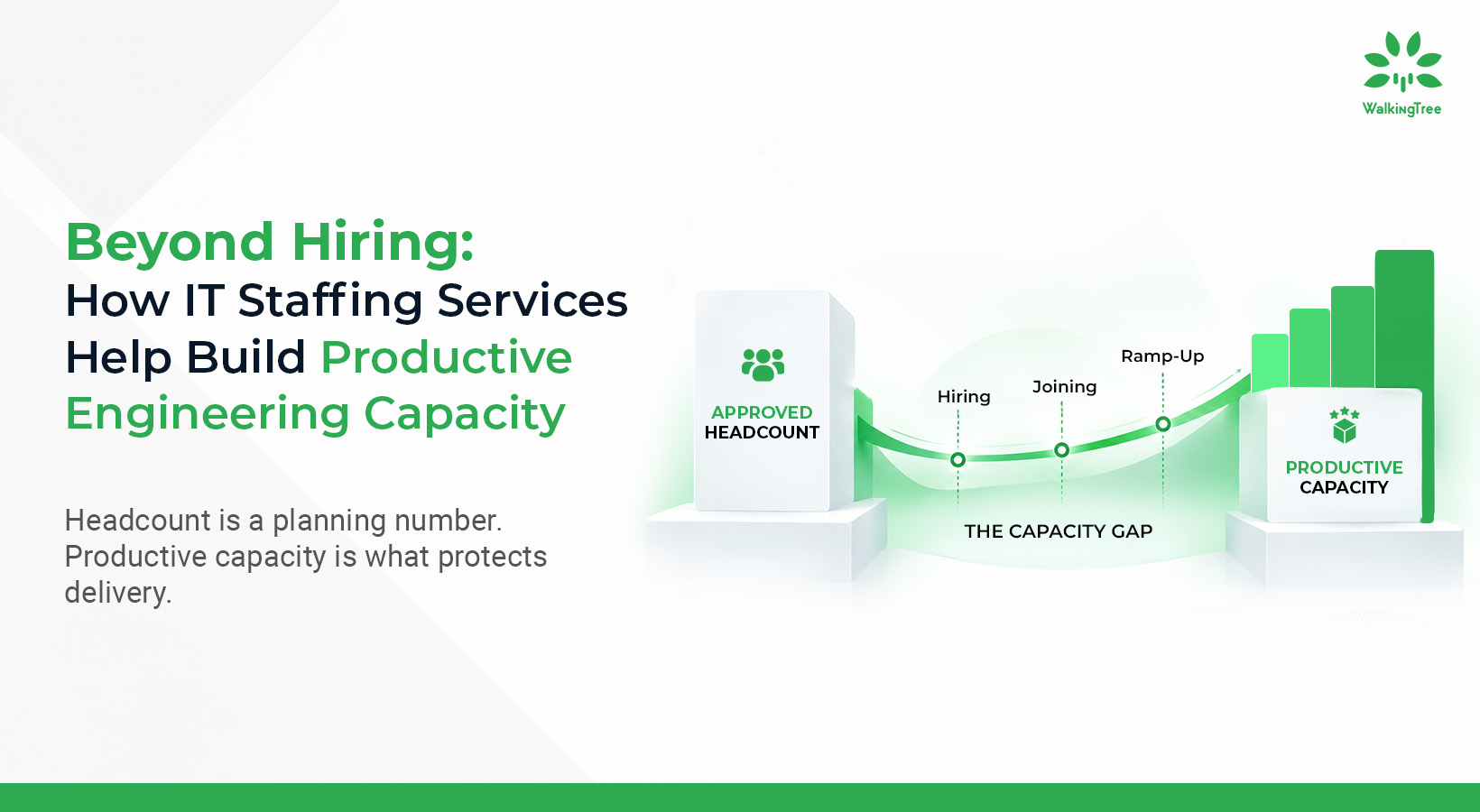
That gap between closing a hire and getting real delivery from them is the subject of this article. Companies that hire software developer talent quickly often assume delivery accelerates at the same pace, and companies that hire software developer talent slowly assume the opposite; neither assumption holds up. It rarely does. Hiring speed measures how fast someone joins. Delivery speed measures how fast they can actually contribute, and the two clocks run on completely different schedules. If your organization is optimizing only to hire software developer talent faster, you are solving half the problem, and possibly not the half that protects your roadmap.
| Technical Staffing Speeds Up Hiring, Not Delivery
Most companies that hire software developer talent track a single clock: requisition, candidate, screening, offer, join. Call this the hiring clock, and it is the only clock most companies that hire software developer talent ever measure. It is the clock recruiting teams live by, and it is the clock most technical staffing programs are built to optimize. Shortening it is genuinely valuable, since a faster technical staffing process means less time with an open seat. Most vendors are judged entirely on this clock, which is exactly why it is the only one that gets optimized.
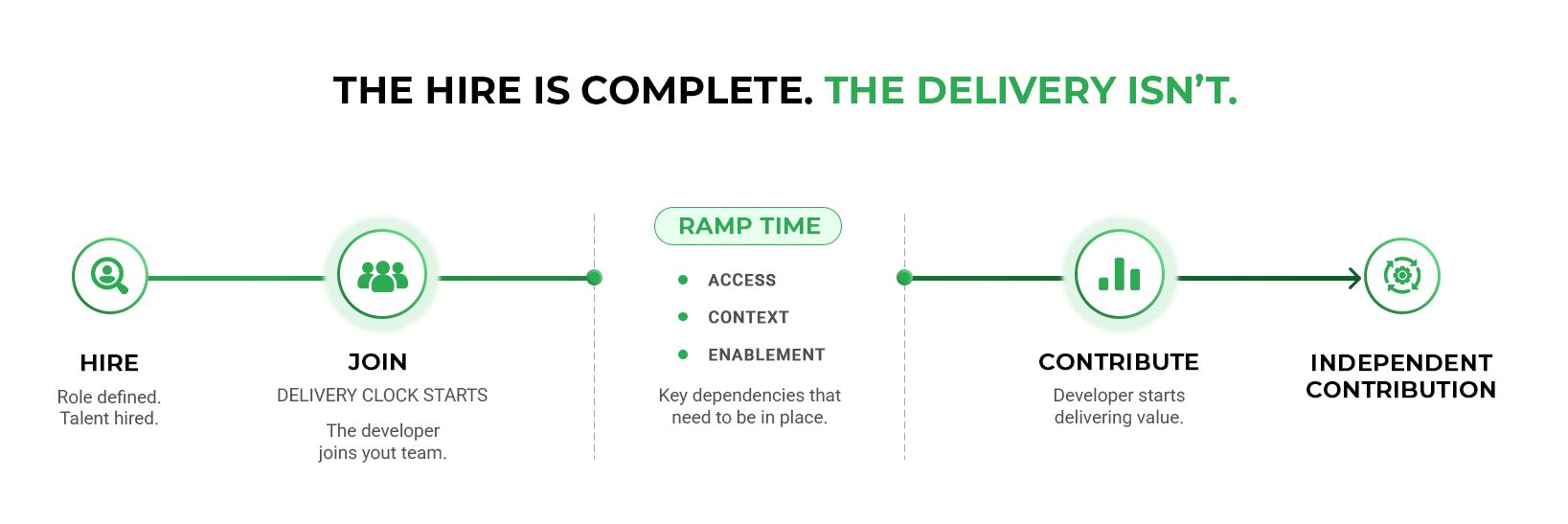
But the hiring clock stops the moment someone joins. It says nothing about what happens next: understand, align, contribute, deliver. That second clock, the delivery clock, starts exactly where the hiring clock ends. GitLab’s research on onboarding found that 44% of organizations report onboarding takes more than two months, and defines onboarding to include far more than paperwork: environment configuration, access to version control and CI/CD, deployment environments, project goals, architecture, coding conventions, and team culture.
None of that is captured by a technical staffing process built around hiring speed alone, and most technical staffing scorecards that stop at offer-accepted don’t show it either. Technical staffing built only around speed-to-offer often optimizes the wrong half of the timeline.
| Developer Onboarding Is Where the Real Work Starts
Developer onboarding is where the real work begins, not where it ends. Google’s own research into developer productivity describes onboarding and ramp-up as fundamentally connected to engineering work itself, not administrative training that happens alongside it. A new engineer has to learn the codebase, the architecture, the APIs, the data models, the CI/CD pipeline, the testing strategy, the review expectations, and the team’s definition of done, before their commits are trusted the way a tenured engineer’s commits are trusted.
Structured onboarding shortens this list without skipping it. Unstructured onboarding just pushes the learning into the sprint itself, one confused thread at a time. Either way, the work happens somewhere. Companies that hire software developer talent without a real onboarding plan are not saving time; they are relocating it to the first few months of the engagement, where it costs more and shows up as missed velocity instead of a line item on a hiring dashboard.
| Technical Recruitment Confirms Skill Fit, Not Context Fit
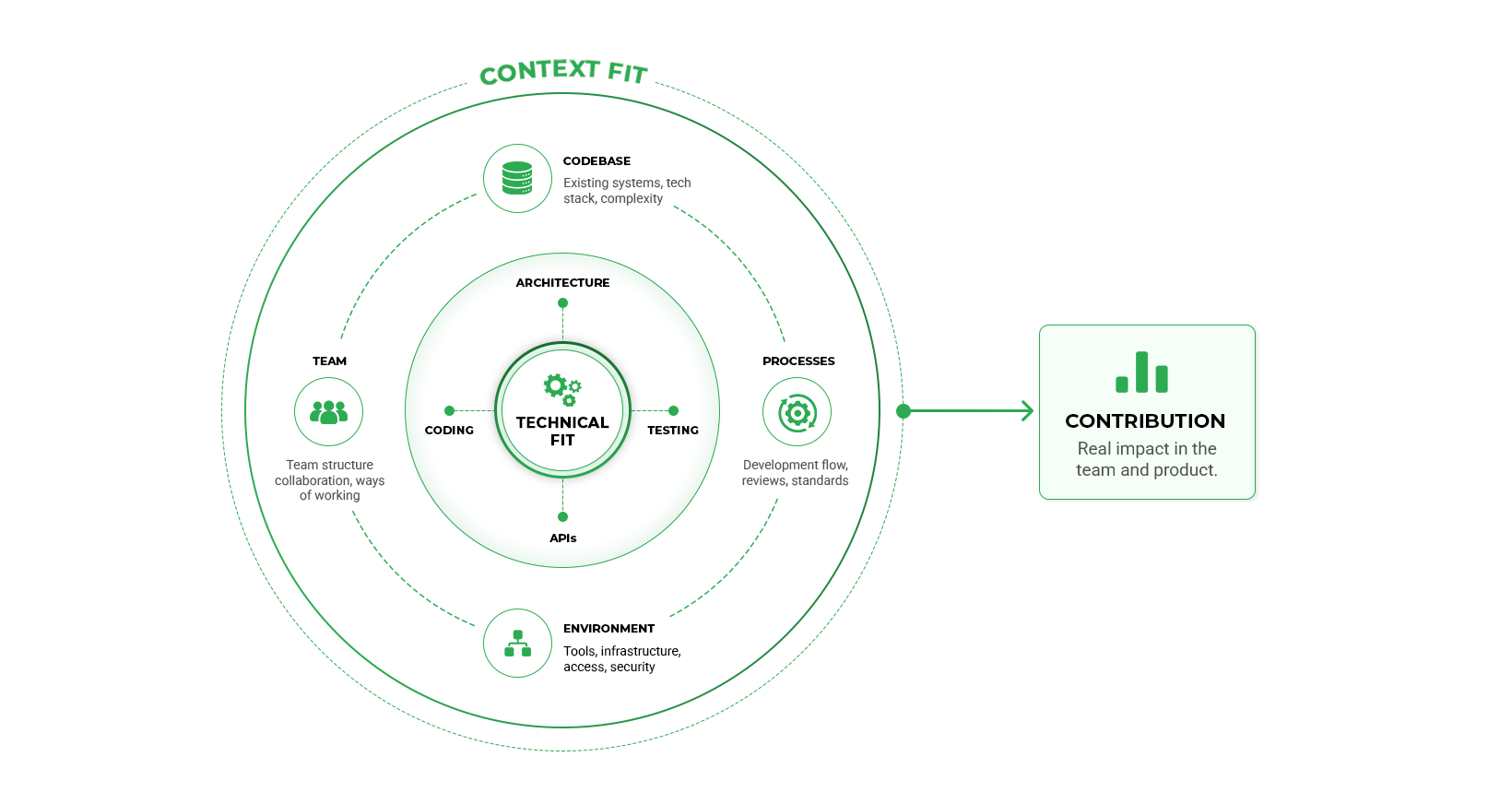
Technical recruitment is built to answer one question: can this person do the work? Interviews, take-home exercises, and system design rounds are all designed to validate capability. That validation matters, and it is a different discipline from technical staffing itself, which is more concerned with sourcing and placement speed than with what happens after. But validation answers Skill Fit, not Context Fit, and Context Fit is what determines how quickly a technically qualified engineer becomes a contributing one.
Microsoft and IEEE researchers studied this directly. Their case study of 32 developers and 15 engineering managers found that the majority of onboarding tasks are not administrative at all; they are real engineering work, fixing bugs and implementing small features, done while the engineer builds confidence and social connection with the team.
A candidate can clear every technical recruitment bar an organization sets and still need weeks to become fluent in a codebase they have never seen. It measures whether someone can do the job in general. It was never built to measure how fast they will be trusted to do it here, and treating that as the finish line is exactly where the delivery clock gets ignored.
| The Hidden Cost of Ramp Time on Developer Productivity
Every week a new hire spends ramping up is a week borrowed from someone else’s developer productivity too. Pluralsight Flow’s analysis of 11.5 million data points across 2,642 engineers found an average full ramp of about six months, with wide variance between organizations, some closer to three or four months, others stretching past eleven or twelve. That range alone should worry any leader planning delivery around a hire date rather than a contribution date.
The cost is not only the new engineer’s own learning curve. Senior engineers lose productivity to mentoring. Teams lose productivity to coordination overhead while a new person gets oriented. For a period that can run to half a year, the team’s total developer productivity is temporarily lower than it was before the new hire arrived, not higher, even though headcount went up on paper.
If you can’t say how long your last hire took to become genuinely productive, that is exactly the gap WalkingTree helps you close before the next one. Get in touch to scope it out.
| Engineering Recruitment Must Measure Time-to-Contribution, Not Just Time-to-Hire
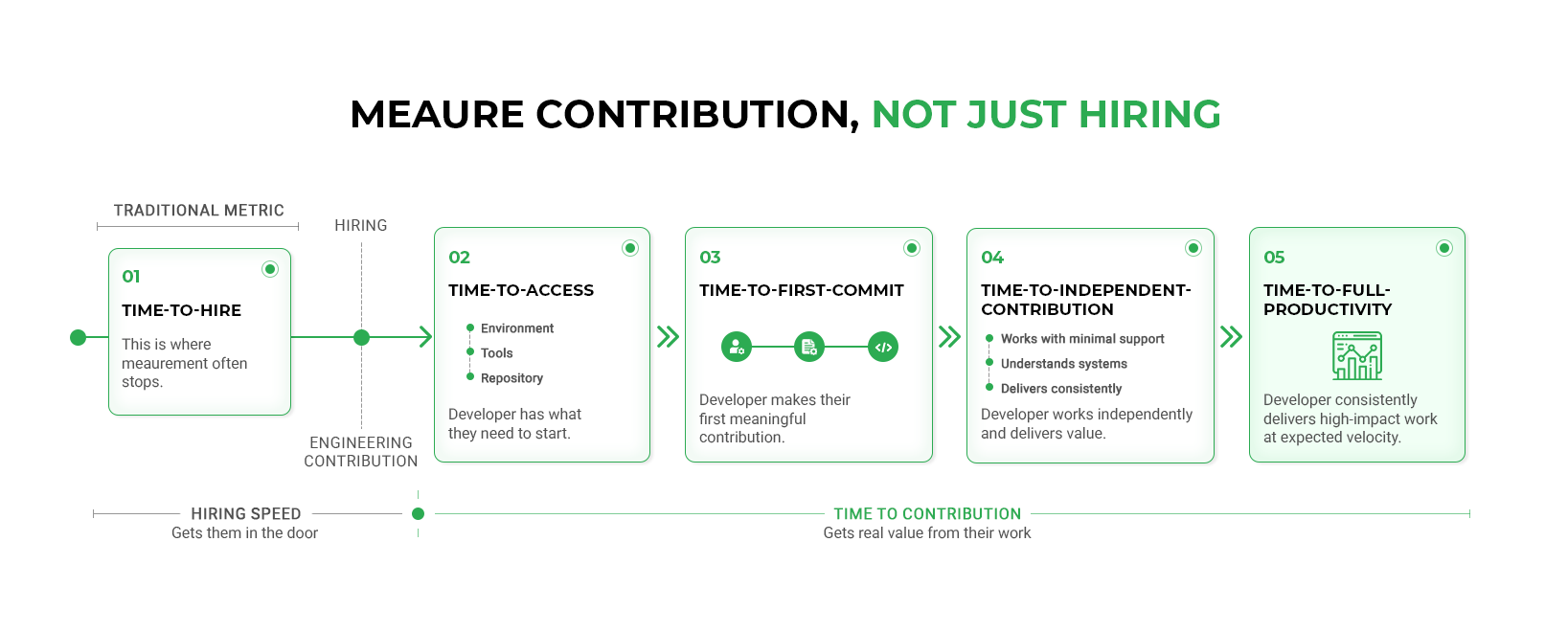
Most engineering recruitment dashboards track one number well: time-to-hire. Almost none of them track what happens after. If engineering recruitment is going to actually protect delivery dates, it needs a second set of metrics that start at Join instead of ending there: time-to-access, time-to-first-commit, time-to-independent-contribution, time-to-full-productivity, and time-to-team-integration.
None of these is a formula so much as a checklist. Time-to-Contribution is really Technical Fit plus Context plus Enablement plus Team Integration, tracked together rather than assumed. Engineering recruitment teams that report only time-to-hire are reporting the easy half of the problem, the half that tells you how fast you hire software developer talent rather than how fast that talent becomes useful. The harder half, and the half that actually predicts delivery, starts the day the offer is signed, and stopping there is only telling half the story leadership needs.
| Where Engineering Staffing Services Actually Fit
This is where engineering staffing services either earn their value or do not. A staffing model that only accelerates the hiring clock, faster sourcing, faster screening, faster offers, has not touched the delivery clock at all. Engineering staffing services that are actually useful are the ones built around what happens after Join, not just before it.
At WalkingTree, this is the specific problem extended engineering teams are structured to solve. Technical fit is validated before a candidate is ever presented, but validation is only the first step. Architecture alignment, structured onboarding, and delivery governance are treated as part of the engagement itself, not left for the client to absorb alone, which is what separates these engineering staffing services from a resume pipeline.
Smart Recruit, WalkingTree’s technical assessment layer, is what makes the technical fit portion fast and defensible: role-calibrated evaluations before a candidate reaches a client interview, with a shortlist typically ready within 48 hours. That figure describes WalkingTree’s own delivery process, not an industry benchmark. The point of engineering staffing services built this way is not to hire software developer talent marginally faster. It is to compress the distance between Join and genuine contribution, which is the clock most staffing models were never built to measure in the first place.
| Hire Software Developer Talent Faster, But Measure Delivery Too
Hiring speed tells you when someone joins the organization. Delivery speed tells you when they start actually contributing to it. Those are not the same measurement, and treating them as interchangeable is how engineering leaders end up surprised that a fully staffed team still is not shipping on schedule. Technical staffing that only reports hiring speed will keep producing that surprise, and recruiting functions that never look past offer-accepted will keep signing off on it.
Organizations that hire software developer talent quickly should keep doing so; speed to offer is not the problem. The problem is stopping the clock there. Engineering leaders need to track time-to-access, time-to-first-commit, and time-to-independent-contribution with the same seriousness they track time-to-hire, because the second set of numbers is what actually predicts whether a hire protects the roadmap or just fills a headcount line. Technical staffing that ends at Join has done half the job. The half that matters for delivery starts on day one and does not finish for months, no matter how quickly you hire software developer talent to begin with.
If you’re trying to close the gap between hiring speed and delivery speed, talk to WalkingTree’s team about where your engineering capacity actually stands.