Blogs
Legacy Application Modernization: From Monolith to Microservices

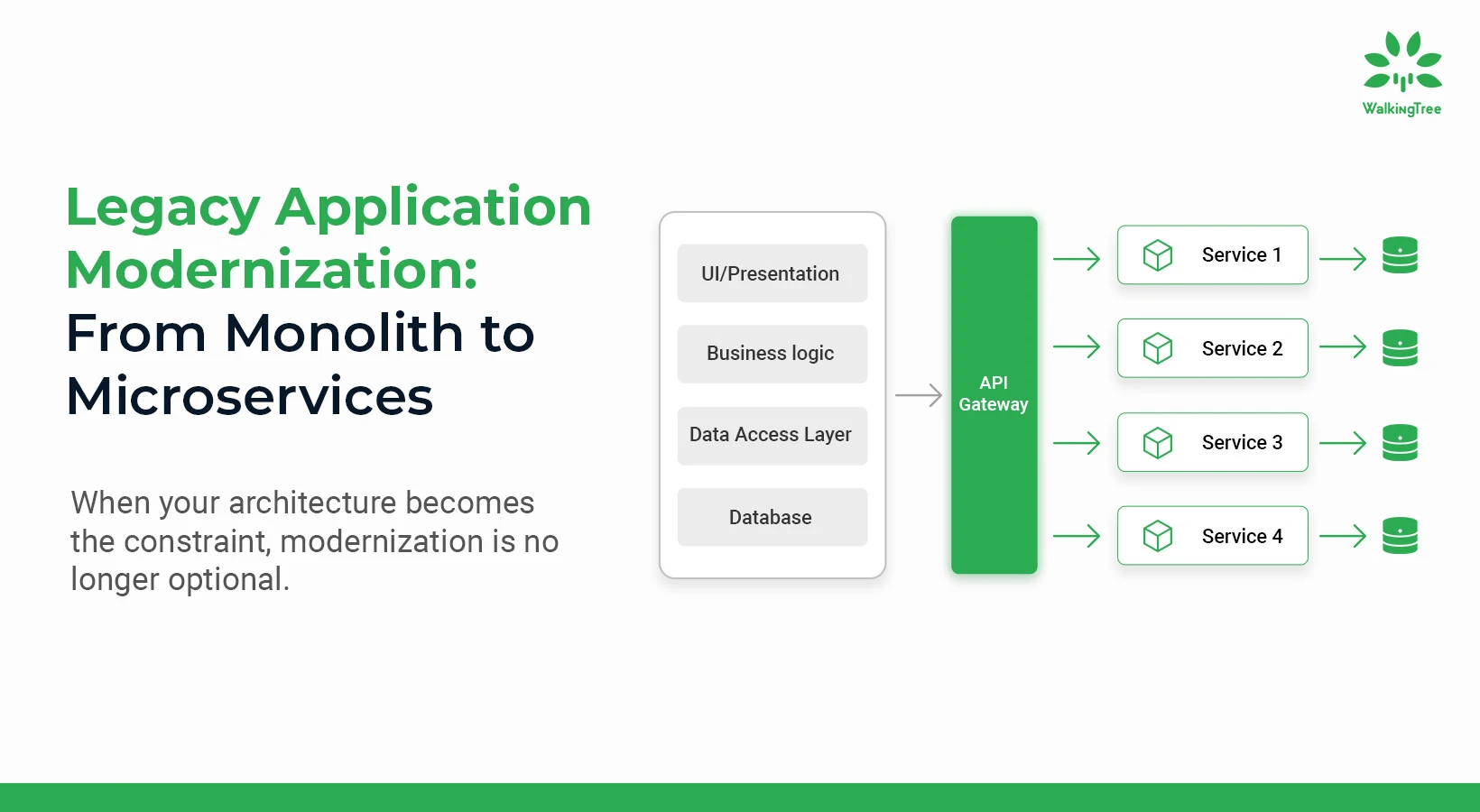
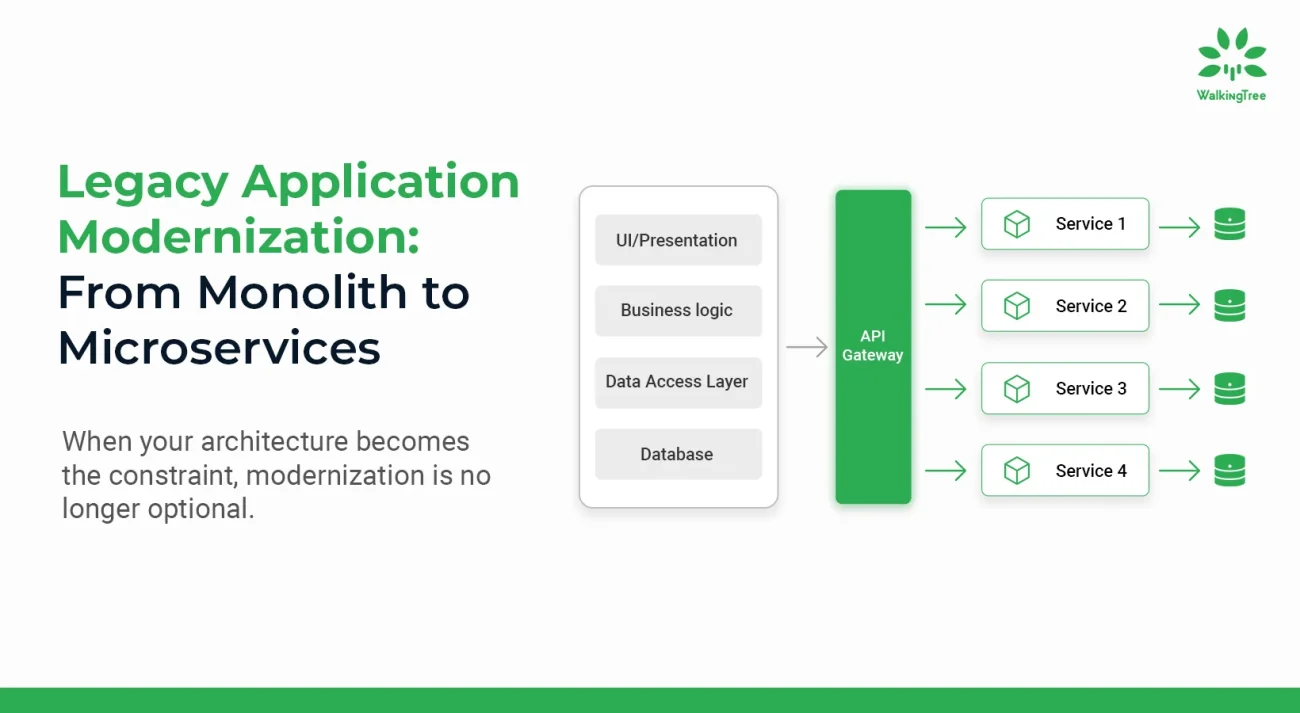
Legacy Application Modernization is no longer a back-office IT decision. Most enterprises today are not held back by a lack of ambition or budget. They are held back by the systems they built a decade ago. Deployment windows stretch across weekends. A change in one module breaks three others. Engineering teams spend more time managing fragility than building capability. And when leadership asks about AI integration, the honest answer is that the current architecture was never designed for it.
According to McKinsey, 10 to 20 percent of technology budgets earmarked for new products is diverted to resolving technical debt. Sixty percent of CIOs said that debt had increased over the past three years. This is not a background problem. It is a compounding business constraint.
Legacy Application Modernization has moved from an IT roadmap item to a boardroom priority because the cost of staying still is now higher than the cost of changing. Programs that fail do not fail because the technology is complex. They fail because organizations approach it as a one-time rewrite rather than building a long-term engineering discipline.
| When the Architecture Becomes the Business Problem
Traditional enterprise applications built on .NET or Java monoliths, tightly coupled ERP systems, and shared relational databases were designed for release cycles measured in months. They worked in that era.
Today those same systems create friction across the delivery chain. A single deployment touches the entire stack. Scaling one high-traffic feature requires scaling everything. Teams operate on synchronized release calendars where a change to the checkout service must wait for the billing team’s deployment window.
AI adoption has sharpened this problem. AI systems depend on APIs, event streams, and real-time distributed data access. Legacy architectures were not designed for that level of openness. The pressure for enterprise application modernization across banking, healthcare, manufacturing, insurance, and retail is not coming from technology preference. It is coming from competitive necessity.
| Monolith vs. Microservices: Understanding the Real Tradeoff
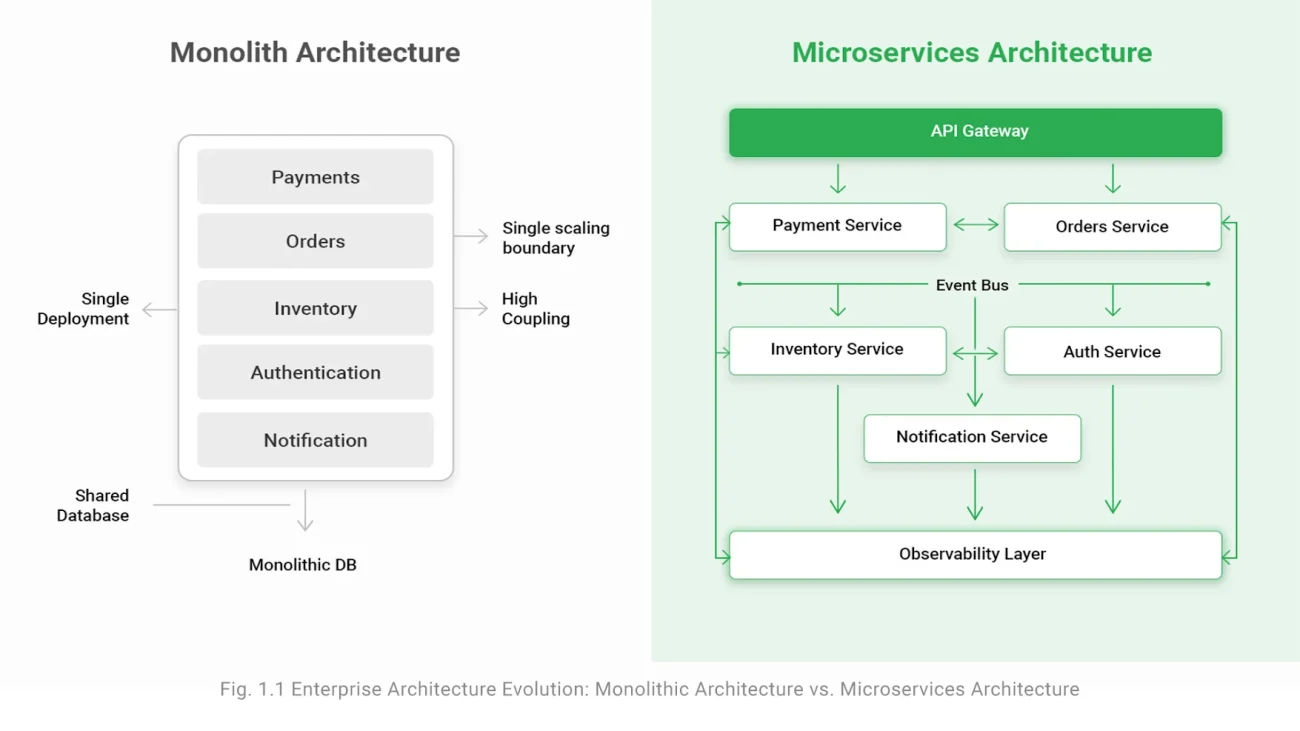
The move from monolith to microservices is not a clean upgrade. It is a structural shift with a different set of tradeoffs. A monolith keeps everything inside one codebase, one deployment pipeline, and one shared database. Teams move fast early. The problem begins when it scales without defined boundaries and a change to one feature creates failures in an unrelated flow because both share a service layer never meant to be independent.
Microservices break the application into independently deployable services where each owns its business capability, runtime behavior, and data store. In practice the differences look like this:
Deployment: Full application deploys together in a monolith. Each service deploys independently in microservices.
Scaling: Monoliths scale as one unit regardless of which feature is under load. Microservices allow individual services to scale without touching the rest.
Data ownership: Monoliths share one database across features. In microservices, each service owns its own data store, eliminating hidden coupling at the data layer.
Team structure: Monoliths require coordinated centralized releases. Microservices enable independent teams to ship without synchronization overhead.
Operational complexity: Monoliths carry lower overhead initially. Microservices require DevOps maturity and platform engineering before benefits materialize.
AI and integration readiness: Monoliths are difficult to expose as clean API surfaces. Microservices are designed for event-driven access and real-time integration from the ground up.
Organizations pursuing microservices migration without first establishing these operational foundations often end up managing distributed chaos rather than gaining agility.
| Portfolio Assessment Before Architectural Decisions
One of the most expensive mistakes in legacy system modernization is treating every application as a candidate for full architectural transformation.
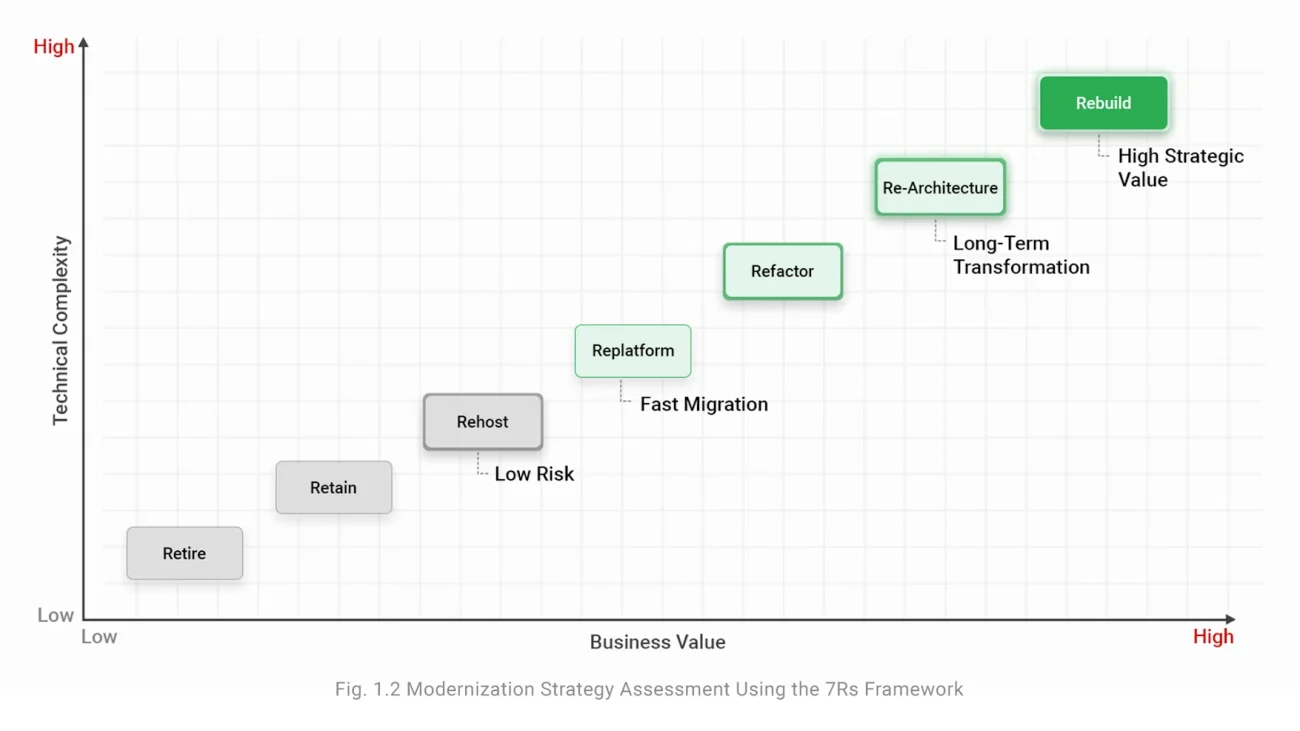
A mature software modernization strategy begins with a portfolio-level assessment. Applications are evaluated across business value, technical health, rate of change, and scalability requirements. Some systems are retained as-is, others retired, some rehosted into cloud environments, some refactored, and only a defined subset re-architected into microservices.
This phased decision-making process is central to successful Replatforming and Modernization initiatives because not every legacy system warrants the same level of architectural investment.
This maps directly to what practitioners refer to as the 7Rs framework: Retain, Retire, Rehost, Replatform, Refactor, Re-architect, and Rebuild, each representing a distinct modernization disposition based on the system’s assessed value and complexity.
The systems that justify re-architecture share two characteristics: high rate of business change and high operational cost under the current structure. Applying transformation investment selectively is what makes Legacy Application Modernization financially sustainable over a realistic 12 to 24-month horizon.
| The Migration Pattern That Actually Works
Large-scale rewrites fail at a high rate. They require maintaining two parallel systems, making all architectural decisions upfront, and delivering business value only at the end of a multi-year program. That combination rarely survives organizational pressures.
The Strangler Fig pattern works differently. An API gateway is placed in front of the existing monolith. Individual capabilities are extracted into independent services one domain at a time. Traffic is gradually rerouted. The legacy core shrinks until it can be decommissioned without disrupting live operations. Modernization programs fail when organizations approach migration without a clear sequencing strategy, operational foundation, or domain-level roadmap.
The success of this approach depends heavily on identifying the right domains to extract first and establishing the operational foundations that support them. This is why many modernization programs begin with an architecture assessment, helping teams validate dependencies, prioritize service boundaries, and sequence migration efforts before large-scale change begins.
At WalkingTree, these assessments are often used to identify modernization priorities, dependency risks, and the most practical path from monolith to service-based architecture.
This phased approach is central to how mature Legacy Application Modernization programs maintain leadership visibility throughout execution, since each extraction delivers a measurable outcome rather than deferring all value to the end of a multi-year program.
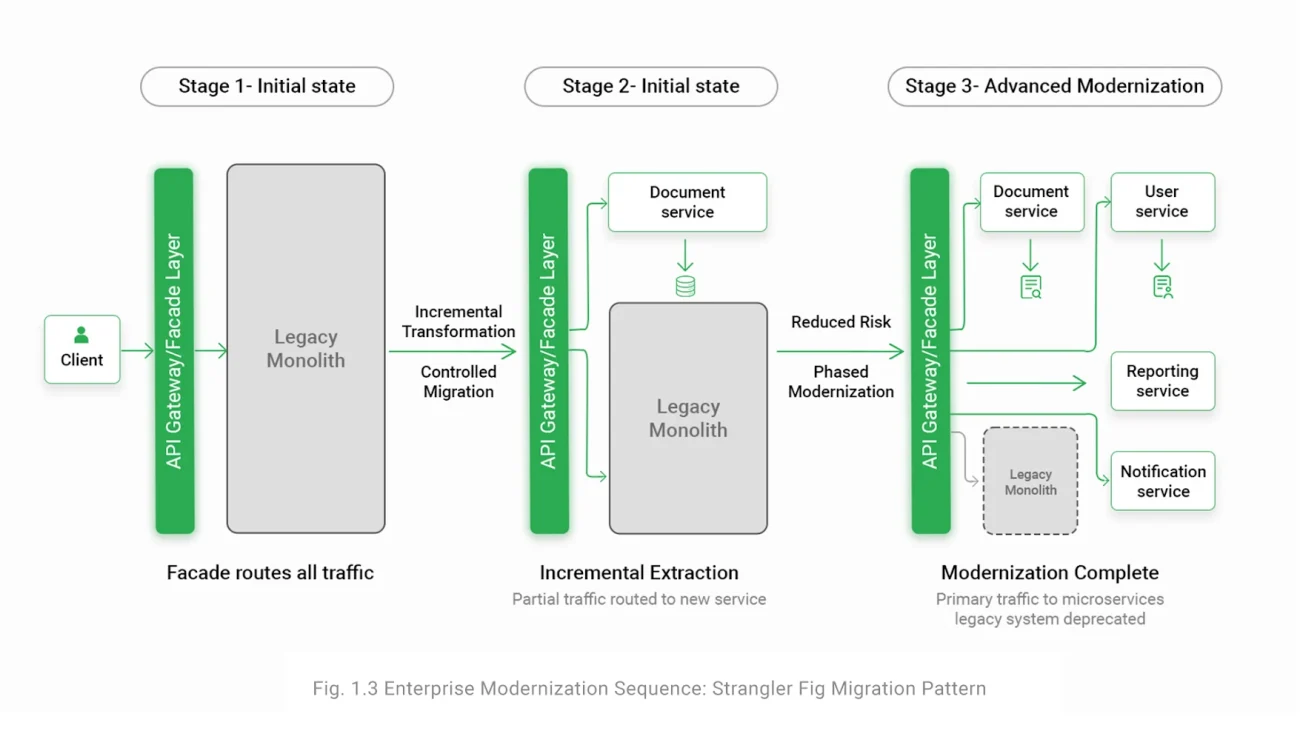
A mid-sized financial services firm used this approach on its loan origination platform. The team extracted document management first, then income verification, then credit decisioning. Over 18 months, the monolith lost more than 60 percent of its surface area with no service interruption. Each extraction built repeatable patterns for the next phase rather than requiring fresh problem-solving every time.
The first domain to extract should have high change frequency and limited dependency complexity. Notifications, reporting, and catalog management are typical starting points. Deeply shared transactional workflows should not be early targets in any microservices migration effort.
| Boundaries Built on Business Logic, Not Technical Layers
Many organizations that decompose monoliths end up with a distributed monolith. Services deploy independently in name but remain tightly coupled in behavior. A single business change requires coordinating six or eight services. The overhead is real. Independence is not.
Domain Driven Design addresses this by identifying bounded contexts that reflect genuine business ownership. For an e-commerce platform, that means separate domains for payments, fulfillment, product catalog, shipping, and customer identity. Each becomes independently owned with its own team, data model, and release cycle. Without this foundation, enterprise application modernization produces complexity without the coordination benefits that justify the investment.
| The Layer That Keeps Your Monolith Alive After Migration
Code migration is manageable. Data ownership is where most programs encounter real complexity.
Each service in a cloud-native architecture must own its own database schema. When services share a database, the coupling that modernization was designed to eliminate moves from the application layer into the data layer. The monolith continues to exist, just invisibly.
Patterns that help include Change Data Capture for streaming legacy database changes into new service-owned stores, the Outbox pattern for reliable event publishing, Saga patterns for distributed transactions, and CQRS for separating read and write workloads in high-volume scalable enterprise system environments. A serious software modernization strategy must also include rollback planning and phased cutover mechanisms. Organizations that treat data as secondary to code migration almost always create long-term instability in the architecture they are trying to modernize.
| The Operational Foundation That Makes Microservices Work
There is a direct relationship between DevOps maturity and microservices migration success. Teams that attempt service decomposition before establishing deployment automation consistently fail to sustain the Legacy Application Modernization program past the first few extractions.
As services grow from one to twenty to a hundred, manual deployment processes become unsustainable. Automated CI/CD pipelines, infrastructure as code, GitOps workflows, and centralized observability are prerequisites, not enhancements.Building these capabilities usually requires a dedicated Architecture & Platform Optimization strategy that aligns platform engineering, deployment automation, scalability, and operational governance before large-scale service decomposition begins. In one retail modernization program, deployment frequency moved from monthly release windows to multiple production deployments per day after service extraction and CI/CD standardization were in place. The architectural change alone did not produce that outcome. The platform engineering investment behind it did.
Observability operates across three layers: metrics for performance, centralized logs for operational visibility, and distributed tracing to follow a request across services and event queues. Security evolves in parallel. Every service boundary in a cloud-native architecture is a potential attack surface. Mutual TLS between services, token-based authentication, policy-driven authorization, and automated secrets rotation must be embedded into the deployment lifecycle from the start, not added as a compliance exercise afterward.
| Why the Hardest Parts of Modernization Are Not Technical
The organizations that complete Legacy Application Modernization successfully share one understanding: the hardest parts are not technical.
Architecture decisions are difficult but documented. What is harder is aligning teams around new ownership models, sustaining stakeholder confidence across a multi-year program, and maintaining organizational patience when the visible output of the first six months is a deployment platform and one extracted service rather than a transformed product.
The organizations that succeed treat modernization as an ongoing engineering discipline instead of a one-time transformation initiative. That discipline creates compounding returns: faster releases, more confident deployments, and a technical foundation that does not regenerate the debt it was built to eliminate. Legacy system modernization done this way becomes a source of competitive advantage rather than a cost center.
| Find Out Where Your Modernization Should Begin
Legacy Application Modernization looks different for every enterprise. The right starting point depends on portfolio complexity, team maturity, data architecture, and the business domains carrying the most operational risk today.
Most organizations do not lack the intention to modernize. They lack a clear, sequenced path that accounts for where they actually are, not where they wish they were.
WalkingTree works with enterprises to design and execute modernization programs built around real constraints. From architecture assessment and domain modeling to DevOps platform engineering and phased migration execution, we engage at the depth the problem requires.
Let’s Map Your Modernization Path