Blogs
Engineering Staffing Services That Reduce Delivery Risk

Engineering staffing services are usually requested when delivery is already under pressure: a release slips, a migration needs skills the team lacks, or a new roadmap lands on a full sprint. The reflex is to add people. But headcount is an input, not an outcome, and headcount planning that stops at the vacancy count can miss the real constraint. The Linux Foundation’s 2025 survey found that filling a technical role and bringing the hire to normal productivity averaged 8.4 months, against 5.2 months to upskill an existing employee. Those are survey averages, not project timelines. WalkingTree’s engineering staffing services, delivered as its Extended Team Services, start with the delivery problem, not the vacancy.
| Why Headcount Planning Alone Does Not Reduce Delivery Risk
Adding engineers to a team blocked by unclear architecture, slow approvals or thin technical leadership can simply add people waiting for decisions. The constraint may be a missing capability, an overloaded architect, team dependencies or a long hiring cycle. That is why headcount planning should start with the constraint, not the vacancy count.
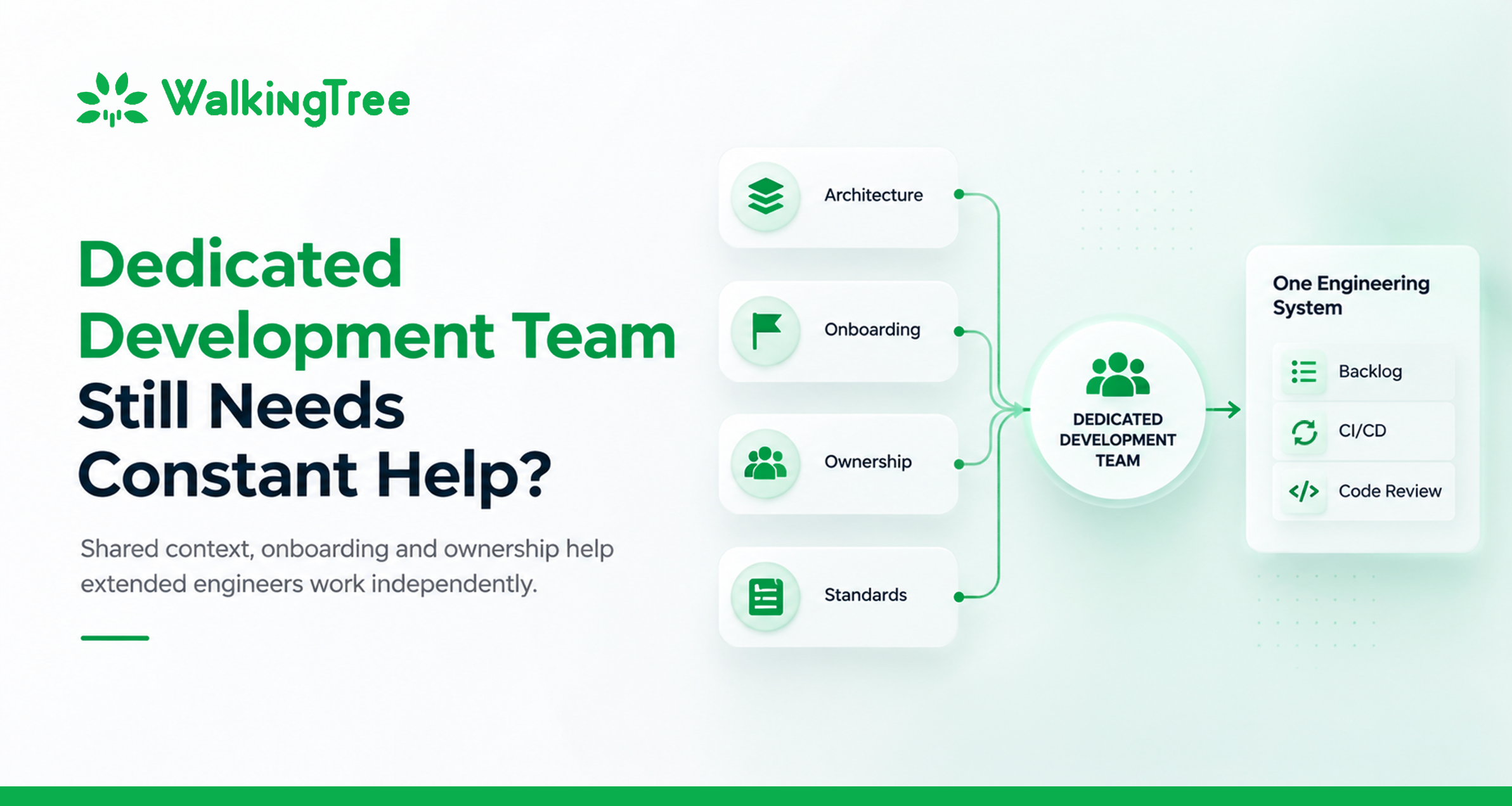
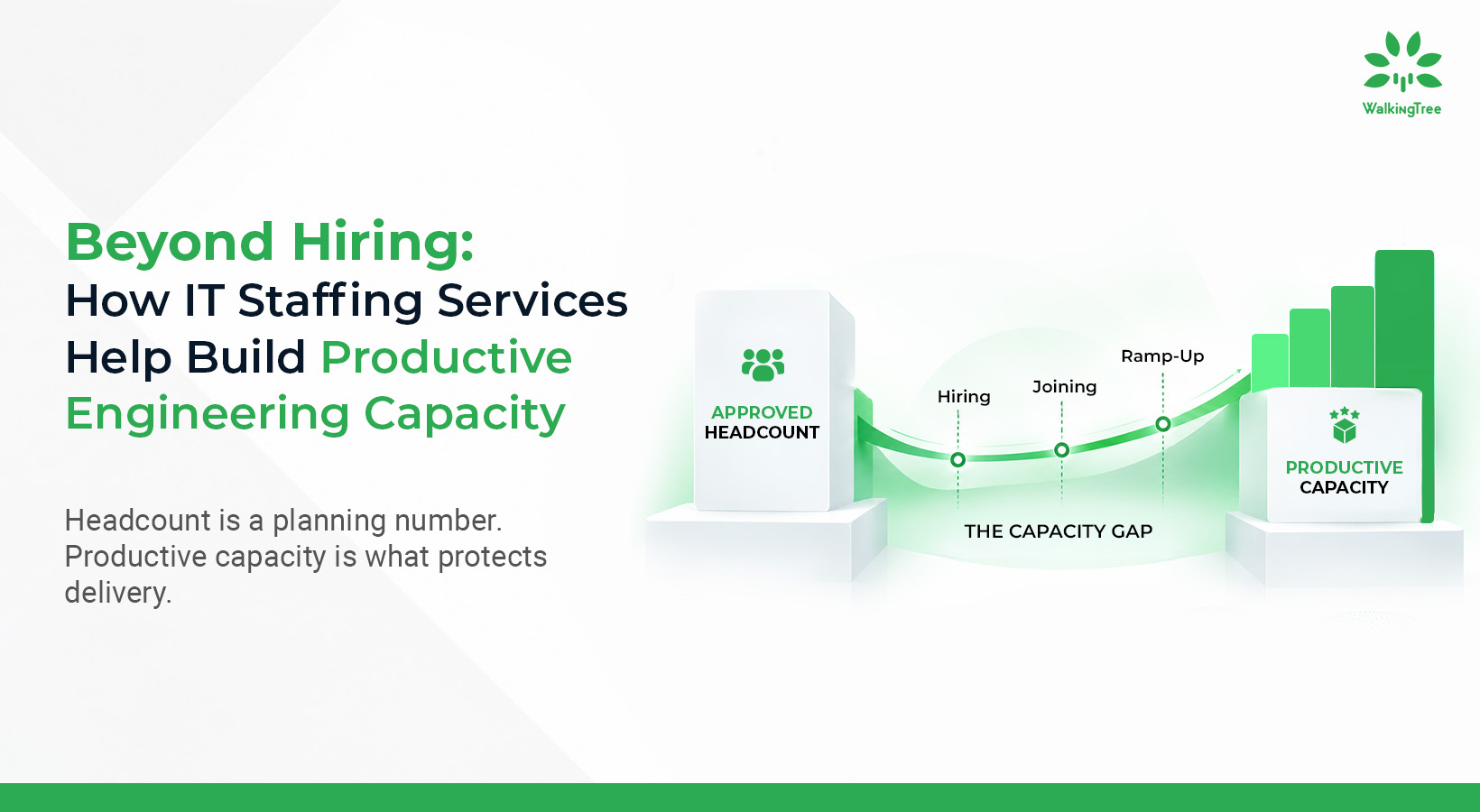
Headcount planning also has to separate capacity from capability: capacity is how much work a team can take on, and capability is what it can actually do. A company may have ten Java developers and still lack the capability to modernize its Kubernetes deployment architecture. Beyond Hiring covers the distinction in depth. Before adding development capacity, identify whether the constraint is capacity, capability or the way work is organized, because headcount planning that treats them as one problem tends to buy the wrong thing. WalkingTree’s Extended Team Services start from the requirement, and when the gap is technical leadership, not developers, its Fractional CAIO service provides on-demand CTO and AI leadership.
| Four Things Engineering Staffing Services Should Improve
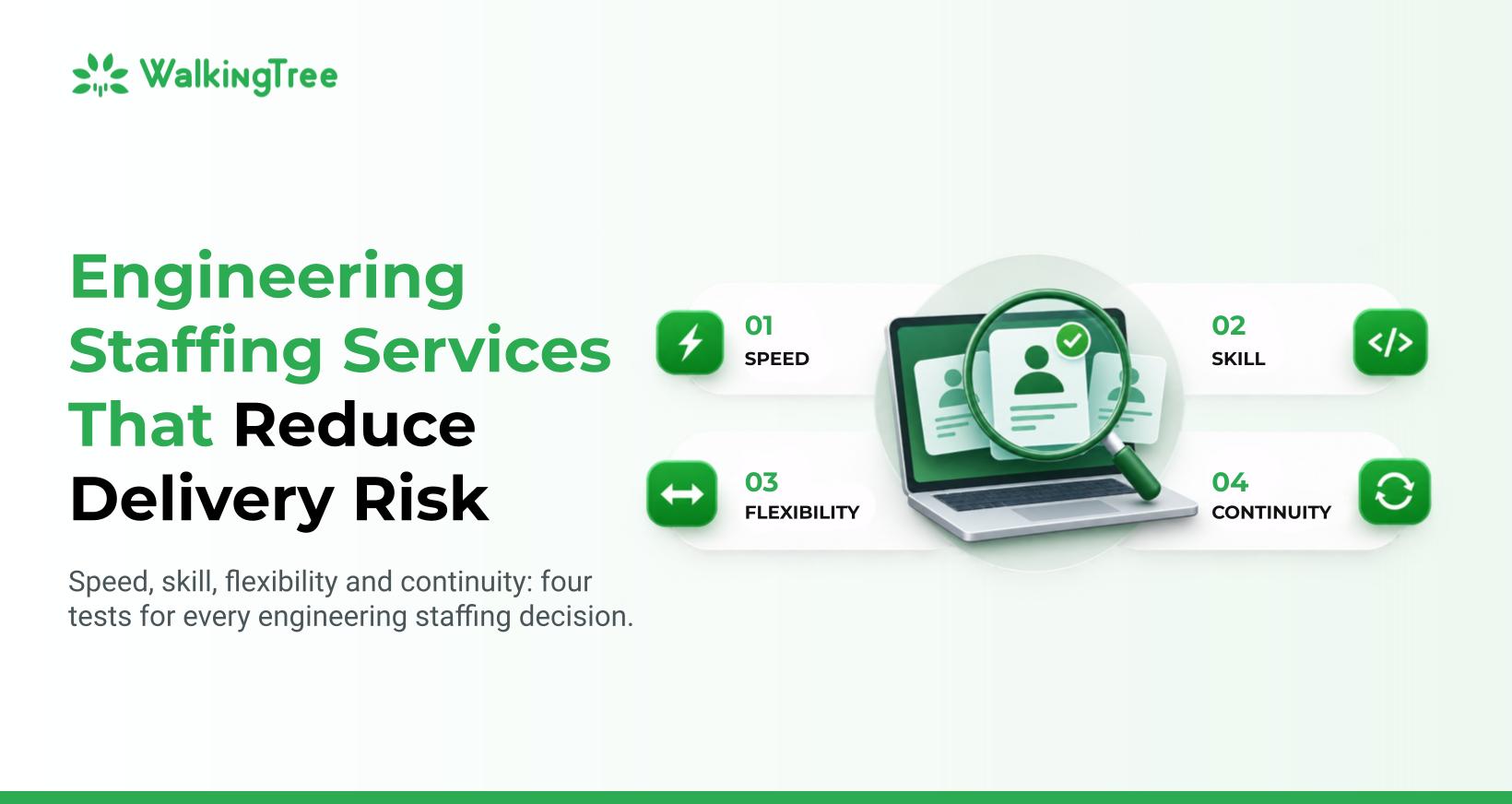
Engineering staffing services earn their value when they improve four things, each tested against the actual work. WalkingTree’s Extended Team Services are built around the same four.
Speed
Speed is not how quickly someone joins; it is how quickly the capability starts contributing. In the same survey, hiring and onboarding for senior technical roles averaged 10.0 months. WalkingTree handpicks resources and accelerates onboarding so talent enters the client’s workflows quickly.
Skill
A team can have enough people and still lack the expertise a project needs. Respondents rated hands-on experience the most important factor when assessing technical skills (95%). Technical staffing decisions should follow the capability required, not the job title. WalkingTree’s talent pool is pre-evaluated and domain-specific, handpicked through an AI-driven platform and subject-matter experts.
Flexibility
Demand shifts across a project: more developers during build, more QA before a release, more DevOps during a migration. The aim is development capacity that follows the roadmap. WalkingTree’s engagement models, from Staff Augmentation to a dedicated development team built through BOT or an ODC, let team size and expertise be adjusted as demand changes.
Continuity
Product knowledge is easy to lose when engineers rotate. Respondents reported that, on average, 19.2% of new technical hires resigned or were asked to leave within six months. WalkingTree supports continuity with knowledge-management tooling, documentation and structured handovers, so a staffing change does not become a delivery change.
| Choosing Between a Dedicated Development Team and Staff Augmentation
No single model suits every requirement. The useful question is which one fits the duration, expertise, ownership and demand pattern of the work.
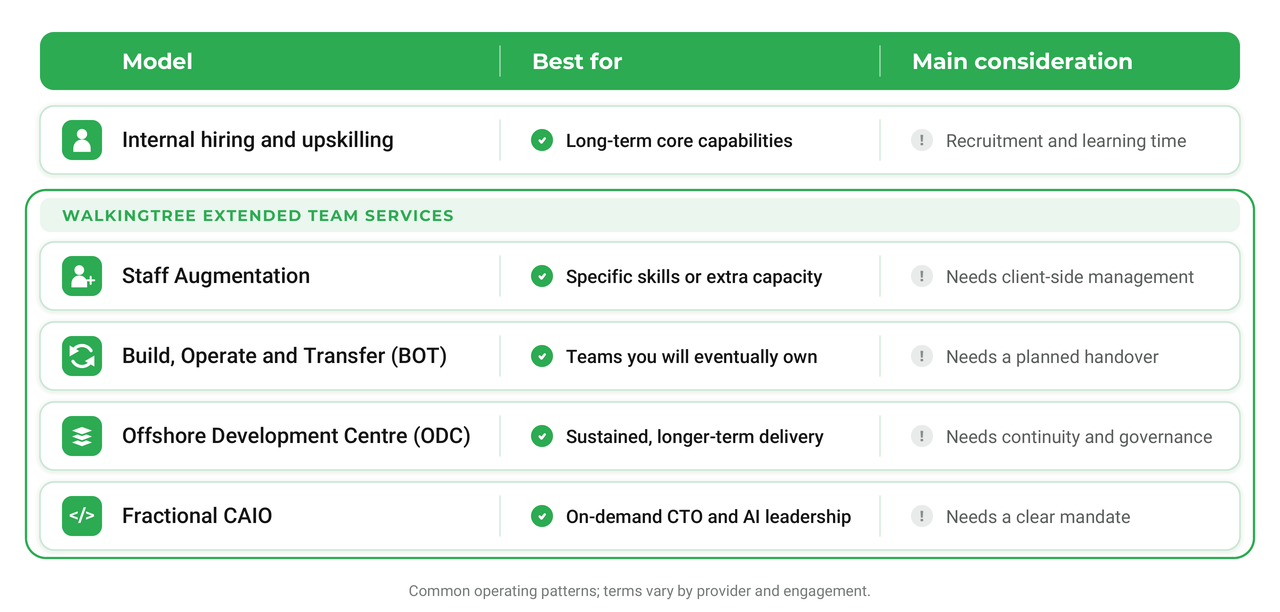
Internal hiring and upskilling suit long-term core capabilities, though recruitment and learning take time. WalkingTree’s Extended Team Services cover the external routes. Staff Augmentation adds specific skills or capacity to a team with strong technical leadership, and software development team augmentation leaves priorities and day-to-day management with the client. Build, Operate and Transfer (BOT) builds a team, runs it and hands it over after an agreed period. An Offshore Development Centre (ODC) provides sustained delivery capacity with shared technical learning. A dedicated development team suits sustained roadmaps but needs a steady workload and clear governance, so the choice between a dedicated development team and augmentation depends on how long the capability is needed and who should own it. WalkingTree’s model comparison sets out the trade-offs.
| A Five-Question Framework Before You Buy Engineering Staffing Services
Instead of asking how many engineers are needed, work through five questions before buying engineering staffing services.
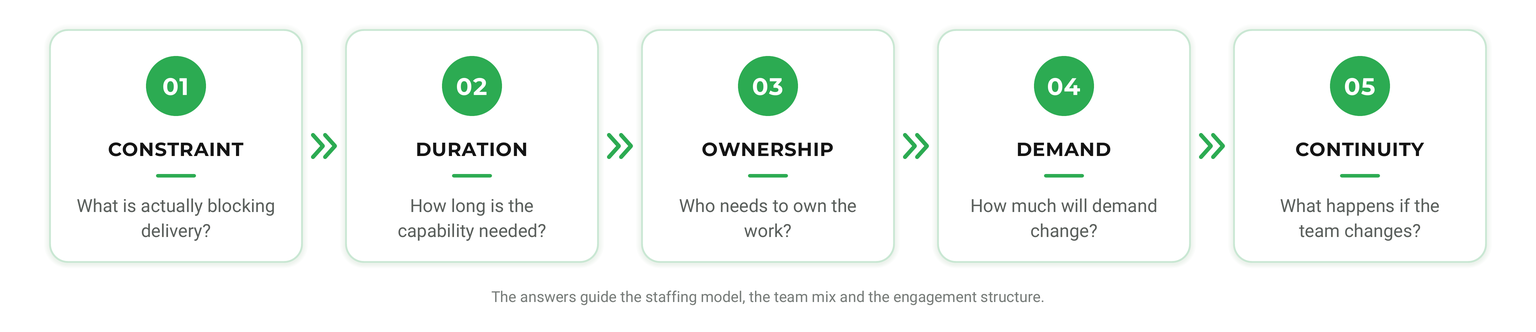
The answers decide the model, the team mix and the engagement structure. Take an illustrative 18-month modernization: product and architecture ownership stays internal, Staff Augmentation covers extra Java and Angular capacity, QA specialists close test-automation gaps, DevOps engineers cover Kubernetes and AWS, and QA and DevOps capacity flex by release phase. Headcount planning works best when each need gets its own answer, and WalkingTree’s engineering staffing services are designed to support that blend of models.
| What Software Development Team Augmentation Really Costs Beyond the Rate Card
The cost of staffing is not only the cost of the people; it is the cost of making their contribution productive, and that rarely shows in a rate comparison. With software development team augmentation, a lower hourly rate can hide onboarding overhead, management and review load, rework from skill mismatches, knowledge loss when people change, and idle capacity when work is not ready. WalkingTree’s pre-evaluated talent and accelerated onboarding are aimed at skill-mismatch rework and onboarding overhead, and its structured handovers at knowledge loss. Software development team augmentation can still be the right choice, but compare total engagement cost, not the rate per resource.
| Scale Development Capacity Without Losing Continuity
Flexibility should not cost continuity. If every adjustment in development capacity removes product knowledge, flexibility creates more delivery risk than it removes.
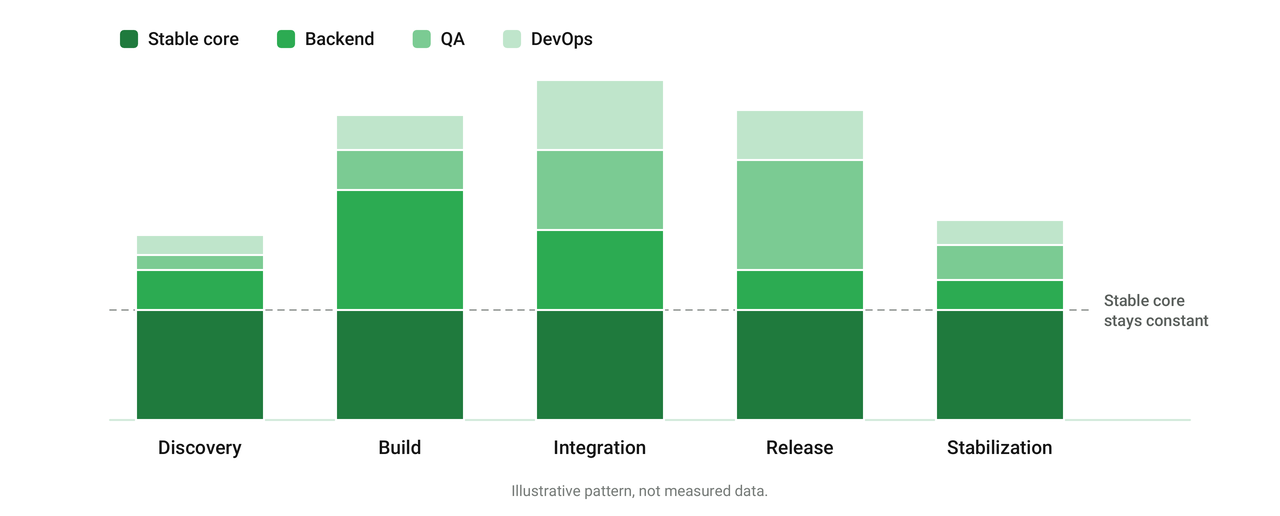
Separate stable ownership from flexible capacity. A stable core keeps product knowledge, architecture and technical leadership; flexible capacity adds developers, QA, DevOps or specialist skills as phases change, so development capacity can follow demand. Team Topologies supports the idea with stable teams, clear responsibilities and deliberate interaction patterns, though not every project needs a formal structure. WalkingTree’s BOT model applies it directly: it builds and operates a team, then transfers it after the agreed period, so ownership of the core can pass to the client. A dedicated development team or an ODC plays a similar role in longer engagements, with technical learning shared inside the centre. Capability can be built, bought or borrowed, so plan development capacity around the full lifecycle of a capability, not the immediate vacancy.
| Measure Technical Staffing by Delivery Outcomes, Not Activity
Staffing measures and delivery measures answer different questions. Staffing measures show how fast capability arrives: time to fill, time to mobilize and time to first meaningful contribution. Technical staffing quality shows up in skills-gap closure and how quickly work becomes independent. DORA’s five software delivery metrics show whether delivery is improving: change lead time, deployment frequency, failed deployment recovery time, change fail rate and deployment rework rate. Use them as team indicators, not as a scorecard for one provider, because staffing is only one factor alongside priorities, architecture and tooling. WalkingTree’s extended teams work through agile workflows with transparent sprint planning and reporting tools, which supports tracking these measures. Avoid lines of code, commits, tickets closed or hours logged as standalone measures, since they show activity, not delivery.
| Where WalkingTree’s Engineering Staffing Services Fit in the Decision
WalkingTree delivers engineering staffing services as Extended Team Services, with four models: Staff Augmentation for specific skills or capacity, Build, Operate and Transfer (BOT) for teams that transition to the client, an Offshore Development Centre (ODC) for sustained delivery, and a Fractional CAIO for on-demand technical and AI leadership.
Its experts are pre-evaluated technical and domain specialists, and the work spans applications, SaaS, AI, GenAI, platform development and simulation, including backend (Java, Spring Boot, .NET, Python), frontend (Angular, React), quality engineering (Selenium, API testing, automation frameworks) and cloud and DevOps (AWS, Azure, Kubernetes, Docker, Jenkins, CI/CD).
WalkingTree’s published success stories include supplying Node.js developers to strengthen a client’s backend, hiring across multiple technology domains for a BFSI client, and staffing a utility client’s mission-critical project against stringent deadlines. Engagements run inside the client’s workflows with agile tooling, shared documentation and structured handovers. The aim is a model that fits the duration and scope of the work and adjusts development capacity as the roadmap changes. WalkingTree does not promise fixed timelines or zero delivery risk; the right engineering staffing services can reduce specific risks for specific work.
| Choose Engineering Staffing Services Around the Delivery Challenge
The right staffing decision is not the one that gives a team the most people. It is the one that supplies the capability the team needs, when it needs it, without compromising continuity. Identify the constraint, choose the model for the work and measure what the decision changes.
Planning to expand your engineering team? Explore WalkingTree’s Extended Team Services and build capacity around your delivery priorities.