


Blogs
How WalkingTree Built Smart Recruit for AI Recruiting with Claude

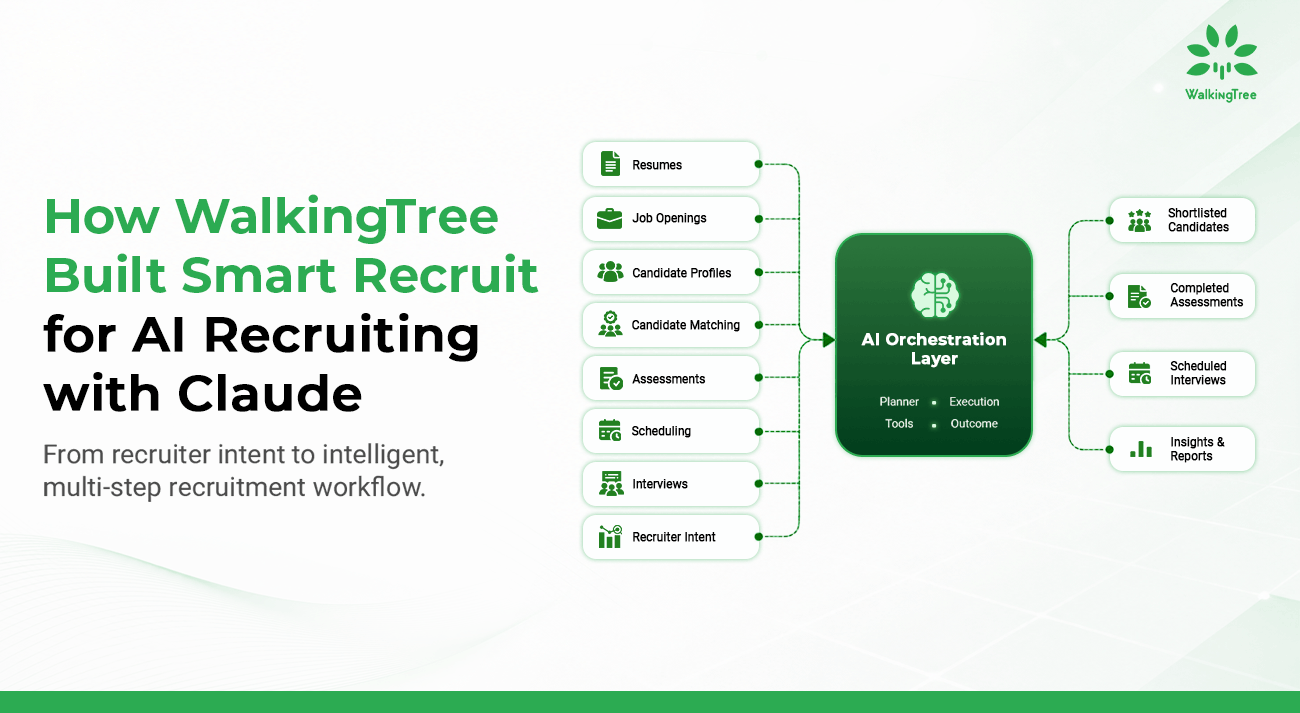
A recruiter may start the day by screening resumes, comparing candidates, reviewing assessments, coordinating interview panels, and following up with candidates. By the end of the day, much of that work can still be operational rather than strategic.
The challenge is not simply the volume of candidates. It is the number of disconnected decisions and actions required to move each candidate through the hiring process.
WalkingTree built Smart Recruit, an AI-powered recruitment platform designed to automate repetitive recruitment activities, support structured candidate evaluation, and help recruiters make faster, more informed decisions. At the core of these workflows, Claude acts as an intelligence and reasoning layer across the recruitment lifecycle.
Rather than using Claude only as a conversational chatbot, WalkingTree integrated it directly into application workflows where its output supports downstream recruitment operations.
| How AI Recruiting Fits Into the Recruitment Workflow
Smart Recruit applies Claude across multiple stages of recruitment, including:
- Natural-language recruitment workflow orchestration
- Resume and document understanding
- Job opening generation
- Candidate-to-job matching
- Semantic candidate discovery
- Assessment question generation and evaluation
- Interview transcript analysis
- AI-led interview evaluation
This approach connects AI recruiting capabilities with the recruitment processes that recruiters already use, allowing intelligence to support both individual tasks and multi-step workflows.
| Co-Pilot: From Natural-Language Intent to Recruitment Action
One of the central capabilities WalkingTree built into Smart Recruit is Co-Pilot, which allows recruiters to interact with the platform using natural-language commands.
Instead of navigating through multiple screens and manually performing individual operations, recruiters can describe the outcome they want to achieve.
For example, a recruiter can request that the system identify suitable candidates and arrange interviews with candidates who meet a defined requirement.
Co-Pilot uses a Planner → Executioner → MCP Tools architecture to turn that request into action.
This approach reflects a broader shift from conversational AI toward agentic systems. Anthropic describes AI agents as systems that can direct their own processes and tool use to accomplish a task, rather than simply following a fixed script. Smart Recruit applies this principle to recruitment: Claude interprets recruiter intent, plans the required sequence of actions, and works with application tools to move the workflow forward.
Planning the Right Sequence
Claude interprets the recruiter’s request and determines the sequence of actions required to accomplish it.
The Planner identifies the appropriate tools and the parameters needed for each operation. This means the recruiter can define the desired outcome without manually executing every step.
Executing Through Controlled Tools
The generated plan is passed to an Executioner that performs the planned operations.
Smart Recruit exposes recruitment capabilities through MCP-based tools, providing controlled access to application APIs and business operations such as candidate retrieval, candidate processing, recruitment workflows, and interview scheduling.
Claude determines which tools are relevant and helps construct the parameters required to execute the operation.
The actual business operation remains within Smart Recruit’s application services. Claude provides the reasoning and orchestration layer around those operations.
| Keeping Multi-Step Workflows Context-Aware
Recruitment workflows do not always have all the information they need at the beginning.
If Co-Pilot cannot proceed because information is missing, it asks the recruiter for the required details. When the recruiter responds, the previous conversation context is provided back to Claude.
The Planner can then determine the remaining steps and continue the workflow from where it stopped.
This enables multi-turn, context-aware recruitment workflows rather than isolated AI interactions.
| No Recruiter Hire: Coordinating Candidate Selection
WalkingTree extended Co-Pilot with an automation workflow called No Recruiter Hire.
The workflow allows recruiters to initiate a candidate-selection process using a natural-language command.
Smart Recruit can retrieve shortlisted candidates, process their profiles, compare them against configured requirements, and identify candidates that meet the required matching threshold.
The workflow can then initiate candidate communication and, based on candidate acknowledgement, proceed toward interview scheduling.
Claude supports the reasoning and orchestration required across these steps, while MCP tools execute the underlying recruitment operations.
The result is a shift from manually performing a sequence of activities to defining the desired outcome and allowing the AI recruiting workflow to coordinate the process.
| Resume Intelligence and Candidate Matching
Resume processing is another major AI-powered workflow within Smart Recruit.
When a recruiter uploads a resume, the document goes through an AI extraction workflow. Claude analyzes the unstructured resume and extracts recruitment information required by the application, including:
- Experience
- Skills
- Education
- Certifications
- Previous roles
- Other relevant candidate attributes
The structured information is then used by downstream recruitment workflows.
Smart Recruit also runs a background matching process after resume processing. Candidate information is compared against available job openings, and Claude helps generate a consolidated candidate-job evaluation and matching score.
This allows recruiters to identify potentially relevant candidates earlier instead of manually reviewing every resume against every available position.
Smart Recruit also uses AI to generate structured job-opening information from minimal recruiter input, reducing the effort required to create and configure new openings.
| Finding Relevant Candidates Beyond Keywords
As part of Smart Recruit, WalkingTree also implemented AI-powered semantic candidate search.
Processed resume information is converted into embeddings and stored in Qdrant. These embeddings enable Smart Recruit to retrieve candidates based on semantic relevance rather than relying solely on exact keyword matches.
This becomes particularly useful when a candidate has relevant experience but uses terminology that differs from the terminology in a job description.
The combination of Claude-based resume understanding and vector-based retrieval gives recruiters a more effective way to discover relevant profiles from a large candidate database.
| AI-Powered Assessments and Structured Evaluation
After creating a job opening, recruiters can configure assessments for candidates.
Recruiters can manually provide assessment topics or use AI to generate relevant topics and questions.
Claude supports question generation based on configured requirements. Once candidates complete an assessment, their responses are sent through the AI evaluation workflow.
Claude analyzes the questions and candidate answers and produces a consolidated evaluation report, giving recruiters a structured view of candidate performance.
This reduces the manual effort involved in reviewing large numbers of assessment responses and provides a more consistent evaluation structure.
| Aspira: AI-Powered Conversational Interviews
WalkingTree also implemented Aspira, an AI-powered conversational interview capability combining AI, voice, video, and WebRTC.
An AI interview bot participates in the interview, presents questions to candidates, captures their responses, and records the interaction.
The resulting interview transcription is then processed by Claude to generate a structured evaluation report.
The workflow enables:
- AI-led interview interaction
- Voice and video-based candidate participation
- Automated response recording
- Interview transcription
- AI-powered transcript analysis
- Consolidated candidate evaluation
This allows organizations to automate portions of first-level candidate evaluation while giving recruiters structured information to support their final decisions.
| Why Claude Fits the Architecture
The AI recruiting use cases within Smart Recruit require more than simple text generation.
Recruitment information is highly unstructured and can be extensive. Resumes may contain several pages of information, while interview transcripts and assessment responses can create similarly large contextual inputs.
Claude’s ability to process long and unstructured content is valuable for resume understanding and interview analysis.
The implementation also requires consistent structured outputs because AI-generated information is consumed by downstream application services. Claude transforms resumes, candidate responses, and interview transcripts into structured recruitment information.
Its contextual reasoning capabilities are particularly important in Co-Pilot, where the model must understand the current recruiter request, previous conversation context, available MCP tools, and the required sequence of actions.
This combination of long-context understanding, structured output, contextual reasoning, and tool-oriented orchestration makes Claude a strong fit for Smart Recruit’s architecture.
| From AI Capabilities to Recruitment Impact
By embedding Claude directly into recruitment workflows, Smart Recruit demonstrates how AI recruiting can address multiple sources of manual effort across candidate screening, assessment evaluation, interview analysis, and recruitment administration.
The key impact areas include:
- Reduced manual resume screening through AI-powered resume understanding and candidate matching
- Faster candidate discovery through semantic search and AI-assisted matching
- Improved recruiter productivity through natural-language workflow orchestration
- More consistent candidate evaluation across assessments and interviews
- Reduced manual interview evaluation effort through automated transcription analysis and reporting
- Faster job-opening creation by generating structured information from minimal recruiter input
- Automated recruitment workflows that can execute multiple application operations from a single recruiter command
Alongside these AI capabilities, Smart Recruit also provides conventional recruitment workflow functionality such as panel scheduling, automated feedback collection, notifications, and recruitment dashboards.
| Building AI Recruiting Systems That Can Act
Smart Recruit demonstrates a practical approach to enterprise AI: Claude is not positioned as a standalone assistant. It is integrated into the application as an intelligence and reasoning layer.
Claude supports document understanding, candidate matching, workflow planning, MCP tool orchestration, assessment generation, assessment evaluation, and interview transcript analysis.
The result is an AI-assisted recruitment platform where recruiters can delegate repetitive and multi-step activities to intelligent workflows while retaining control over important hiring decisions.
WalkingTree’s approach shows how AI can be connected to real business operations, combining unstructured data understanding, long-context reasoning, structured evaluation, conversational workflows, and multi-step process orchestration within a single recruitment platform.
Have a recruitment workflow you want to make more intelligent? Talk to our Experts to discuss your use case.
2 thoughts on “How WalkingTree Built Smart Recruit for AI Recruiting with Claude”