Blogs
ERP for Small Business: Why Business Central Matters

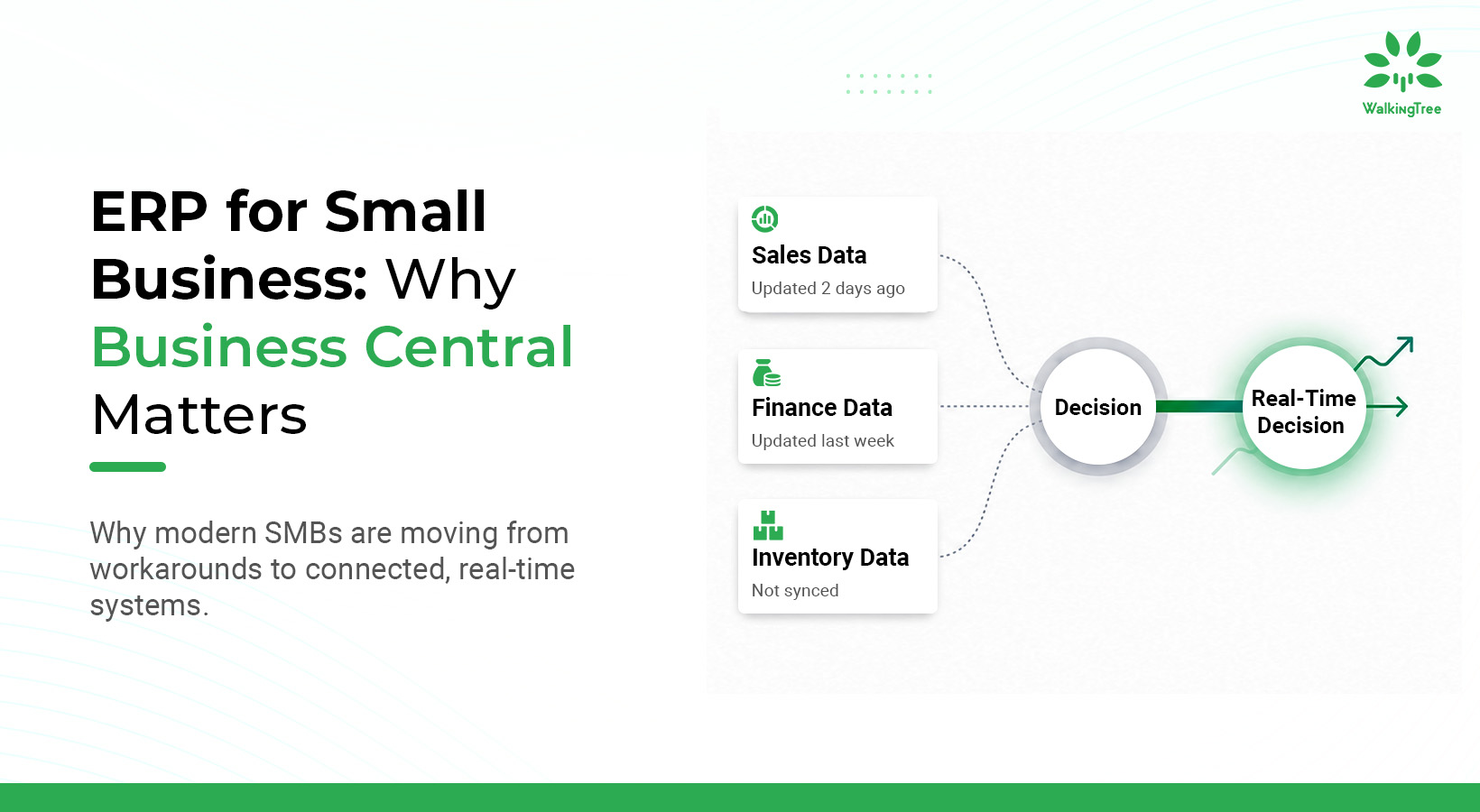
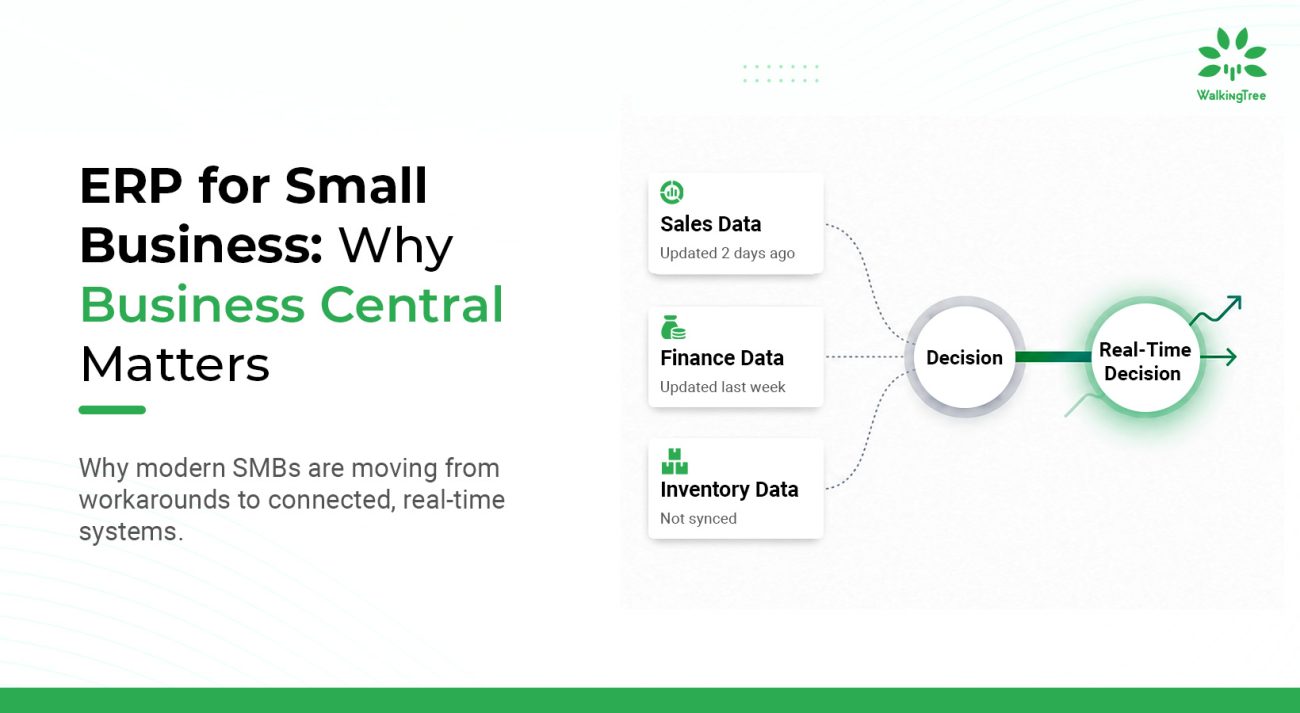
Small and medium-sized businesses today are caught between two realities. On one side, there is the pressure: macroeconomic uncertainty, talent shortages, rising customer expectations, and an AI wave that rewards only those who were already ready for it. On the other hand, there is an opportunity most SMBs have not fully grasped: the same technology that enterprise giants use to pull ahead is now purpose-built as an ERP for small business, delivered through the cloud, without enterprise complexity.
The question is no longer whether to modernize. It is whether you understand what waiting is actually costing you.
Patchwork tools made sense when ERP for small business alternatives were expensive and complex. That calculus has changed. The cost of staying fragmented now exceeds the cost of getting connected. And yet most SMBs keep adding tools instead of replacing the ones that no longer serve them.
At WalkingTree Technologies, we have sat across from enough SMB leadership teams to recognize the pattern. The businesses that fall behind do not make one catastrophic decision. They make dozens of small ones, spread over years, each one justified at the time. Another spreadsheet. Another workaround. Another tool bolted onto a system that was already stretched.
By the time the cost becomes visible, it is embedded in the culture.
| The Hidden Friction Slowing SMB Growth
Most SMBs do not fail dramatically. They bleed slowly.
It shows up in ways that feel normal. Until you add them up.
- Your finance lead spends Monday morning re-entering numbers that already exist in another system
- A customer asks for an order update and your sales rep checks three places before answering
- Month-end close takes two weeks because reconciliation is still manual
- A pricing call gets made on last quarter’s data because this quarter’s numbers are not ready yet
- A new hire takes three months to become productive because the system requires tribal knowledge to navigate
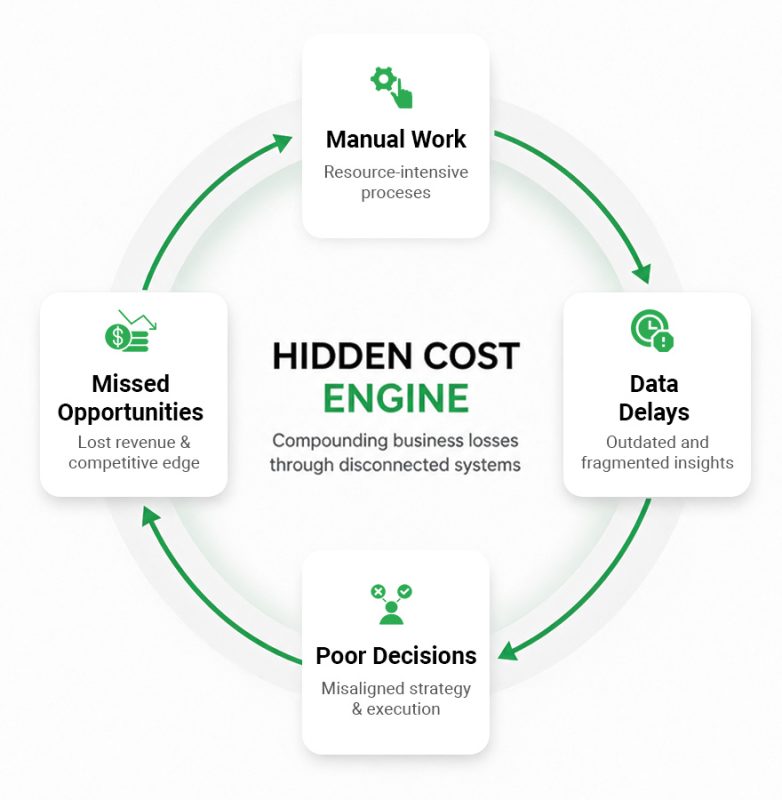
None of these feel like emergencies. Together, they compound into something that quietly limits how fast your business can move.
According to Salesforce’s Small and Medium Business Trends Report, more than half of SMB leaders report inconsistencies in data across their business tools, directly slowing decision-making and creating operational friction. The systems exist. The data exists. It just cannot find its way to the people who need it, at the moment they need it.
But here is what most SMBs underestimate: this is not just a productivity problem. It is a decision-making problem. Fragmented data means leadership is always operating on a slight delay. By the time the full picture arrives, the moment to act has already shifted. In a market where decision speed now separates leaders from laggards, that delay compounds into something far more expensive than the cost of fixing it.
| What Disconnected Systems Actually Cost an SMB
Disconnected ERP for small business setups cost an SMB in three compounding ways. First, time: staff compensate for integration gaps through manual workarounds, duplicate data entry, and spreadsheet reconciliation that quietly consume weeks of productive capacity per person every year. Second, decision quality: when sales data lives separately from inventory and finance, leadership is always working from a partial picture, making calls on information that is already out of date by the time it arrives. Third, and most consequentially, AI exclusion: businesses running fragmented, manually maintained data cannot benefit from AI in any meaningful way because there is no clean foundation for intelligence to work on. Each of these costs compounds the others. The longer the fragmentation continues, the wider the gap between where the business is and where it could be.
| Why Most ERP for Small Business Implementations Miss the Point
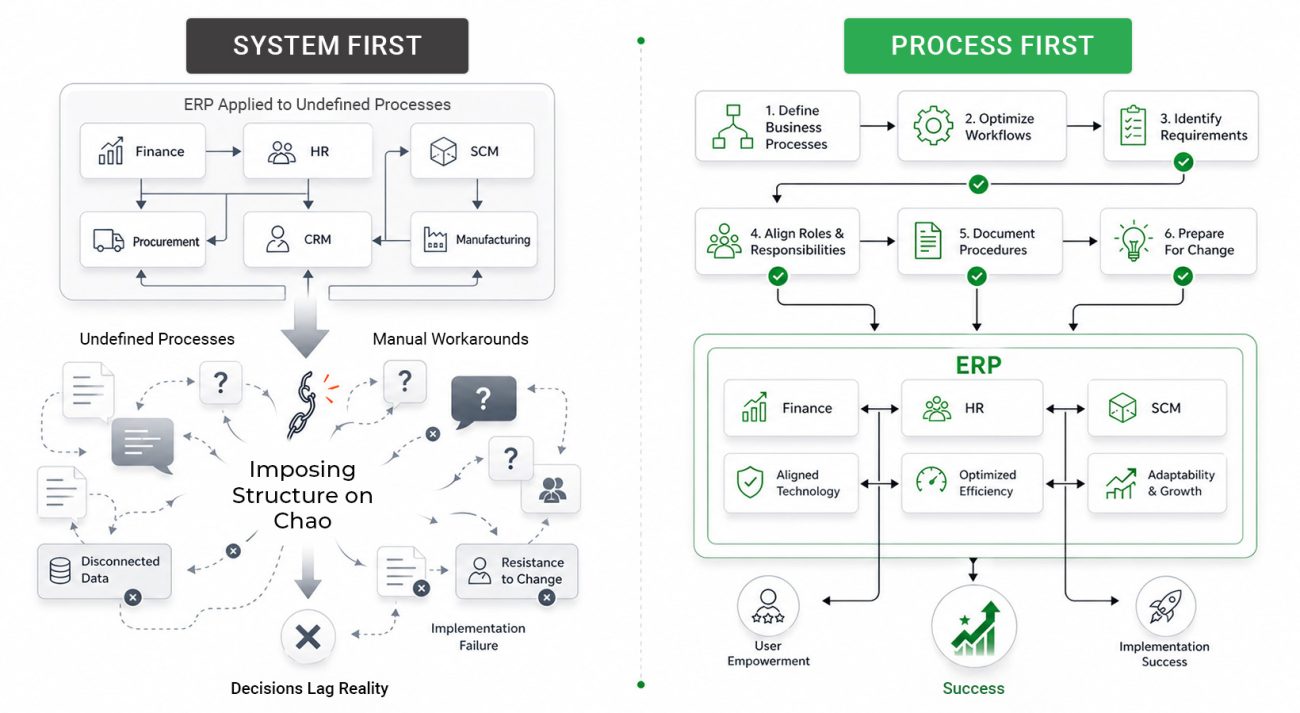
Here is the uncomfortable truth most Microsoft partners will not say out loud: most SMBs do not fail at choosing the right ERP for small business. They fail at defining their processes before implementation even begins.
They come in expecting the software to fix the process. It will not. If your approval workflows are broken, the ERP will automate broken approvals. If your data is inconsistent, the ERP will give you a very fast, very clean view of inconsistent data.
What changes outcomes is the thinking that happens before go-live. Which processes are you standardizing? Where do handoffs break down? What does a successful month-end actually look like for your specific team?
We have seen Microsoft Dynamics 365 Business Central deliver transformational results. We have also seen businesses spend their first year fighting their own configuration. The platform is the same. The preparation is different.
| What AI Readiness Actually Requires
There is another gap that rarely gets discussed: most SMBs believe they are AI-ready when they are not.
AI readiness is not about having a Copilot license or enabling a chatbot. It is about the quality and connectivity of the data underneath. You cannot layer intelligence onto fragmented, manually maintained data and expect clarity. The AI will surface confusion faster, not insight.
This is one of the most underestimated arguments for getting your core ERP for small business right first. Business Central gives Copilot something real to work with: clean, connected, real-time data across finance, operations, sales, and supply chain. That is when AI stops being a demo feature and starts being a daily operational advantage.
The businesses getting outsized value from AI right now are not the ones who jumped on the latest tool. They are the ones who built a clean foundation first.
| What the Right ERP for Small Business Actually Unlocks
Most ERP tools claim broad coverage. What matters is whether that coverage actually connects, and whether it changes how decisions get made.
A real estate company managing a diverse portfolio of residential and commercial properties across the UAE had reached a point where their existing Business Central environment was holding them back rather than moving them forward. Reporting gaps meant finance teams were working without the visibility they needed. Collections management was constrained by a module that could no longer be enhanced. Power BI dashboards were absent, so leadership had no real-time view into receivables or operational performance. After a structured reassessment and re-implementation of their Business Central environment, including enhanced cheque lifecycle tracking, rebuilt RDLC reports, and live Power BI dashboards connected directly to their ERP data, the business saw faster reporting cycles, improved collections management, and a measurable increase in team productivity. The system went from being a source of friction to the foundation their growth decisions now run on.
That shift only happens when the system is implemented to fix how the business runs, not just to replace the tools it already uses.
Across SMBs, the pattern is consistent. When systems are connected, decisions stop waiting. Reporting moves from retrospective to real-time. Teams spend less time maintaining data and more time acting on it. What changes is not just efficiency, but how quickly the business can respond when something shifts.
| End-to-End Coverage Without the Gaps
Most ERP for small business systems do not fail at features. They fail at connection.
Finance tracks numbers. Sales tracks deals. Operations tracks inventory. Each system works, but the business does not see itself as a whole.
When finance, sales, supply chain, and operations operate on the same system, the business stops reconciling information and starts acting on it. A sales decision reflects real inventory. A financial forecast reflects actual pipeline movement. A delay in operations shows up before it becomes a customer issue.
What changes is not visibility alone. It is timing. The business sees what is happening while there is still time to do something about it.
| Copilot: What AI in an ERP Actually Looks Like in Practice
Most AI in business software still lives at the edges. You export data, run an analysis, and bring the insight back into your workflow.
The difference here is where that interaction happens. Instead of stepping out of your system to get answers, the system itself becomes responsive. You ask questions, reconcile accounts, or generate outputs in the same place where the work is already happening.
Analyze: Ask a plain-language question and get a structured answer. Summaries, pivots, totals, and filters are generated without formulas or queries, and without needing someone technical in the room.
Chat: An intelligent assistant built into the system. Ask it to find records, explain a process, or walk through a configuration. It responds with context-aware answers, not generic documentation links.
Reconcile: Bank reconciliation handled automatically. Copilot matches statement lines to ledger entries, including complex cases where multiple charges consolidate into a single bank transaction. What used to take half a day now takes minutes.
Suggest and Guide: Product descriptions drafted from attributes already in your system. New users navigate the platform faster with guided assistance. Onboarding time drops, along with the support burden on experienced staff.
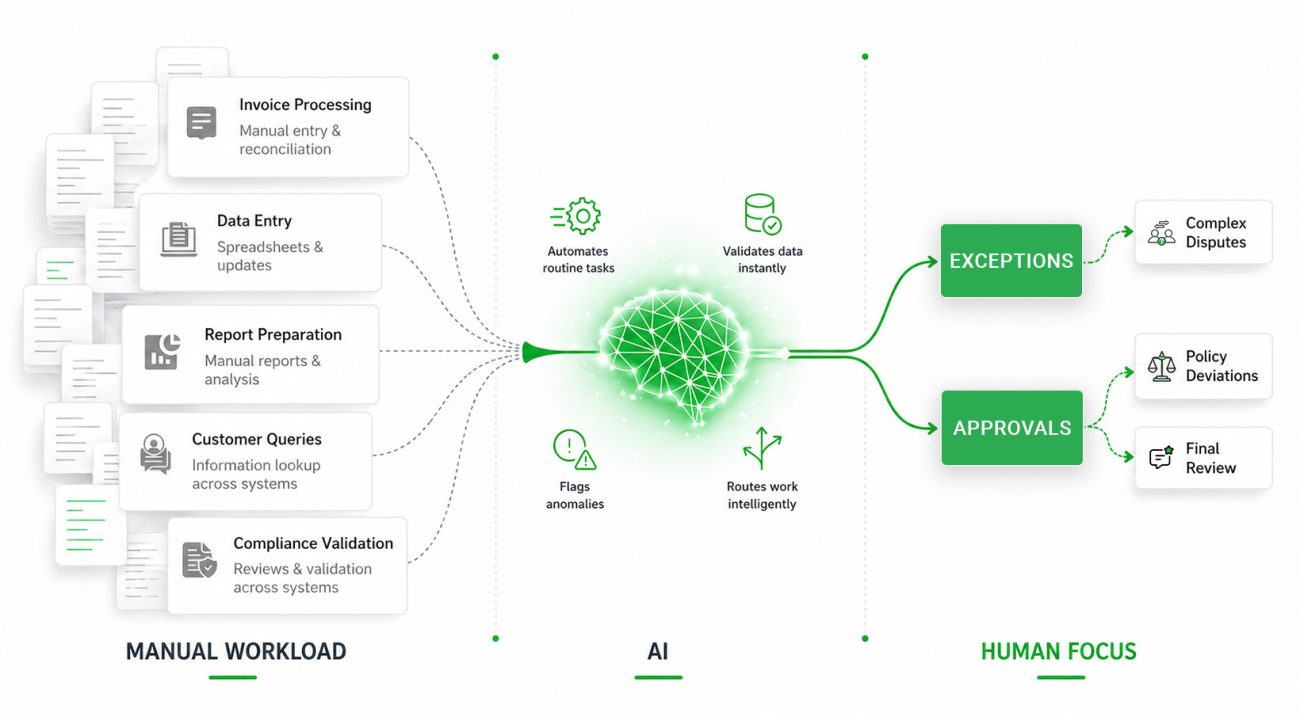
Beyond Copilot, Microsoft is building autonomous agents that act without waiting for a prompt. A Sales Order Agent that interprets requests and sends quotes automatically. A Payables Agent that processes vendor invoices according to your approval policies. Custom agents built in Copilot Studio or Azure AI Foundry, designed around your specific workflows, no coding required. For teams already stretched, the agents handle the queue. Your people handle the exceptions.
| The Trust Foundation Underneath It All
Every serious AI conversation eventually arrives at the same question: what happens to our data?
Microsoft’s answer rests on three commitments. Your data is yours: you own it, control it, and decide how it is used. It is never used to train AI models for other customers without your explicit permission. And the infrastructure underneath Business Central is the same Azure stack that banks, governments, and healthcare systems globally run on, built to meet some of the most demanding compliance and security requirements in any industry.
For businesses in financial services, healthcare, or government contracting, these are not reassuring marketing points. They are non-negotiable prerequisites. Business Central meets them.
| The Advantage Has Already Shifted
The businesses pulling ahead right now are not the ones with the largest teams or the biggest budgets. They are the ones who recognized that competitive advantage is no longer about having more resources. It is about building systems that multiply the ones you already have.
The cost of staying fragmented now exceeds the cost of getting connected. Without the right ERP for small business, disconnected systems do not just slow you down today. They limit the ceiling of what your business can become.
Every quarter spent managing workarounds is a quarter not spent on the decisions, the customers, and the opportunities that actually determine where you end up.
The next step is not adding another tool. It is finding the right ERP for small business that connects everything. WalkingTree can help you do that with clarity.