


Blogs
AI for Equity Research: How Investment Teams Are Automating Research Workflows

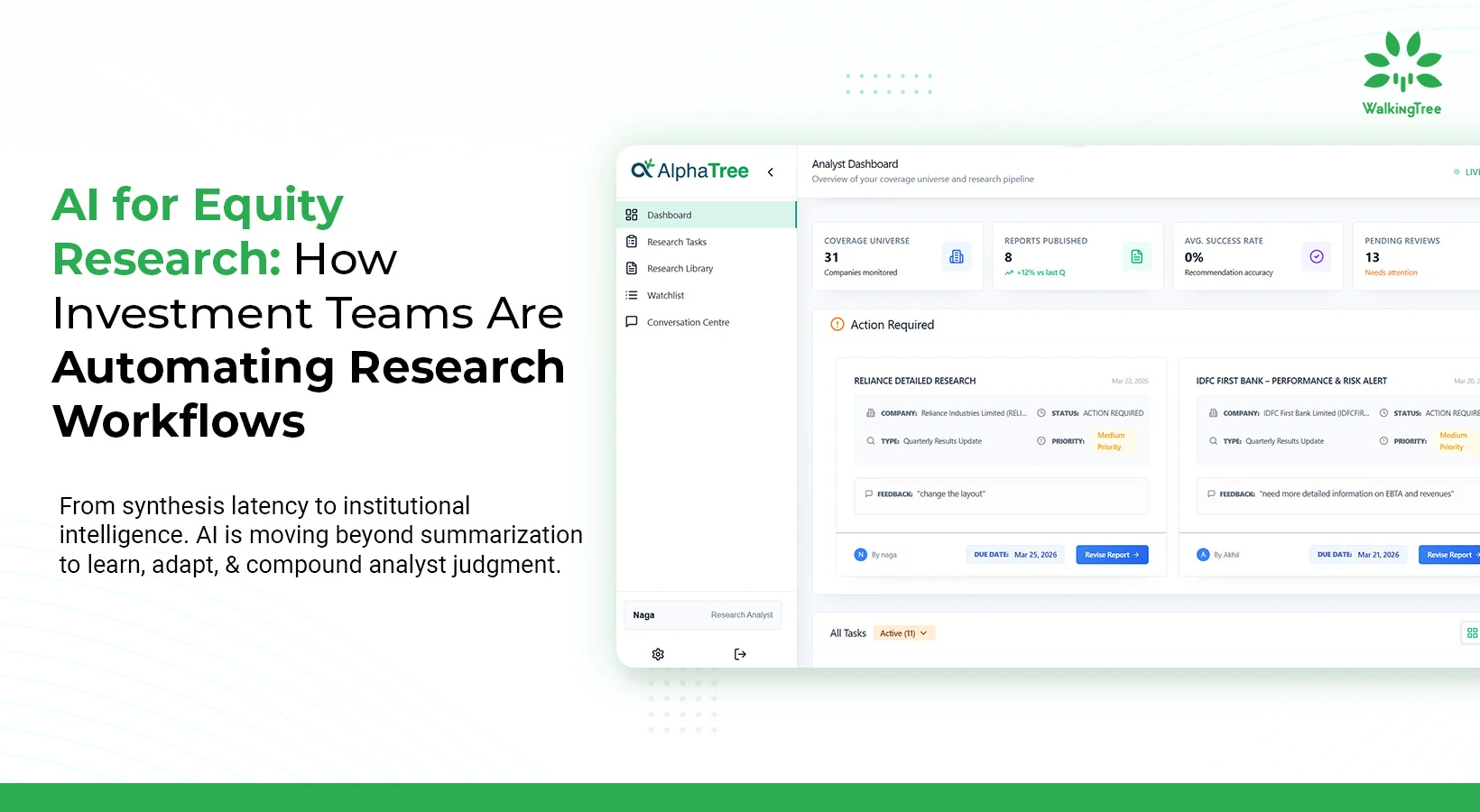
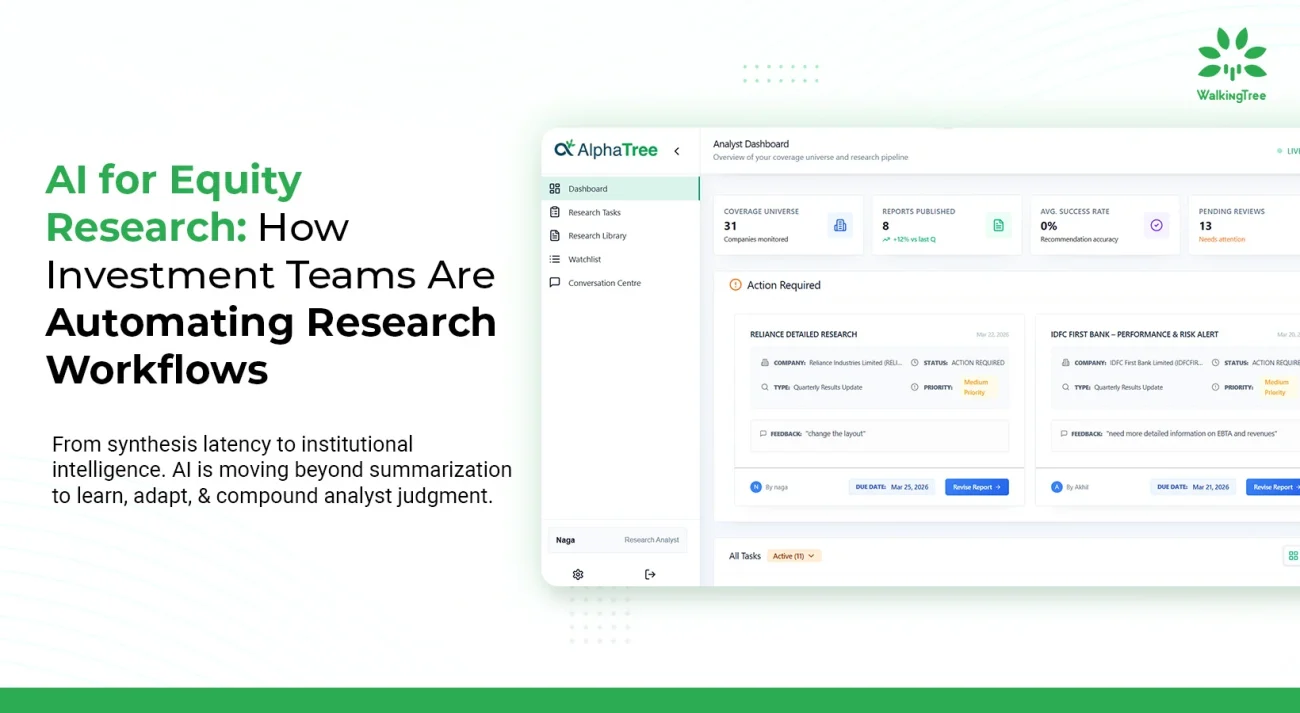
There is a moment every research analyst knows well. It is late in the evening, several earnings transcripts remain unread, the morning investment call is only hours away, and the portfolio manager is waiting for conclusions. The data exists, but the synthesis does not. By the time the analysis is complete, the opportunity may already be gone.
Many AI tools today can research, synthesize, and even reason across documents. The gap is not intelligence. It is context. General purpose AI tools do not know your firm’s investment philosophy, your analyst’s coverage mandate, or how your PM weighs risk against return. They produce capable answers for anyone. AlphaTree is built to produce the right answer for your team, shaped by how your people actually think and decide.
AlphaTree is built on a different premise: that the most valuable signal in any research workflow is the judgment your analysts already carry, and that a platform should capture, reflect, and compound that judgment rather than override it with generic output. It starts where other tools stop, building institutional intelligence that gets sharper with every human review.
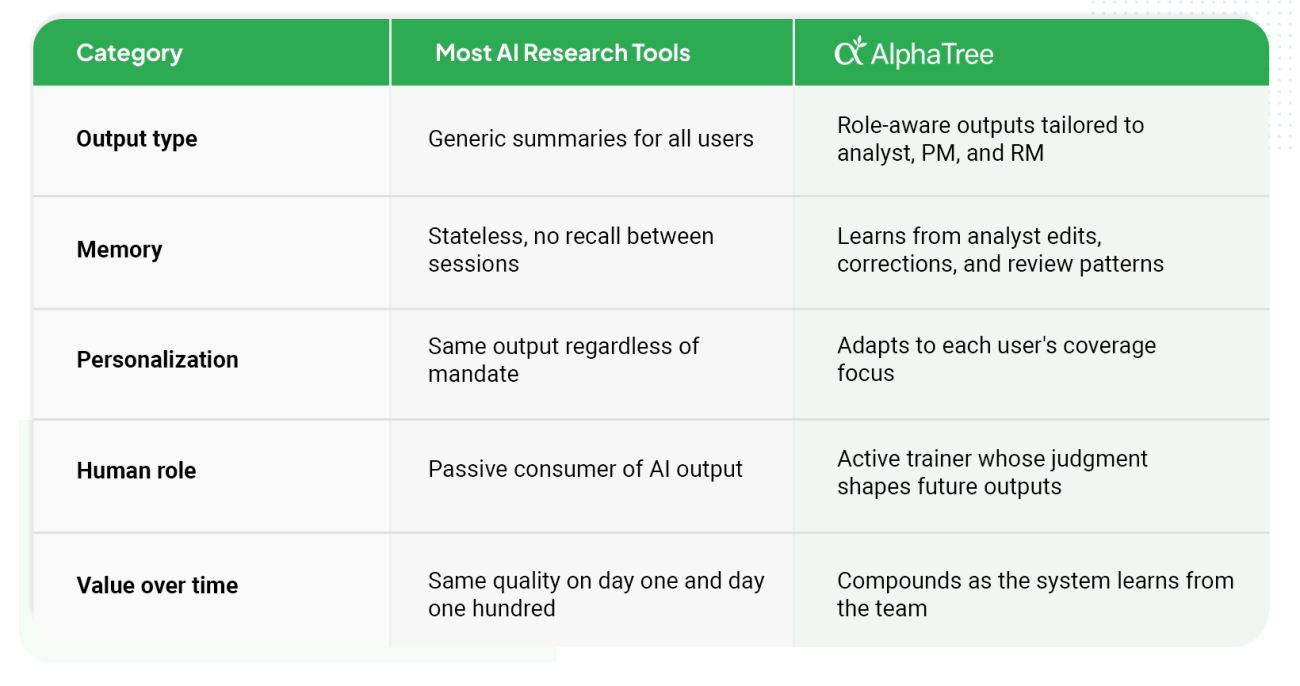
AI without human feedback produces generic output. Human analysts without AI cannot keep pace. AlphaTree is built on the belief that neither works alone and that the real advantage comes from designing a system where each makes the other sharper.
| The Real Constraint in Equity Research Is Synthesis Latency
Most institutional desks already have the data. Bloomberg, FactSet, and other providers ensure that. The real constraint is the workflow itself.
Before analysts can form an investment view, they must:
- Read long financial documents
- Extract key metrics and operational updates
- Compare current results with previous guidance
- Identify tone changes in earnings calls
- Summarize insights for internal decision makers
Most AI tools have made meaningful progress on raw document processing. The harder problem is what comes next. Insights that are not personalized to the reader’s role, not connected to the firm’s proprietary knowledge, and not retained between sessions do not compound into better decisions. They simply pile up.
In financial markets where significant price movement occurs shortly after earnings releases, even a few hours can determine whether an opportunity is captured or missed.
Compounding this is the fact that the data itself is rarely in one place. Proprietary research notes, house models, and internal analysis live across email threads, shared drives, and personal folders with no single knowledge source connecting them. Analysts are not just slow to synthesize. They are working from a fragmented foundation.
| The Architecture Behind AI for Equity Research
A production grade AI investment research platform is not simply a summarization tool. It operates through a structured architecture designed to process large volumes of financial information.
Most enterprise systems built for AI for equity research follow three core stages:
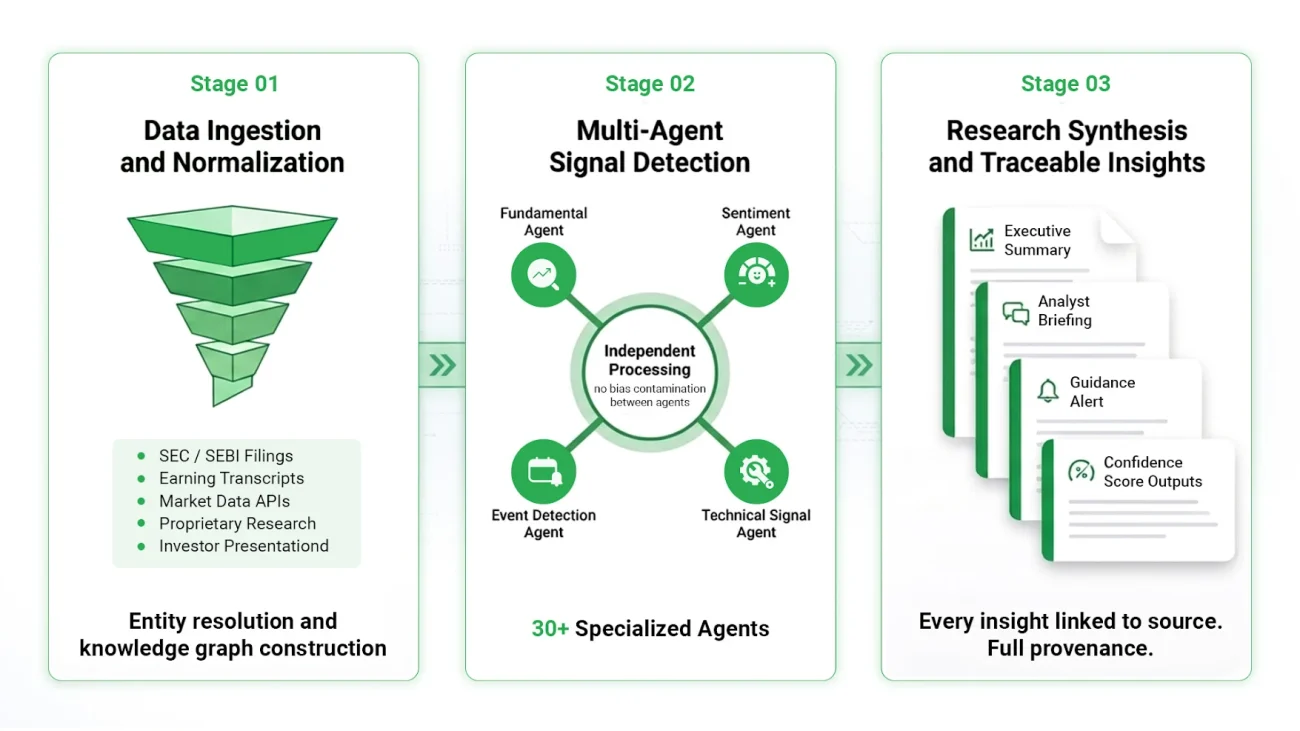
Stage 1: Data Ingestion and Normalization
The first layer of AI for equity research focuses on gathering and structuring financial information from multiple data sources.
Typical data sources include:
- SEC or SEBI regulatory filings
- Earnings call transcripts
- Investor presentations
- Sell side research reports
- Proprietary internal research documents
- Market data APIs
Critically, this includes proprietary internal documents – house models, analyst notes, and firm-specific research, ingested securely within the organization’s own environment. Unlike generic AI tools that require data to leave the firm’s infrastructure, AlphaTree is designed to work within enterprise security boundaries, making proprietary knowledge a first-class input rather than a security risk.
At this stage the system performs entity resolution to ensure company names, executives, and financial metrics are interpreted consistently across documents. This type of processing often depends on scalable data engineering pipelines designed to integrate multiple financial data sources.
For example, a company may appear as a ticker symbol in one filing and a shortened brand name in another. The ingestion system resolves these variations so signals can be accurately analyzed.
The result is a structured knowledge graph connecting companies, events, and financial data points.
Stage 2: Multi-Agent Signal Detection
Once data is structured, specialized analytical agents examine different dimensions of financial information. Modern AI for equity research platforms rely on these agents to detect signals across filings, transcripts, and market data.
These agents operate independently to avoid bias contamination across signals.
Fundamental analysis agent
- Extracts financial metrics and operational indicators.
- Calculates year over year and quarter over quarter changes.
- Compare reported results with previous guidance.
Sentiment analysis agent
- Evaluates tone and language used in earnings calls.
- Detects shifts in management confidence or outlook.
Event detection agent
- Identifies regulatory filings, insider transactions, and sector news.
Technical signal agent
- Analyzes price movement, volume anomalies, and correlation breaks.
This multi-agent architecture allows platforms to produce more reliable insights than systems that rely on a single analytical model. This structure mirrors how experienced analysts evaluate investments from multiple perspectives before forming a view.
We explore how agent-based AI is transforming financial services in more detail in our blog on the rise of agentic AI in wealth management. Read the full blog.
Stage 3: Research Synthesis and Traceable Insights
After signals are detected, AI in equity research platforms synthesize them into concise, role-specific research outputs.
Typical outputs include:
- Executive summaries for each company
- Three-point analyst briefings
- Alerts when guidance language changes
- Confidence scores associated with each signal
These outputs are not static. Analysts review, validate, and refine them, creating a feedback loop that allows the system to improve over time and align with the team’s investment approach.
Role-Aware Personalization
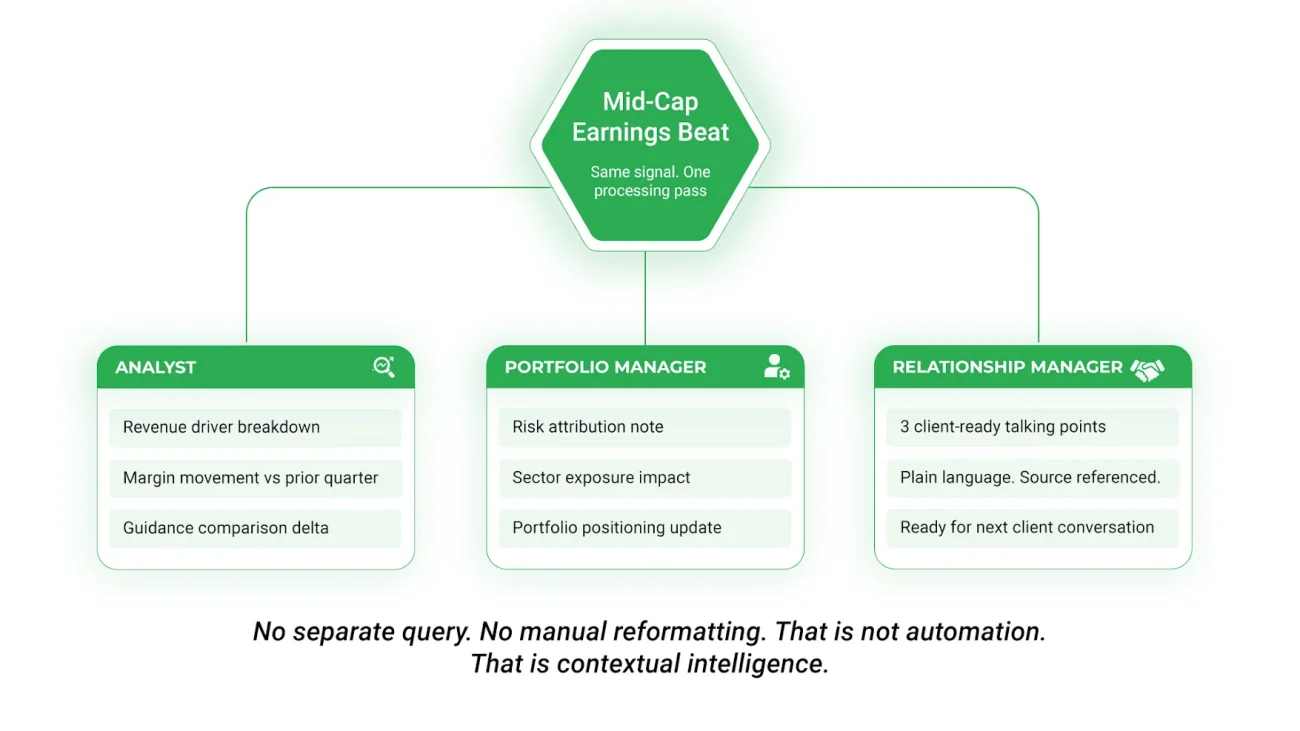
To understand what role-aware personalization looks like in practice, consider a single earnings beat from a mid-cap manufacturing company. For the equity research analyst, AlphaTree surfaces a detailed breakdown of revenue drivers, margin movement, and a comparison against the guidance given in the prior quarter call. For the portfolio manager, the same event triggers a risk attribution note showing how the beat affects sector exposure and overall portfolio positioning. For the relationship manager, it generates three client-ready talking points in plain language, referenced to the earnings release, ready to use in the next client conversation. None of these outputs require a separate query or manual reformatting. The same underlying signal, processed once, delivers what each role actually needs. That is not automation. That is contextual intelligence.
The Adaptive Research Engine
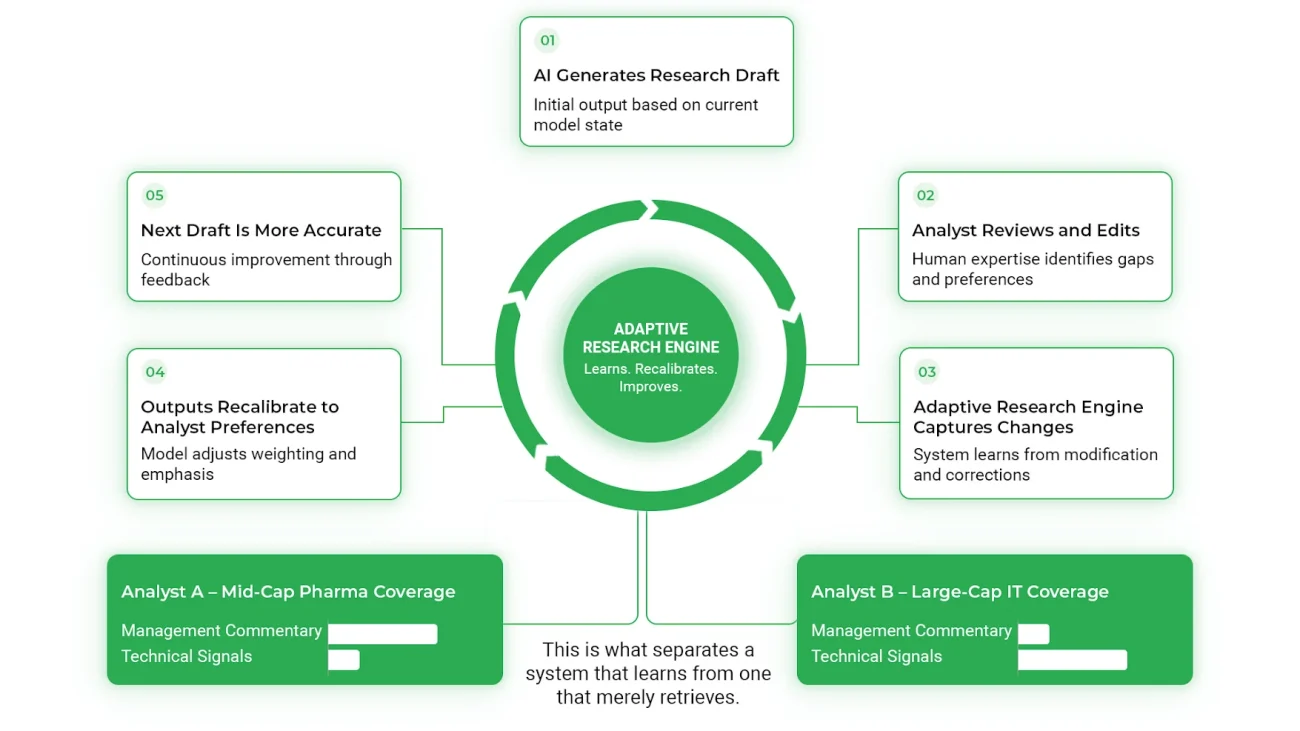
When an analyst edits an AI-generated draft, that edit is not discarded. The Adaptive Research Engine captures what was changed, kept, and removed. If an analyst consistently de-emphasises technical signals and prioritises management commentary, future outputs adjust accordingly. If a portfolio manager repeatedly overrides a sentiment-based signal, the system registers that preference going forward. Over time, two analysts at the same firm covering different mandates will receive materially different outputs from the same underlying data. This is what separates a system that learns from one that merely retrieves.
Provenance and Human Oversight
The most important capability at this stage is provenance. Each insight is linked back to the exact source document and passage that generated it. This enables analysts to verify context, apply judgment, and intervene when needed. For institutional investors operating in regulated environments, this combination of traceability and human oversight is essential for governance and compliance.
| Why Explainability Matters in Institutional Research Platforms
Explainability is often misunderstood as a user interface feature. In reality it is an architectural requirement.
If a system produces insights without exposing intermediate reasoning, analysts cannot validate the results.
Modern investment research platforms, therefore, design explainability directly into the pipeline through the following:
- Independent analytical agents
- Visible confidence scores
- Source-level citations
- Transparent query logs
These capabilities align with regulatory expectations in financial markets where auditability and decision traceability are required.
Financial institutions operating in sectors such as wealth management and asset management increasingly adopt AI systems that support transparent analytics and compliance ready data pipelines, similar to the solutions being developed across multiple financial services and industry sectors.
| AI Expands Coverage Across the Investment Desk
The impact of AI for equity research extends beyond individual analysts.
Research insights must reach multiple roles within an investment organization, including:
- Equity research analysts
- Portfolio managers
- Relationship managers
- Institutional investors
Platforms designed for institutional use integrate research outputs across these roles so that insights flow throughout the investment desk. Each of these roles receives outputs shaped to their specific decision context, not a uniform summary distributed across the desk. The equity research analyst receives deep-dive financial models and guidance comparisons. The portfolio manager receives risk attribution and sector exposure notes. The relationship manager receives plain-language client talking points referenced to source documents. The institutional investor receives portfolio-level summaries tied to their holdings. The same underlying data serves every stakeholder, but the output each person receives reflects their mandate, not a one-size-fits-all report.
Organizations implementing automated research infrastructure have reported improvements such as:
- Substantially faster first-draft research preparation
- Meaningful time savings per earnings and company analysis cycle
- Considerably broader company coverage at the initial research stage
- Source-level traceability with citation-backed insights
These improvements allow analysts to focus on interpretation and strategy rather than document processing.
| What CIOs Should Evaluate in an AI Investment Research Platform
When evaluating AI investment research platforms, focus on architecture over interface features.
Key evaluation areas include the following:
Data ingestion fidelity
Can the system process complex filings, research reports, and internally generated documents?
Agent independence
Do analytical models operate independently before combining signals?
Citation and provenance depth
Does every insight link back to the specific passage that generated it?
Deployment flexibility
Can the system operate through SaaS, private cloud, or on-premises deployment models?
Feedback and learning capability
Does the system incorporate analyst feedback and improve outputs over time?
Platforms that meet these criteria are better suited for institutional investment workflows.
| AlphaTree and the Evolution of Automated Investment Research
AlphaTree supports end-to-end investment research workflows within a single environment designed for analysts and portfolio managers.
Instead of focusing only on summarization, AlphaTree bridges the gap between AI speed and human judgment through:
- Role-aware output personalization across analyst, PM, and RM workflows
- Feedback-driven learning that improves outputs with every analyst interaction
- Human-in-the-loop validation with full source provenance
- Multi-agent signal detection across fundamentals, sentiment, and technicals
AlphaTree is not a one-size-fits-all deployment. The platform is configured to match your organization’s existing workflows, coverage universe, and data sources. Whether your team runs on Azure, requires on-premises deployment, or needs integration with existing terminals and CRM systems, AlphaTree adapts to how your organization works rather than asking your organization to adapt to it.
This approach allows research teams to automate mechanical research tasks while maintaining transparency and analyst oversight.
| The Infrastructure Shift in Equity Research
Financial information volumes continue to grow each year. Manual document analysis alone cannot keep pace with the speed of modern markets.
Investment firms that adopt automated research platforms gain advantages in three critical areas:
- Faster synthesis of financial information
- Broader company coverage per analyst
- Traceable insights that support governance and compliance
These advantages compound over time as more data flows through automated systems.
| See AlphaTree in Action
The shift toward AI in equity research is ultimately an infrastructure decision. The advantage is not just faster access to insights, but the ability to build systems that learn from analysts, adapt to investment context, and improve decision quality over time. Most AI tools give every analyst the same answer. AlphaTree gives each analyst a better answer every time, because it is built on the understanding that institutional intelligence compounds when human judgment and AI capability reinforce each other. The platform does not just process financial data. It learns how your team thinks.
AlphaTree was built specifically for this environment. The platform combines financial document ingestion, multi-agent signal detection, and explainable research synthesis in a single system designed for analysts, portfolio managers, and investment teams.
If you want to see how automated research infrastructure works in practice,
Schedule a walkthrough of the platform-
Request a demo: https://walkingtree.tech/contact-us/
