


Blogs
Software Supply Chain Security: Managing Third-Party Dependency Risks

Imagine an enterprise development team preparing a new application release. The code has passed testing, the latest features are working, and the deployment pipeline is ready. A routine security advisory then identifies a vulnerability in one of the open-source libraries used by the application. The team now needs to determine whether the affected version is present, which services depend on it, and whether the release needs to be delayed.
The challenge is that the vulnerable component may not even be one the team deliberately installed. It could be a transitive dependency several layers below the application’s own code.
This is where software supply chain security becomes critical to application development. An application’s security depends not only on the code developers write, but also on the components they adopt, the sources from which those components are obtained, and the processes through which they are built, integrated, and deployed.
The challenge is not to avoid third-party software. Modern development depends on it. The challenge is to make dependencies visible, assess their risks, and manage them throughout the software development lifecycle.
| Why Software Supply Chain Security Extends Beyond Application Code
Modern applications rarely consist entirely of code written in-house. Development teams rely on open-source libraries, frameworks, APIs, container images, build tools, and third-party services to deliver features faster and reduce development effort.
Each component introduces a dependency. Some are selected directly by developers, while others are automatically brought in by frameworks or libraries. These indirect dependencies can become difficult to track, particularly across large applications with multiple services and development teams.
A component may be widely used and still contain a vulnerability. It may also become unsupported, receive a security advisory, or be replaced by a compromised version. If an organisation cannot identify where that component is used, responding to the issue becomes considerably harder.
This makes software supply chain security an engineering responsibility, not simply a final security check. Teams need visibility into the components that make up an application and processes to assess, update, and verify them throughout development and deployment.
| The Hidden Complexity of Third-Party Dependencies
Dependency management becomes more complicated as applications grow. A single application may use hundreds of direct and indirect dependencies. Microservices can introduce separate dependency trees, while container images and build pipelines bring in additional components.
Consider an application built using a popular framework. The framework depends on several libraries, and those libraries may rely on other packages. A vulnerability discovered in one of these lower-level components can affect the application even if developers never interacted with it directly.
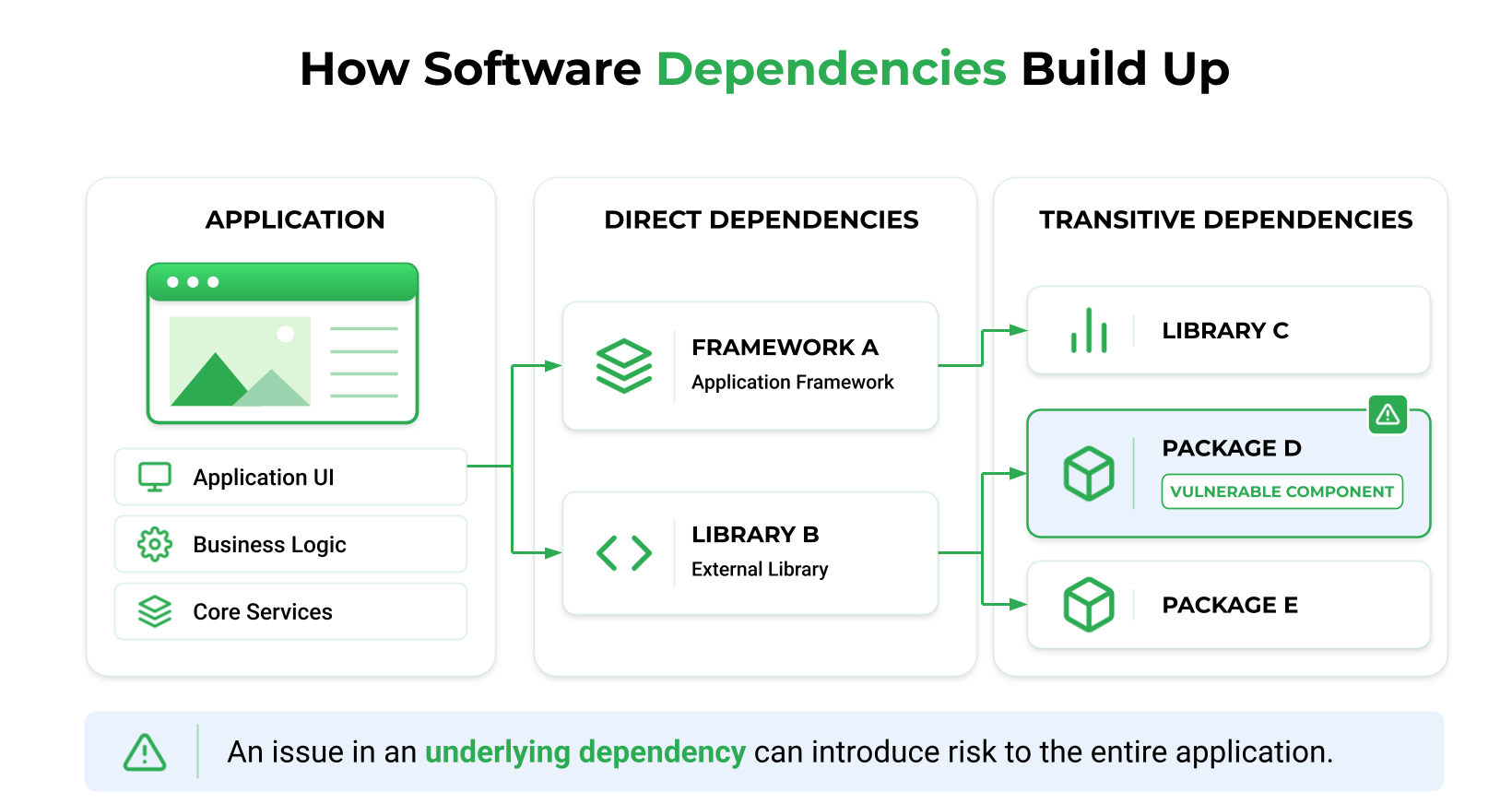
There are several common risks:
- Known vulnerabilities: A dependency may contain a publicly disclosed security flaw that remains present in the application’s deployed version.
- Outdated components: Older libraries may no longer receive security updates or maintenance.
- Compromised components: Attackers may target package repositories, maintainers, or distribution channels to introduce malicious code.
- Untracked dependencies: Transitive dependencies and components embedded in container images may not be visible through basic dependency records.
- Licensing and provenance concerns: Organisations may lack sufficient information about component licensing, origin, and maintenance status.
These risks are not limited to open-source software. Commercial components, vendor-provided libraries, build tools, and third-party services can also affect the security and reliability of an application.
| What PHP2Shell Reveals About Software Supply Chain Security
In October 2026, two critical vulnerabilities in PHP, collectively known as PHP2Shell, brought attention to the risks associated with widely used software components. PHP is a popular server-side programming language used to power websites and web applications. The vulnerabilities could allow unauthenticated attackers to execute malicious code on affected servers, prompting emergency security updates and precautionary website shutdowns.
As reported by The Indian Express in its coverage of PHP2Shell, services operated by organisations including Japan’s Finance Ministry, BambooHR, the Port of Rotterdam, and the Wikimedia Foundation were among those taken offline as a precaution.
India’s Computer Emergency Response Team (CERT-In) also issued advisory CIAD-2026-0052 on October 22, 2026, classifying the vulnerabilities as critical and recommending that affected organisations update vulnerable PHP installations.
The vulnerabilities existed in PHP itself, rather than in the business logic written by individual application teams. Organisations therefore needed to identify affected runtime versions, assess their exposure, and apply the relevant security updates.
PHP2Shell was a runtime vulnerability, not a compromised package registry. Its relevance to software supply chain security is the broader dependency lesson: applications inherit risks from the underlying components on which they run. The incident highlights why software supply chain security must account for the runtimes and components on which applications depend. Knowing which components are deployed, which versions are in use, and how quickly they can be updated is essential to managing that exposure.
| Software Bill of Materials: Making Dependencies Visible
An important step towards better dependency visibility is maintaining a Software Bill of Materials (SBOM). An SBOM is a structured inventory of the components that make up a software application. It can include details such as component names, versions, suppliers, and dependency relationships.
For software supply chain security, an SBOM provides a practical foundation for identifying and tracking these components. When a vulnerability is disclosed, teams can use this information to identify affected components and determine which applications or services may need attention.
The importance of SBOM quality is also reflected in updated guidance from the Cybersecurity and Infrastructure Security Agency (CISA). Its July 29, 2026 publication, 2026 Minimum Elements for a Software Bill of Materials, updates the expectations for SBOM information, including component hash values, licensing, SBOM tool identification, and generation context.
An SBOM is most useful when it is accurate, maintained, and connected to the software delivery process. A document generated once and left untouched can quickly become outdated as dependencies change. Teams should therefore generate and update SBOMs as part of their build and release workflows.
| Five Engineering Practices for Stronger Software Supply Chain Security
Managing third-party dependencies requires consistent engineering practices. The following measures help teams reduce exposure while keeping application development moving. A consistent software supply chain security strategy brings these practices together across development, testing, and deployment.
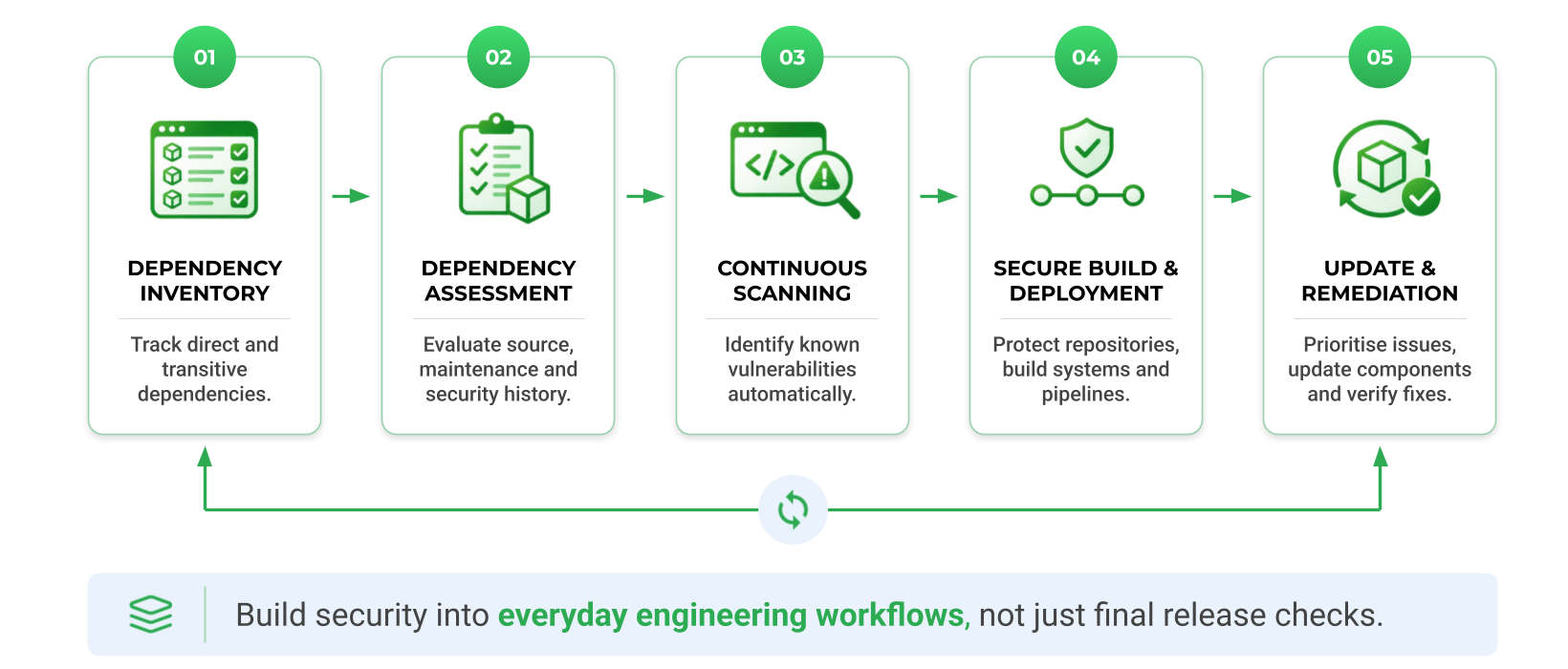
- Maintain an inventory of dependencies
Track direct and transitive dependencies across applications, services, containers, and build environments. Maintain component names, versions, and dependency relationships so teams can identify where a vulnerable component is being used.
- Assess dependencies before adoption
Evaluate a component’s maintenance activity, security history, source, licensing, and compatibility before introducing it into an application. Prefer maintained libraries with clear release practices and an established support history.
- Scan dependencies continuously
Use software composition analysis (SCA) tools to identify known vulnerabilities in application dependencies. Run scans during development and as part of CI/CD pipelines rather than relying only on periodic security reviews. Define a process for prioritising findings based on severity, exposure, and application context.
- Secure build and deployment processes
Protect source code repositories, package managers, build systems, container registries, and deployment credentials. Restrict access to critical pipeline components and verify software artefacts before they are promoted to production.
Teams can also use software provenance records and signed build artefacts to establish where software came from, how it was built, and whether it has been altered before deployment.
- Establish a clear update and remediation process
Define how teams respond when a dependency vulnerability is reported. Assign ownership, assess affected applications, prioritise remediation, and verify that updated components are successfully deployed. Where an immediate update is not possible, document the risk and apply appropriate mitigation measures.
These practices work best when they are part of everyday engineering workflows. Treating dependency security as a separate activity makes it harder to maintain visibility as applications and delivery environments evolve.
| Integrating Software Supply Chain Security Into the Development Lifecycle
Software supply chain security should be considered from the beginning of application development, not introduced just before release.
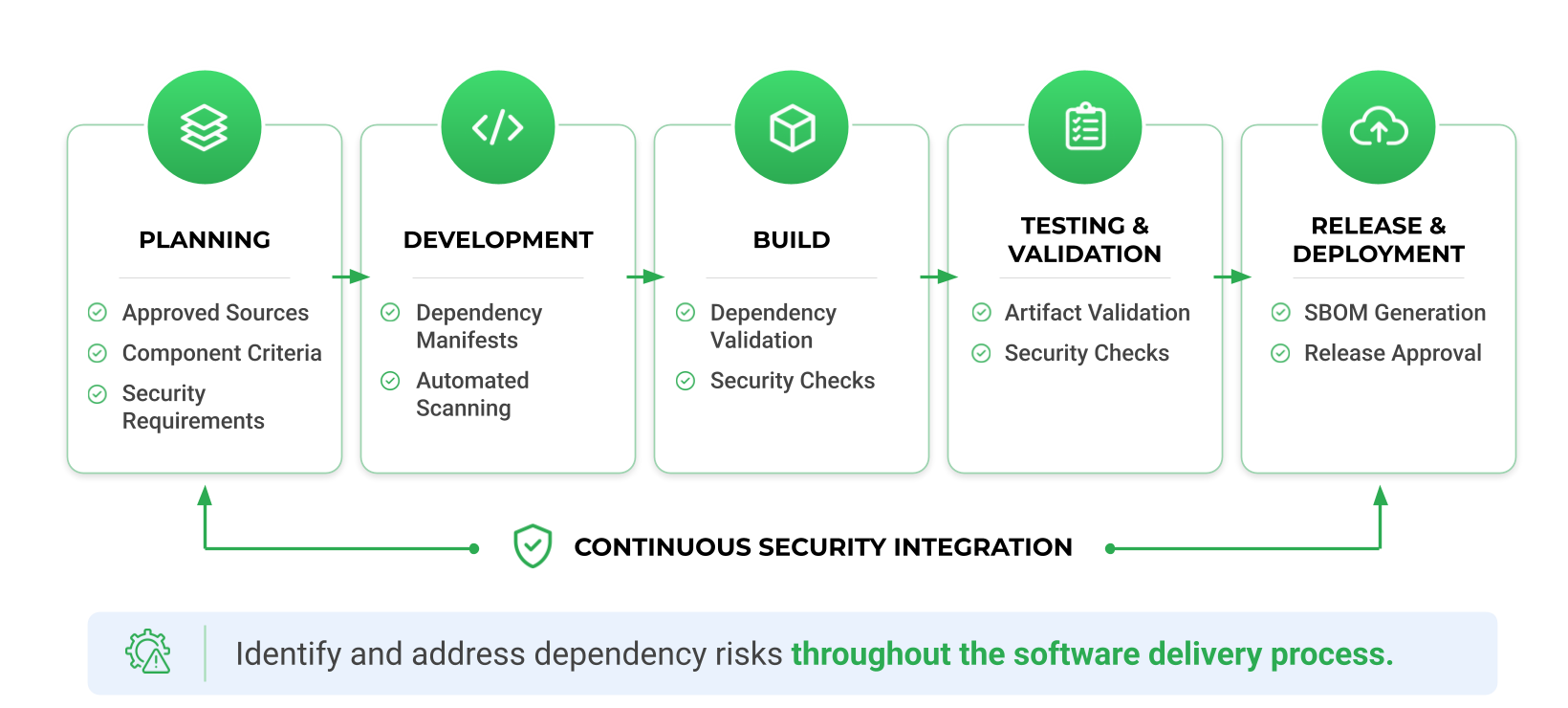
During planning and architecture, teams can define approved dependency sources, component selection criteria, and security requirements. During development, dependency manifests and automated scanning can help identify issues as libraries are introduced or updated.
Build and release workflows provide another important control point. For example, an automated CI/CD workflow can check dependencies for known vulnerabilities, scan container images, validate software artefacts, and generate an SBOM before a release is approved. This allows engineering teams to identify dependency risks earlier in the delivery process.
NIST’s 2024 SP 800-204D, Strategies for the Integration of Software Supply Chain Security in DevSecOps CI/CD Pipelines provides guidance on integrating software supply chain security practices into CI/CD pipelines. Its recommendations reinforce the importance of addressing security across the software development and delivery process.
For organisations modernising older applications, dependency visibility is equally important. Legacy applications may rely on outdated frameworks, unsupported libraries, or components that are difficult to replace. A structured legacy application modernisation approach can help teams assess these dependencies, plan upgrades, and reduce technical risk without disrupting critical business operations.
| Where Product Engineering and Quality Engineering Fit
Software supply chain security is closely connected to how applications are designed, developed, tested, and maintained.
Product Engineering teams influence dependency choices, application architecture, integration patterns, and the way components are managed across the development lifecycle. This includes establishing dependency management standards, selecting supported frameworks, maintaining component inventories, and incorporating security validation into development workflows.
Quality Engineering adds another layer of assurance. Automated testing, regression validation, and release checks help teams verify that dependency updates do not introduce functional issues or affect existing application behaviour. Security checks can also be incorporated into continuous testing and deployment workflows.
Together, these practices help organisations manage third-party dependencies without treating security and delivery speed as competing priorities.
| Building Accountability Into the Software Supply Chain
Software supply chain security is now an essential part of responsible application development. Third-party dependencies help teams build faster, reuse established capabilities, and maintain complex applications. But every dependency also creates a responsibility to understand what is being used, where it comes from, and how it is maintained.
Software supply chain security depends on visibility, consistent dependency management, automated checks, and clear ownership across the development lifecycle. An SBOM can help establish that visibility, while secure CI/CD practices and continuous testing help teams act on it.
WalkingTree Technologies helps enterprises build, modernise, and maintain applications through Product Engineering and Quality Engineering. From application architecture and dependency management to automated testing and secure delivery practices, our teams help organisations build applications that remain maintainable, reliable, and secure throughout their lifecycle.
If your organisation is modernising applications, managing complex software dependencies, or strengthening its development and delivery practices, connect with us to discuss how our Product Engineering and Quality Engineering teams can help.