


Blogs
Atlanta’s Enterprise Tech Surge: Choosing the Right Software Development Company in Atlanta

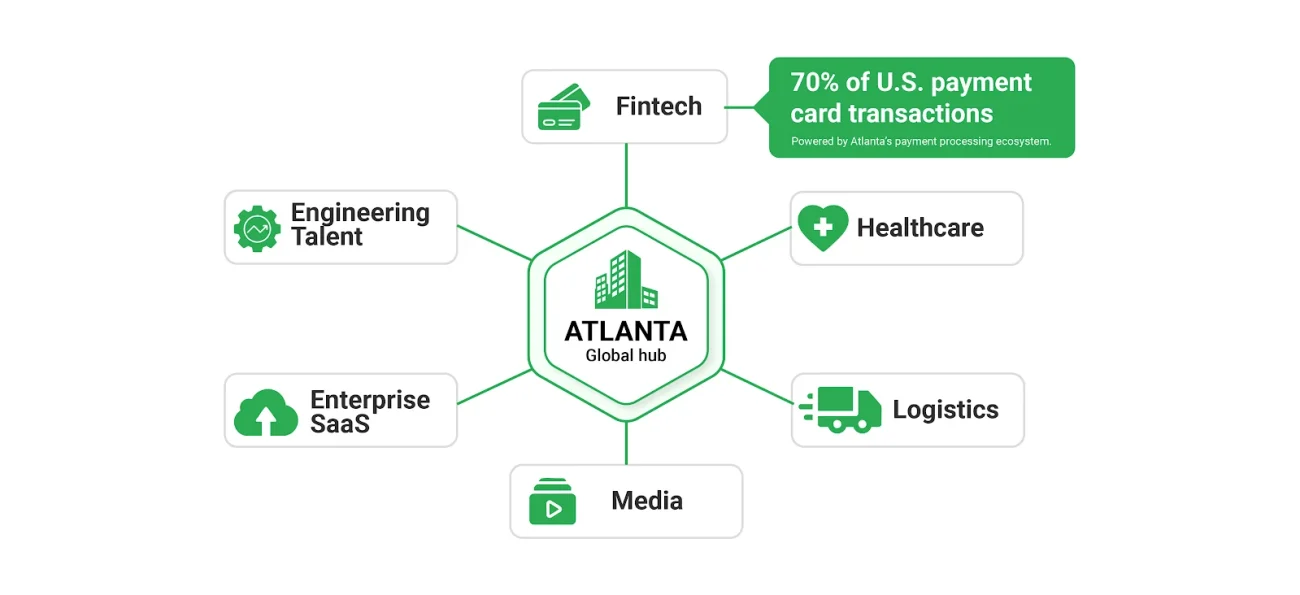
Atlanta has become one of the most important enterprise technology centers in the United States. Organizations across fintech, healthcare, logistics, and media are modernizing legacy systems, launching digital platforms, and embedding intelligence into core operations. The city’s fintech prominence is particularly notable, with Atlanta-based companies processing an estimated 70% of U.S. payment card transactions. As demand grows, selecting the right software development company in Atlanta is becoming a critical factor in long-term transformation success. What was once viewed as a regional business hub is now a strategic base for large-scale digital transformation.
According to Georgia Trend Magazine’s 2025 economic outlook, high-tech jobs make up 6.5% of employment in the Atlanta MSA, outpacing both state and national averages and reflecting the region’s growing enterprise tech concentration. Metro Atlanta is also the second-largest data center market in the U.S., underscoring its role in large-scale digital infrastructure. Industry reports indicate the average tech salary in Atlanta approaches $125,000, with entry-level software engineering roles often starting around $100,000, reinforcing the region’s ability to deliver enterprise-ready talent with a cost advantage.
As this shift accelerates, enterprises evaluating software initiatives in the region face a more important question than cost alone:
How should software be designed, governed, and delivered to ensure scalability, compliance, and long-term value?
Enterprises assessing the cost of software development in Atlanta are discovering that architecture decisions and delivery governance have a far greater impact on long-term value than initial estimates.
Rates and estimates matter. But architecture, governance, and delivery models determine whether systems succeed or become expensive liabilities.
| Atlanta’s Rise as an Enterprise Technology Hub
Atlanta’s growth as a technology center is driven by enterprise demand, not startup hype. Major industries are investing in platforms that support millions of users, complex data flows, and strict regulatory requirements.
Key drivers include:
- A strong fintech ecosystem supporting global payment platforms
- Major healthcare systems investing in digital infrastructure and patient platforms
- Logistics and supply chain innovation tied to global trade networks
- A steady pipeline of engineering talent from Georgia Tech and regional universities
- Operating costs lower than coastal tech hubs while maintaining enterprise-grade expertise
This combination has attracted a wide range of providers offering Atlanta software development services, giving enterprises more options than ever before.
| A Crowded Vendor Landscape Creates New Risks
In traditional software systems, scaling is usually measured in terms of throughput and infrastructure utilization. More users result in more requests, which are handled by adding compute resources.
Atlanta offers flexibility in provider choice, but it also makes vendor evaluation more complex. Organizations must navigate a mix of delivery models, each with trade-offs. The region’s growth has also attracted a wide range of delivery models, from global consulting firms and product studios to engineering-focused hybrid providers.
Common provider models
• Staff augmentation firms
Fill roles quickly but leave architecture ownership and delivery risk with the client. Capacity increases, but system integrity remains your responsibility.
• Boutique product studios
Excel at UX and rapid prototypes. Often lack experience with enterprise-scale systems, compliance requirements, and long-term modernization.
• Large consultancies
Bring process maturity and brand recognition. Typically operate at premium cost levels with rigid engagement models that limit flexibility.
• Offshore-heavy vendors with local sales presence
Offer cost advantages but may introduce alignment challenges without strong governance and transparent delivery practices.
Many enterprises are moving toward hybrid delivery models that combine local leadership with global engineering depth. This approach improves control while enabling scale.
The challenge is no longer finding a vendor. The challenge is finding a partner whose delivery model aligns with enterprise complexity and long-term goals.
Differences in software development cost in Atlanta often reflect delivery structure rather than capability, making governance and accountability critical evaluation factors.
| Why Software Initiatives Fail Despite Strong Talent
Even with access to skilled engineers, organizations encounter recurring problems:
• Architecture decisions delayed until late stages
• Difficulty scaling teams without quality erosion
• Misalignment between prototypes and production systems
• Governance gaps across distributed teams
• Rising total cost of ownership due to rework and technical debt
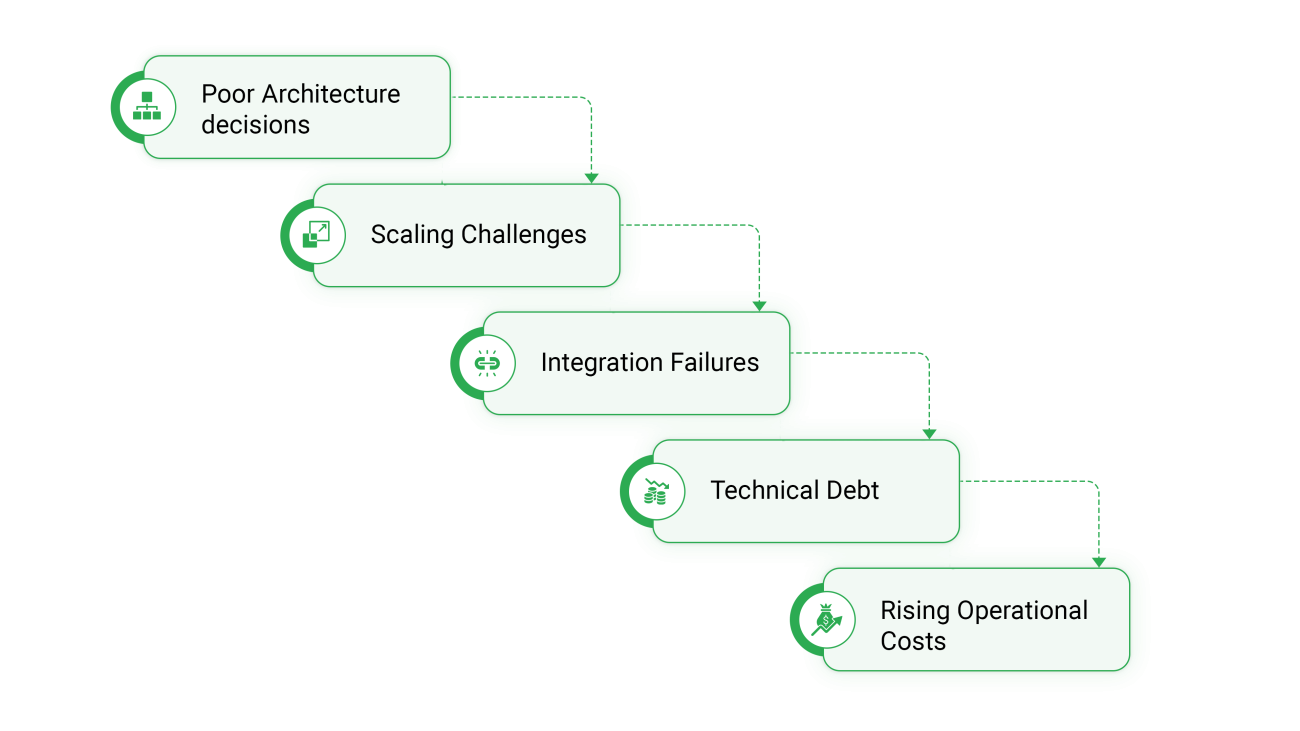
These failures rarely stem from talent shortages. They stem from delivery models optimized for speed or short-term savings rather than long-term system integrity.
These challenges show up consistently across industries.
In fintech systems, weak transaction architecture leads to reconciliation gaps and operational delays as volumes scale. In healthcare platforms, missing auditability and access controls create compliance risks that require expensive redesign. In logistics systems, the absence of a unified data model results in tracking inconsistencies and manual intervention as integrations grow.
These are not edge cases. They are predictable outcomes of architecture decisions made too late or without sufficient rigor.
When architecture is treated as an afterthought, organizations pay later through performance issues, integration failures, and costly rework.
When delivery models prioritize speed over structure, the apparent short-term savings can erode long-term platform stability due to rework and technical debt.
| Total Cost of Ownership: The Metric That Actually Matters
Initial development cost is only one component of software investment. Enterprises must consider total cost of ownership, including maintenance, scalability, performance tuning, and future enhancements.
Systems built without architectural rigor often require frequent rework, manual interventions, and costly performance fixes. Over time, these expenses exceed the original development investment.
Factors that shape long-term cost
• Quality of system architecture and documentation
• Maintainability through modular design and clean code practices
• Observability for monitoring, diagnostics, and incident response
• Ease of integrating new services and third-party tools
• Automation of testing, deployment, and infrastructure management
Organizations that treat software as a long-term asset reduce operational friction and avoid costly rebuilds. The true cost of enterprise platforms in Atlanta emerges over years of operation, where maintainability, automation, and architectural clarity drive long-term efficiency.

| Regulated Industries in Atlanta Require Engineering Discipline
Atlanta’s technology demand is heavily influenced by regulated industries such as fintech and healthcare.
These industries operate under strict regulatory frameworks, making architecture decisions, security practices, and governance models central to platform success.
These sectors require systems that meet strict standards for compliance, security, and auditability. In regulated sectors, the true investment includes compliance readiness, auditability, and resilience, not just initial build expenses.
Atlanta is widely recognized as a global fintech center, with a dense concentration of payment processors and financial platforms operating at scale.
Enterprise platforms in these industries must support:
- Data protection and privacy controls
- Regulatory reporting and audit trails
- High availability and disaster recovery
- Secure integrations with legacy systems
- Role-based access and governance policies
This is why enterprises increasingly seek partners who combine architectural depth with operational discipline in enterprise software development Atlanta initiatives.
| How to Evaluate a Software Partner in Atlanta
Cost comparisons alone do not predict success. Mature organizations evaluate partners using criteria that reflect long-term operational realities.
Key evaluation areas
- Architecture ownership
Who is accountable for scalability, resilience, and integration design? - Compliance maturity
Can the partner support regulated environments and audit readiness? - Delivery governance
How are distributed teams managed, monitored, and aligned? - Hybrid scaling capability
Can the team scale without losing quality, transparency, or control? - Total cost transparency
Does the model minimize rework, technical debt, and operational overhead?
Delivery models that integrate architecture, governance, and distributed coordination produce more predictable outcomes when selecting a software development company in Atlanta.
| The Shift Toward Hybrid Delivery Models

Enterprises in Atlanta are increasingly adopting hybrid delivery structures that combine local leadership with global engineering teams.
This model enables:
• Real-time collaboration with local stakeholders
• Access to specialized global talent
• Unified governance and engineering standards
• Flexible scaling aligned with project phases
When implemented with strong architectural oversight, hybrid delivery reduces costs while preserving quality and transparency. Hybrid delivery model software teams help optimize delivery by balancing local oversight with scalable global engineering capacity.
| What Architecture-Led Hybrid Delivery Looks Like in Practice

WalkingTree Technologies operates from Midtown Atlanta, placing its U.S. team within the city’s primary technology corridor. From this base, the company collaborates with enterprises across North America while coordinating delivery with global engineering teams.
With experience supporting regulated industries and large-scale platforms, WalkingTree focuses on initiatives where reliability, compliance, and performance are as critical as speed.
Rather than functioning as a staffing provider or design studio, the team emphasizes architectural clarity, scalable delivery, and long-term system integrity through its digital engineering approach. This approach aligns with the needs of enterprises managing complex integrations, compliance obligations, and platforms expected to evolve over years.
| What Differentiates WalkingTree’s Approach
In a market where many providers optimize for speed, staffing volume, or design aesthetics, WalkingTree prioritizes engineering integrity and long-term platform health.
Architecture-led delivery
Scalability, compliance, and integration planning are addressed early. This reduces rework, prevents performance bottlenecks, and stabilizes long-term investment.
This approach has been applied in fintech platforms where microservices-based architectures support real-time underwriting, partner integrations, and high-volume transaction workflows.
True hybrid delivery
Atlanta-based leadership works alongside global engineering teams, enabling real-time alignment and scalable execution.
Organizations gain:
• Direct collaboration with local technical leadership
• Access to specialized global talent
• Unified governance and delivery standards
• Flexibility to scale teams as needs evolve
Enterprise readiness beyond MVPs
Systems are designed to scale, integrate, and meet regulatory requirements, making the approach well suited for fintech, healthcare, logistics, and enterprise platforms.
In financial services, centralized data platforms have been built to integrate multiple third-party systems and support scalable, compliant data management across distributed operations.
AI integrated into core systems
Rather than adding AI as an afterthought, intelligence is embedded into system architecture to enable automation, predictive insights, and intelligent workflows.
Through AI-assisted product engineering, these capabilities are built directly into core systems rather than layered on later.
In healthcare use cases, this has included automating contract analysis and claims processing, achieving over 95% extraction accuracy with validation workflows.
This has resulted in:
• Significant reduction in manual effort
• Faster claims processing turnaround
• Improved accuracy and consistency in data extraction
| When WalkingTree Is the Right Fit
WalkingTree is particularly well suited for organizations facing complex transformation initiatives where long-term reliability matters more than rapid experimentation.
Typical scenarios include:
• Modernizing legacy systems without disrupting operations
• Scaling platforms to support rapid growth or transaction volume
• Integrating systems across cloud and on-premises environments
• Embedding AI into core business workflows
• Establishing governed hybrid delivery models
In these environments, success depends on architectural clarity, strong governance, and the ability to scale without losing control.
| Atlanta Provides the Environment. Delivery Models Determine the Outcome.
Atlanta offers a rare combination of enterprise demand, strong engineering talent pipelines, and sustainable operating costs, making it one of the most attractive locations in the United States for large-scale digital platform development.
However, the success of software initiatives is determined less by location and more by how systems are designed, governed, and scaled.
Delivery models that prioritize architecture, transparency, and scalability consistently outperform those focused solely on speed or short-term savings.
By aligning local collaboration with global engineering depth, enterprises can build systems that are resilient, compliant, and ready to evolve with changing business demands.
Atlanta provides the environment. The right engineering model determines how far that environment can scale. Organizations that take an architecture-first approach and partner with teams experienced in hybrid, enterprise delivery are better positioned to build platforms that perform reliably and adapt over time. WalkingTree Technologies, based in Atlanta, works with enterprises to design and deliver architecture-led, hybrid solutions built for scale, compliance, and long-term resilience.
Talk to our Atlanta team about your platform roadmap and next steps.
